
According to the International Center for Academic Integrity, 39% of undergraduate students admit to copying or paraphrasing internet sources without citation, not because they intend to cheat, but because nobody ever clearly explained how to cite sources in academic writing. That is exactly what this guide fixes.
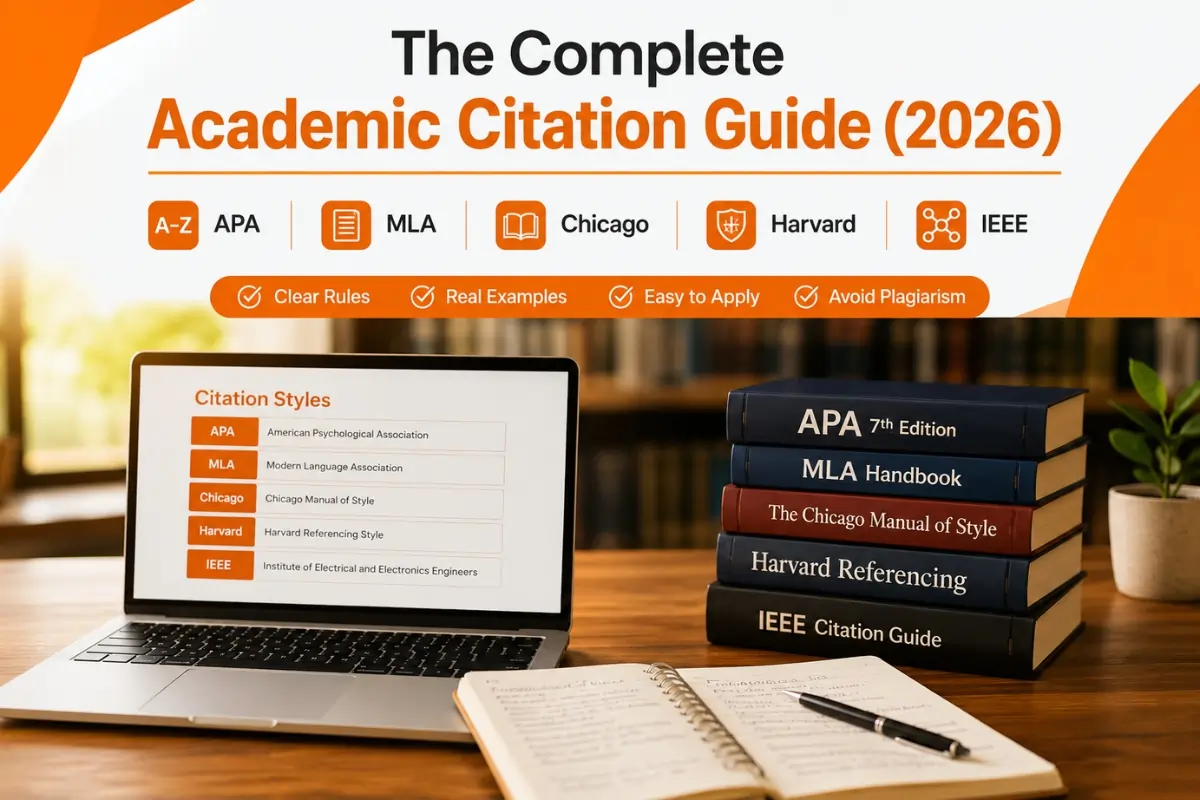
This complete academic citation guide covers APA, MLA, Chicago, Harvard, and IEEE in plain language, with examples you can copy and adapt today.
What Is an Academic Citation?
A citation is a formatted reference that identifies the source of an idea, fact, quotation, or data you used in your work.
Done correctly, it does two things:
- Gives credit to the original creator
- Gives your reader a verified path back to that source
What a citation includes
A complete citation typically contains some combination of:
- Author's full name
- Publication date
- Title of the work
- Publisher, journal name, or website
- Volume, issue, and page numbers (for journals)
- DOI or URL (for online sources)
Where citations appear
In-text citations: Brief references inside your writing, placed directly after the borrowed idea or quote. Usually just an author's name and year, or a page number.
Reference list / Works Cited / Bibliography: A full list at the end of your document with complete details of every source cited. The name of this section depends on which style you are using.
Why Citing Sources Matters and What the Research Shows
Proper citation is not a bureaucratic formality. It is the foundation of academic trust.
What current data tells us
- Universities confirmed over 30,000 plagiarism cases globally in 2025, up from 24,000 in 2022 (EssayPro Academic Integrity Trends Study)
- 28% of students who plagiarised did so out of lack of understanding, not deliberate intent (International Center for Academic Integrity)
- 44% of academic integrity violations involve paraphrasing without proper citation
- US plagiarism rates stabilised at 26.9% in 2024, still above one in four students (PlagiarismCheck.org)
Why correct citation matters beyond compliance
- Builds credibility: A well-cited paper tells professors and journal editors your claims are grounded in real evidence
- Respects intellectual property: Researchers spent years producing the knowledge you are building on
- Enables further research: Your reference list is a curated resource that future scholars will use
- Prevents cascading errors: Correctly cited sources can be traced, checked, and corrected; uncited ones embed misinformation permanently
Major Citation Style Explained with Examples
Academic institutions use different citation styles depending on the discipline. While all citation styles aim to credit sources and prevent plagiarism, they differ in formatting, in-text citations, and reference list structure.
1. APA Citation Style, 7th Edition
| Used in | Psychology, social sciences, education, nursing, business |
|---|---|
| Current edition | 7th (2019) |
| Governing body | American Psychological Association — apa.org/style |
| Defining feature | Author–date in-text citations |
APA In-Text Citation Format
| Situation | Format |
|---|---|
| Paraphrase | (Smith & Johnson, 2023) |
| Narrative citation | Smith and Johnson (2023) found… |
| Direct quote | (Smith & Johnson, 2023, p. 47) |
| Two authors | (Smith & Johnson, 2023) |
| Three or more authors | (Smith et al., 2023) |
| No author | ("Mental Health Statistics," 2023) |
| No date | (Smith, n.d.) |
APA Reference List Examples
Journal article with DOI:
Smith, J. D., & Johnson, L. M. (2023). The impact of social media on adolescent mental health. Journal of Adolescent Psychology, 15(3), 45–60. https://doi.org/10.1234/jap.2023.15.3
Book:
Brown, A. (2022). Research methods in the social sciences (3rd ed.). Academic Press.
Book chapter in an edited volume:
Taylor, R. (2023). Cognitive development in early childhood. In P. Harrison & M. Wells (Eds.), Handbook of developmental psychology (pp. 112–134). Springer.
Website:
World Health Organization. (2024, March 15). Mental health and young people. https://www.who.int/mental-health/youth
Newspaper article:
Chen, L. (2023, October 4). Universities tackle citation literacy gap. The Guardian. https://www.theguardian.com/example
Key APA Rules
- Sentence case for article and book titles; only capitalise the first word and proper nouns
- Italicise journal names, book titles, and volume numbers
- Always include a DOI when one exists; never omit it
- The reference list is alphabetical by the first author's last name
- Use a hanging indent (0.5 inches) for every entry
- Section title is simply: References (centred, not bold)
2. MLA Citation Style — 9th Edition
| Used in | Literature, languages, film studies, cultural criticism, humanities |
|---|---|
| Current edition | 9th (2021) |
| Governing body | Modern Language Association, style.mla.org |
| Defining feature | Author–page in-text citations |
MLA In-Text Citation Format
| Situation | Format |
|---|---|
| Paraphrase | (Johnson 45) |
| Direct quote | (Johnson 78) |
| Two authors | (Smith and Johnson 33) |
| Three or more authors | (Smith et al. 102) |
| No author | ("Digital Literacy" 45) |
| No page number (websites) | (Johnson) |
MLA Works Cited — Examples
Journal article:
Johnson, Sarah M. "Digital Literacy in Higher Education." Journal of Educational Technology, vol. 15, no. 2, 2023, pp. 123–45. https://doi.org/10.1234/jet.2023.15.2.
Book:
Atwood, Margaret. The Handmaid's Tale. McClelland and Stewart, 1985.
Book chapter:
Brown, David. "Citation Practices in the Digital Age." The Academic Writer's Handbook, edited by Claire Ford, Routledge, 2023, pp. 88–104.
Website:
Jones, Robert. "Understanding Climate Feedback Loops." NASA Earth Observatory, 10 Feb. 2024, earthobservatory.nasa.gov/article/climate-loops. Accessed 11 June 2025.
Film:
Parasite. Directed by Bong Joon-ho, CJ Entertainment, 2019.
Key MLA Rules
- Title case for all titles: capitalise all major words
- Italicise books, journals, films, and websites; put article and chapter titles in "quotation marks"
- Works Cited list is alphabetical by author's last name
- Use a hanging indent for each entry
- Section title: Works Cited (centred, not bold or italicised)
- MLA does NOT require a publication city or country
3. Chicago / Turabian Style — 18th Edition
| Used in | History, fine arts, philosophy, some social sciences, and book publishing |
|---|---|
| Current edition | 18th (2024) |
| Governing body | University of Chicago Press. chicagomanualofstyle.org |
| Defining feature | Two completely separate systems. Choose one, do not mix them |
The Two Chicago Systems
Notes–Bibliography (NB)
- Citations appear as numbered footnotes or endnotes
- Paired with a Bibliography at the end
- Preferred in humanities, especially history
- Good when you want to add commentary alongside citations
Author–Date (AD)
- Parenthetical in-text citations similar to APA
- Paired with a References list
- Preferred in social sciences and sciences
Chicago Notes–Bibliography Examples
Footnote, first full reference:
¹ Sarah M. Johnson, "Digital Literacy in Higher Education," Journal of Educational Technology 15, no. 2 (2023): 127, https://doi.org/10.1234/jet.2023.15.2.
Footnote, subsequent short reference:
² Johnson, "Digital Literacy," 130.
Bibliography entry (journal article):
Johnson, Sarah M. "Digital Literacy in Higher Education." Journal of Educational Technology 15, no. 2 (2023): 123–45. https://doi.org/10.1234/jet.2023.15.2.
Bibliography entry (book):
Brown, Amanda. Research Methods in the Social Sciences. 3rd ed. Academic Press, 2022.
Chicago Author–Date Examples
In-text:
(Johnson 2023, 127)
Reference list:
Johnson, Sarah M. 2023. "Digital Literacy in Higher Education." Journal of Educational Technology 15 (2): 123–45. https://doi.org/10.1234/jet.2023.15.2.
Key Chicago Rules
- Footnotes use full details on first mention, shortened form after
- "Ibid." replaces a repeated footnote if the source is identical and immediately prior
- Bibliography and reference lists use hanging indents
- Major works are italicised; articles and chapters go in "quotation marks"
- Turabian note: Kate Turabian's A Manual for Writers is a student-friendly adaptation of Chicago. Rules are nearly identical if your university says "Turabian," follow Chicago guidelines above.
4. Harvard Referencing Style
| Used in | Most UK and Australian universities, life sciences, international institutions |
|---|---|
| Current edition | No single governing manual. Harvard is a family of institutional styles |
| Defining feature | Author–date format, similar to APA but with different punctuation and title treatment |
Harvard In-Text Citation Format
| Situation | Format |
|---|---|
| Paraphrase | (Smith and Johnson, 2023) |
| Narrative citation | Smith and Johnson (2023) identified… |
| Direct quote | (Smith and Johnson, 2023, p. 47) |
| Three or more authors | (Smith et al., 2023) |
| No date | (Smith, no date) or (Smith, n.d.) |
Harvard Reference List Examples
Journal article:
Smith, J.D. and Johnson, L.M. (2023) 'The impact of social media on adolescent mental health', Journal of Adolescent Psychology, 15(3), pp. 45–60.
Book:
Brown, A. (2022) Research methods in the social sciences. 3rd edn. London: Academic Press.
Website:
World Health Organization (2024) Mental health and young people [Online]. Available at: https://www.who.int/mental-health/youth (Accessed: 11 June 2025).
Key Harvard Rules
- Article titles go in 'single quotation marks' NOT italicised
- Italicise book and journal titles only
- Use sentence case for article titles
- Include "Accessed" date for websites (unlike APA 7th edition)
- The reference list is alphabetical by author surname
- Each entry uses a hanging indent
5. IEEE Citation Style
| Used in | Electrical engineering, computer science, IT, telecommunications |
|---|---|
| Current edition | IEEE Editorial Style Manual (2018, ongoing updates) |
| Governing body | Institute of Electrical and Electronics Engineers. ieeeauthorcenter.ieee.org |
| Defining feature | Numbered citations in order of first appearance |
IEEE In-Text Citation Format
| Situation | Format |
|---|---|
| Single source | [1] |
| Multiple sources | [1]–[3] or [1], [3], [5] |
| Same source again | Always reuse the same number [1] |
Example in text: Machine learning has shown significant promise in early disease detection [1], and recent improvements in model efficiency [2], [3] have accelerated clinical adoption.
IEEE Reference List Examples
Journal article:
[1] S. M. Johnson, "Deep learning approaches to medical imaging," IEEE Trans. Med. Imaging, vol. 42, no. 3, pp. 501–515, Mar. 2023.
Conference paper:
[2] A. Brown and R. Patel, "Efficient transformer architectures for edge computing," in Proc. IEEE Int. Conf. Comput. Vis., Paris, France, 2023, pp. 1234–1242.
Book:
[3] L. Chen, Fundamentals of Signal Processing, 2nd ed. New York, NY, USA: Wiley, 2021.
Key IEEE Rules
- References listed in order of first appearance not alphabetical
- Author names abbreviated: first initial(s) + last name (S. M. Johnson)
- Journal and conference names heavily abbreviated check the IEEE abbreviations list
- All reference numbers in square brackets: [1]
- Article titles in "quotation marks"; journal and book titles italicised
Quick Comparison: All Citation Styles Side by Side
| Style | Field | In-Text Format | End List Name | Edition |
|---|---|---|---|---|
| APA | Social sciences, psychology | (Smith, 2023, p. 47) | References | 7th (2019) |
| MLA | Humanities, literature | (Smith 47) | Works Cited | 9th (2021) |
| Chicago NB | History, fine arts | Footnote ¹ | Bibliography | 18th (2024) |
| Chicago AD | Social sciences | (Smith 2023, 47) | References | 18th (2024) |
| Harvard | UK/AU universities | (Smith, 2023, p. 47) | Reference List | Institutional |
| IEEE | Engineering, CS, IT | [1] | References | 2018 |
| Vancouver | Medicine, biomedical | (1) or superscript | References | Ongoing |
| ASA | Sociology | (Smith 2023:47) | References | 6th (2019) |
| AMA | Medicine, health sciences | Superscript¹ | References | 11th (2020) |
| Bluebook | Law (US) | Footnote | Bibliography | 21st (2020) |
How to Cite Sources in Academic Writing: A Simple Workflow
Step 1: Set Up a Citation Manager
Before you begin researching, set up a tool like Zotero or Mendeley. These tools automatically save source details and generate citations, saving time and reducing errors.
Step 2: Identify the Source Type
Different sources require different citation formats. Common source types include:
- Journal articles
- Books and book chapters
- Websites
- Government reports
- Conference papers
- Newspapers and magazines
- Theses and dissertations
- Podcasts, videos, and AI-generated content
Step 3: Record Source Details Immediately
As you research, save all bibliographic information right away.
- Journal articles: Author, year, title, journal, volume, issue, pages, DOI
- Books: Author, year, title, edition, publisher
- Websites: Author/organization, date, page title, URL
Step 4: Cite While You Write
Insert citations as soon as you use a source. Waiting until the end often leads to missing references and citation errors.
Step 5: Understand Quotes vs. Paraphrases
| Direct Quote | Paraphrase | |
|---|---|---|
| Uses exact words | Yes | No |
| Quotation marks needed | Yes | No |
| Citation required | Yes | Yes |
| Page number needed | Usually | Usually not |
Remember: Paraphrasing still requires a citation because the idea belongs to the original author.
Step 6: Build Your Reference List Along the Way
Add sources to your reference list as you cite them. This keeps your bibliography organized and prevents last-minute formatting issues.
Step 7: Perform a Final Check
Before submitting:
- Every in-text citation should appear in the reference list.
- Every reference list entry should be cited in the text.
- Verify formatting matches the required citation style.
A quick cross-check can help you avoid unnecessary grade deductions.
How to Cite Digital, Online, and AI-Generated Sources
The internet and AI tools created source types that did not exist when most citation styles were designed. Here is how to handle each one.
DOIs vs URLs: Always Prefer the DOI
A DOI (Digital Object Identifier) is a permanent code assigned to most peer-reviewed articles. Unlike URLs, DOIs do not break when journals change publishers or redesign websites.
- Always use a DOI when one is available
- Format: https://doi.org/10.xxxx/xxxxx
- Can't find a DOI? Search CrossRef (crossref.org) with the article title many older articles have DOIs assigned retrospectively
Websites and Online Reports
When citing websites:
- Look for a named author, a person or an organisation
- Record the publication date or last-updated date
- Note your access date (required by Harvard, Chicago, and sometimes MLA)
- Use the most specific URL possible, link directly to the page, not the homepage
- For government and institutional reports, cite the organisation as author
Social Media Posts
- APA format: Smith, J. [@JSmithAcademic]. (2024, April 3). New data on citation literacy among first-year students [Tweet]. Twitter. https://twitter.com/JSmithAcademic/status/1234567890
- MLA format: Smith, John. "New data on citation literacy among first-year students." Twitter, 3 Apr. 2024, twitter.com/JSmithAcademic/status/1234567890.
For content that may be deleted, archive the post at web.archive.org before citing it.
AI-Generated Content — The 2025 Standard
- APA format: OpenAI. (2025). ChatGPT (GPT-4o version) [Large language model]. https://chat.openai.com
Include in the text: tool name, version, date of generation, and the prompt where relevant. Example: (OpenAI, 2025).
- MLA format: "Describe the symbolism of the green light in The Great Gatsby." Prompt. ChatGPT, OpenAI, 3 June 2025, chat.openai.com.
Critical warning: Many universities prohibit submitting AI-generated content as your own work, even when cited. Always check your institution's academic integrity policy first.
Common Citation Mistakes and How to Fix Them
Mistake 1: Missing DOIs
Problem: Listing a journal article without its DOI, even when one exists
Fix: After every journal citation, search CrossRef for the DOI. It takes 30 seconds and is now expected in all current style editions
Mistake 2: Wrong Capitalisation
Problem: Mixing APA sentence case with MLA/Chicago title case
Fix: APA → capitalise only the first word and proper nouns. MLA/Chicago → capitalise all major words (nouns, verbs, adjectives, adverbs)
Mistake 3: Citing a Secondary Source
Problem: You read Jones (2023) quoting Brown (2018). You cite Brown but have never read Brown
Fix: Find and read the original. If genuinely inaccessible, APA requires: (Brown, 2018, as cited in Jones, 2023)
Mistake 4: Not Citing a Paraphrase
Problem: Believing that rephrasing removes the need for a citation
Fix: Every borrowed idea requires attribution. Citation is about ideas, not just copied words
Mistake 5: Mismatched In-Text and Reference List Entries
Problem: The year in your in-text citation (Smith, 2022) doesn't match the reference list (Smith, 2023)
Fix: Run a final search for every author name in the text and verify year, spelling, and title match exactly
Mistake 6: Using the Wrong Edition
Problem: Following APA 6th edition rules in a paper that requires the 7th edition
Fix: APA 7th = standard since 2020. Chicago 18th = released 2024. MLA 9th = since 2021. When in doubt, use the most current edition
Mistake 7: Incorrect Multi-Author Formatting
Problem: Writing "Smith, Johnson, and Williams (2023)" in APA when three or more authors require "Smith et al."
Fix: APA 7th and MLA 9th, use et al. for three or more authors from the first citation onward
Mistake 8: Forgetting Hanging Indents
Problem: Reference entries formatted with standard paragraph indentation or none at all
Fix: In Microsoft Word → select all reference entries → Paragraph → Indentation → Special → Hanging (0.5 inches)
Mistake 9: Citing Wikipedia
Problem: Wikipedia is not an accepted academic source
Fix: Use Wikipedia to identify primary sources. Follow its footnotes to find peer-reviewed originals then cite those instead
Mistake 10: Fabricating Citation Details
Problem: Adjusting a year, page number, or author name to make a citation "look right"
Fix: Never estimate or invent citation details. Fabricated citations are treated as academic fraud, not formatting errors. If you cannot verify it, find it properly or do not use that source
Proper citations are only one part of scholarly writing. To see the bigger picture, explore why academic writing requires strict formatting.
Best Citation Tools and Reference Managers for 2026
Full Reference Managers (Best for All Researchers)
Zotero: Free, open-source
- Browser extension auto-captures details from most academic databases
- Generates citations in 10,000+ styles
- Works on Mac, Windows, and Linux
- Best for: everyone
Mendeley: Free (owned by Elsevier)
- Strong PDF annotation and highlighting tools
- Built-in academic social network
- Best for: researchers working with large PDF libraries
EndNote: Paid (usually free via institutional licence)
- Industry standard in research institutions
- Most powerful option for complex workflows
- Best for: postgraduate researchers with institutional access
Quick Citation Generators
- ZoteroBib (zbib.org): Paste a DOI, URL, or ISBN and get a formatted citation instantly. Most accurate free generator available. No account needed.
- Citation Machine (citationmachine.net): APA, MLA, Chicago, Harvard. Fast for single citations; verify before use.
- EasyBib (easybib.com): Student-friendly. APA, MLA, Chicago. The free tier has limitations.
- Google Scholar: Click "Cite" under any result for instant APA, MLA, Chicago, Harvard, or Vancouver formatting. Fast but frequently contains errors. Always verify.
Free Reference Resource (Not a Generator)
Purdue OWL (owl.purdue.edu): The gold standard free-style reference for APA, MLA, Chicago, IEEE, and AMA. Comprehensive, accurate, and updated regularly. Bookmark this above all other tools.
Warning: No citation generator is 100% accurate. They frequently misformat author names, miss volume numbers, or generate broken DOIs. Treat every generated citation as a first draft that requires human review before submission.
Frequently Asked Questions
What is the difference between a bibliography and a reference list?
- Reference list (APA, Harvard, Chicago Author–Date) contains only sources you directly cited in the text
- Bibliography (Chicago Notes–Bibliography, MLA) may also include sources consulted but not directly cited; a broader record of your research
Do I need to cite common knowledge?
No, for facts that are universally known and uncontested (e.g. "World War II ended in 1945"). Yes, for statistical claims, research findings, interpretations, and contested facts. When in doubt, always cite it.
How do I cite a source with no author?
- APA / Harvard: Move the title to the author position
- MLA: Begin the Works Cited entry with the title
- Chicago NB: Use the title in footnotes
- If an organisation is clearly responsible for the content, use that organisation as the author
How do I cite a source with no date?
- APA: (Smith, n.d.)
- MLA: Omit the date field
- Chicago: Leave the date blank; note its absence in a footnote if relevant
- Websites: Include your access date
What is the difference between citing a whole book and a chapter?
- Citing the whole book: Use the book's author(s) or editor(s) and the full title
- Citing a chapter in an edited volume: Cite the chapter author, chapter title, then the editors and book details separately. This is one of the most commonly confused citation types
Is APA or MLA harder to learn?
Most students find APA slightly harder at first due to:
- Sentence-case title rule (feels unnatural after a lifetime of title case)
- Strict DOI requirements
- Specific References page formatting
MLA is more intuitive for humanities students because page numbers, not dates, are the primary navigation tool. Both become second nature with practice.
Can I mix citation styles in one paper?
No. A paper must use a single consistent citation style from the first page to the last. Mixing APA in-text citations with a Chicago bibliography is a clear formatting error. For multi-author publications, follow the house style specified by the journal or editor.
How do I cite a source found via Google Scholar when I cannot access the full text?
Cite the source, not Google Scholar. If you only have an abstract, consider whether you have enough information to use the source responsibly. If not, request the full text through your library's interlibrary loan service before citing.
When should I use a footnote vs an in-text citation?
- APA, MLA, Harvard, IEEE: In-text citations only; footnotes are for content notes, not citations
- Chicago Notes–Bibliography: Footnotes are the primary citation mechanism
Never add citation footnotes to an APA or MLA paper; they belong in the reference list
Struggling to manage research, citations, and formatting on your own? Explore our Buy Research Paper Online service for professional academic support.
Need Help With Academic Writing?
Learning citations is essential for producing credible, plagiarism-free academic work, but formatting references correctly can be time-consuming. If you're struggling with APA, MLA, Chicago, Harvard, or IEEE citations, My Premium Essay Writers can help.
Our academic expert writers provide professionally written essays, research papers, dissertations, and editing services with accurate citations and references tailored to your required style guide. Whether you need help organizing sources, formatting a bibliography, or polishing a final draft, we're here to support your academic success.
Get expert writing assistance today and submit your next assignment with confidence.
 MyPremiumEssay