
Structure gives your essay clarity and direction. It organizes your ideas into a logical progression, allowing readers to follow your argument, connect your evidence, and see how each point leads naturally to your conclusion.
This guide explains what essay structure is, why it matters, how to use it effectively, and how to adapt it to different types of essays. By the end, you will have a clear framework for organizing your ideas and strengthening your writing with confidence.
What Is Essay Structure?
Essay structure is the organizational framework that determines how your ideas are arranged, sequenced, and connected throughout a piece of writing. It is the difference between a well built argument that your reader can follow effortlessly and a jumble of thoughts that leaves them confused about what you are trying to say.
Your ideas may be original, your vocabulary rich, and your research thorough, but without structure, those qualities cannot carry your reader where you want them to go.
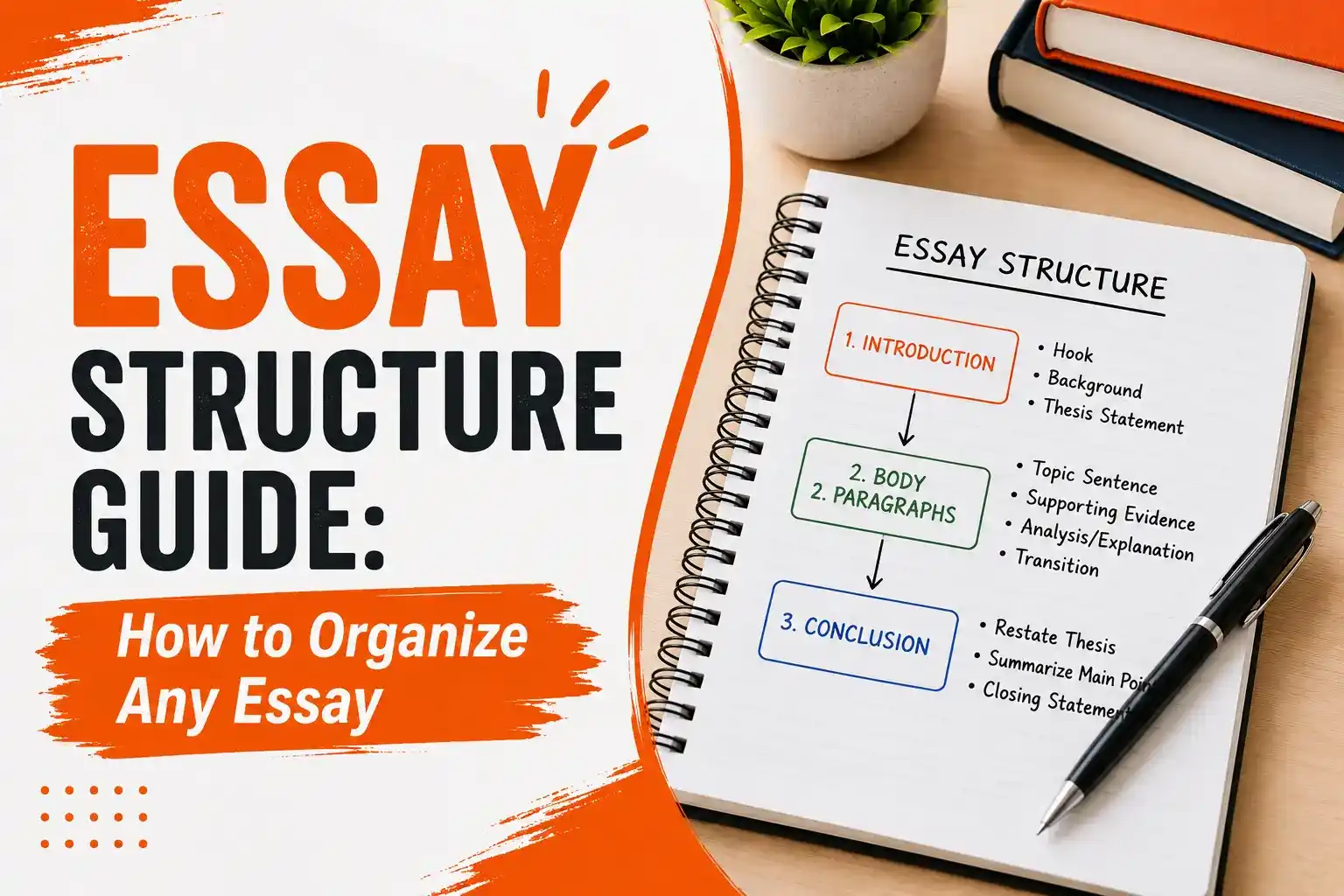
At its most fundamental level, every essay, regardless of length, subject, or complexity, shares the same three part structure: a beginning, a middle, and an end. In academic writing, these are called the introduction, the body, and the conclusion. Everything else, every paragraph, every sentence, and every transition, exists in service of this core architecture.
Why Essay Structure Matters
Students sometimes resist the idea of structure, worried that it will make their writing feel formulaic or mechanical. In fact, the opposite is true. Structure does not constrain good writing; it enables it. When you know where you are going and how you plan to get there, your writing becomes more confident, focused, and persuasive. You spend less time staring at a blank page and more time developing your ideas.
Structure also matters for your reader. Reading an unstructured essay is a disorienting experience. The reader cannot tell what the main argument is, why one paragraph follows another, or what they are supposed to take away from the piece. A well structured essay, by contrast, creates a clear pathway. The reader always knows where they are, where they have been, and where they are going.
For students, strong essay structure directly correlates with stronger grades. Teachers and professors are trained to evaluate writing based on clarity of argument, logical organization, and coherent development of ideas, all of which are products of structure. An essay with original ideas but poor structure will consistently score lower than one with sound ideas presented in an organized, logical way.
The Core Parts of an Essay
Understanding the parts of an essay is the foundation of everything that follows. Each part serves a distinct and essential function, and understanding what each section is supposed to accomplish changes how you approach writing it.
Part 1: The Introduction
The introduction is your essay's first impression, and it carries more weight than many writers realize. A strong introduction does three essential things: it captures your reader's attention, provides the context they need to understand your argument, and states your thesis, the central claim your essay will make and defend.
The Hook
The hook is the opening sentence or sentences of your introduction. Its sole purpose is to make your reader want to keep reading. A weak hook, such as "In this essay, I will discuss...", signals immediately that the writing ahead will be routine. A strong hook surprises, challenges, or intrigues the reader.
Effective hook strategies include:
- A striking statistic or fact: "More than one million words have been added to the English language since Shakespeare's time, yet most students are never taught how to organize even the simplest of them into a coherent essay."
- A provocative question: "What separates a forgettable essay from one a teacher remembers years later? It is rarely vocabulary. It is almost always structured."
- A vivid scene or anecdote: A brief, specific story that draws the reader in before pulling back to the broader topic.
- A bold or counterintuitive statement: Something that challenges conventional wisdom and makes the reader curious about your argument.
- A relevant quotation: A well-chosen line from a respected source that frames your topic compellingly.
The hook should be relevant to your essay's topic. It is not decoration; it is the first brick in your argument.
The Background or Context
After the hook, your introduction should provide the background information your reader needs to understand your thesis. This is not the place for extensive detail; that belongs in the body. This is simply the information required to make your central argument intelligible.
If you are writing about the causes of World War One, a sentence or two establishing the geopolitical landscape of early twentieth century Europe is appropriate context. If you are writing about a novel, a sentence identifying the author, the work, and its general subject gives your reader their bearings. The background section bridges the hook and the thesis. It moves your reader from the broad opening toward the specific claim you are about to make.
The Thesis Statement
The thesis statement is the most important sentence in your entire essay. It states the central argument your essay will make, not just the topic, but your specific, arguable claim about that topic. Every paragraph in your body should connect back to this sentence. Every piece of evidence you present should support it.
A strong thesis statement is:
- Specific: It makes a precise claim, not a vague observation.
- Arguable: It takes a position that could be debated, not a statement of obvious fact.
- Unified: It makes one central claim, not three loosely related ones.
- Proportionate: It is a claim your essay can actually support within its length.
Weak thesis: "Shakespeare wrote many famous plays that are still read today." This is a statement of fact, not an argument. There is nothing to prove.
Stronger thesis: "Shakespeare's Hamlet derives its enduring power not from its plot but from its portrayal of a mind at war with itself, a psychological portrait so precise that it anticipates modern understandings of depression and existential crisis by four centuries." This is specific, arguable, and gives the essay clear direction.
Your thesis typically appears at the end of your introduction, the culmination of the context you have established and the point toward which everything in your opening paragraph has been built.
Part 2: The Body Paragraphs
The body of your essay is where your argument is built, developed, and supported. It is the largest section of your essay and the one that requires the most careful planning. Each body paragraph makes one distinct point that supports your thesis, develops that point with evidence, and explains how the evidence connects to your central argument.
The Anatomy of a Body Paragraph
A well-constructed body paragraph has a clear internal structure of its own. Understanding this structure is one of the most practical skills in academic writing.
Topic Sentence Every body paragraph begins with a topic sentence, a clear statement of the single point that paragraph will make. The topic sentence functions like a mini thesis for the paragraph. It tells your reader exactly what to expect and how the paragraph connects to your overall argument.
A topic sentence is not a fact or a piece of evidence. It is a claim, something your paragraph will then go on to prove.
Evidence After establishing your point in the topic sentence, you support it with evidence. Evidence can take many forms depending on the type of essay you are writing: quotations from a text, statistics from research, historical examples, data from studies, logical reasoning, or specific illustrative examples.
Evidence should be introduced with a signal phrase that identifies its source and integrates it smoothly into your writing. Do not drop a quotation into your paragraph without introduction; contextualize it first.
Analysis This is where many students shortchange themselves. After presenting evidence, you must analyze it, explain what it means, why it matters, and how it connects to your topic sentence and broader thesis. Analysis is your thinking. It is the part of the paragraph that demonstrates genuine intellectual engagement with the material.
A paragraph that presents evidence without analysis is incomplete. Your reader needs to see not just what the evidence is, but what you make of it.
Transition The final sentence of each body paragraph should either summarize the point made or transition smoothly to the next paragraph. Effective transitions create a sense of logical flow. Each paragraph feels like a natural continuation of the one before it, rather than an isolated unit.
How Many Body Paragraphs Do You Need?
The number of body paragraphs depends on the length and complexity of your essay. In a standard five-paragraph essay, there are three body paragraphs. In a longer academic essay, there may be five, seven, or more. The principle is consistent regardless of number: each paragraph makes one distinct point, and together the body paragraphs build a complete, convincing case for your thesis.
A useful test: if you can remove a body paragraph without weakening your argument, it probably does not belong. Every paragraph should be doing essential work.
Part 3: The Conclusion
The conclusion is where many essays lose the momentum they have built. Students either rush through it, treating it as a formality, or repeat their introduction almost word for word, which leaves the reader feeling the essay went nowhere. A strong conclusion does neither of these things.
The conclusion's job is to bring your essay to a satisfying, purposeful close. It should accomplish three things: restate your thesis in light of the evidence you have presented, synthesize your main points rather than merely listing them again, and close with a final thought that gives your reader something to carry forward.
Restate Your Thesis, Transformed by the Argument
Your conclusion should return to your thesis, but not by copying it verbatim from the introduction. By the time your reader reaches the conclusion, they have traveled through your entire argument. Your thesis restatement should reflect that journey. It should feel earned, not mechanical.
Compare these two versions:
Introduction thesis: "Shakespeare's Hamlet derives its enduring power from its portrayal of a mind at war with itself."
Conclusion restatement: "Four centuries after its first performance, Hamlet endures not because it tells a story of murder and revenge, but because it maps with uncanny precision the interior landscape of a mind unable to reconcile what it knows with what it can bring itself to do, a portrait of paralysis that has never been more relevant."
The second version restates the core claim but enriches it with the insight the essay has developed.
Synthesize Your Argument, Don't Summarize It
There is a critical difference between summarizing your essay and synthesizing it. A summary lists what you said. A synthesis reveals the meaning of it all. Instead of "In paragraph one I discussed X, in paragraph two I discussed Y," a synthesis might say: "Taken together, these three examples reveal a pattern that challenges the conventional reading of the text and suggests a more complex authorial intent."
End on a Thought That Opens Outward
End your essay with a sentence or two that opens outward, a broader implication of your argument, a question your analysis raises, a connection to the larger world, or a statement about why your argument matters beyond the essay itself. This is the moment to leave your reader thinking. A closing thought that is too narrow or too abrupt deflates the essay at its final moment. One that gestures toward significance gives the whole piece a sense of purpose.
How to Structure Different Types of Essays
The core architecture of introduction, body, and conclusion applies to every essay, but how that architecture is filled in varies depending on the type of essay you are writing.
The Argumentative Essay
In an argumentative essay, your thesis takes a clear position on a debatable issue and your body paragraphs present evidence and reasoning to support that position. Strong argumentative essays also address counterarguments, acknowledging the opposing view and explaining why your argument is more persuasive. This demonstrates intellectual honesty and significantly strengthens your credibility as a writer.
The Expository Essay
An expository essay explains, informs, or describes something without taking a personal position. The thesis states what will be explained, and the body paragraphs develop each aspect of the explanation in logical sequence. Clarity, accuracy, and organization are the primary goals.
The Narrative Essay
A narrative essay tells a story, usually a personal one, with a reflective purpose. The structure is less rigid than academic essay formats, but it still requires a clear arc: an opening that establishes context and draws the reader in, a middle that develops the story and its significance, and a conclusion that reflects on what the experience meant. The thesis in a narrative essay is often implicit rather than explicitly stated.
The Compare and Contrast Essay
A compare and contrast essay examines the similarities and differences between two subjects. There are two primary structural approaches: the block method, where you discuss everything about Subject A and then everything about Subject B, and the point by point method, where you alternate between subjects for each point of comparison. The point by point method is generally more effective for longer essays because it keeps the comparison active throughout.
The Analytical Essay
An analytical essay breaks a subject, such as a text, film, historical event, or cultural phenomenon, into its component parts and examines how those parts work together to create meaning. The thesis makes a specific interpretive claim, and the body paragraphs analyze specific elements as evidence for that claim. Analysis goes deeper than summary. It asks not just what something is, but how and why it works the way it does.
The Persuasive Essay
Similar to the argumentative essay but with a stronger emphasis on rhetorical appeal, the persuasive essay is designed to convince the reader to adopt a specific viewpoint or take a specific action. It draws on logos (logical reasoning), ethos (establishing credibility), and pathos (emotional appeal) to build a compelling case.
Essay Format: The Technical Essentials
Beyond the structural elements of your essay, format refers to the technical presentation requirements that govern how your essay looks on the page. Different academic contexts use different formatting standards, and following them precisely signals professionalism and attention to detail.
The Five-Paragraph Essay Format
The most foundational essay format taught in schools, the five-paragraph essay consists of one introduction paragraph, three body paragraphs, and one conclusion paragraph. It is an excellent training format for developing clear, organized thinking and is used widely in middle and high school settings.
MLA Format
MLA (Modern Language Association) format is standard in humanities courses such as English, literature, philosophy, and the arts. Key features include one inch margins, double spacing, a 12 point serif font (traditionally Times New Roman), a header with your name, instructor's name, course name, and date in the upper left, a centered title, and in text citations using the author's last name and page number in parentheses.
APA Format
APA (American Psychological Association) format is standard in social sciences such as psychology, education, sociology, and related fields. It uses a title page, an abstract, in text citations with the author's name and publication year, and a References page. Headings are often used to organize longer papers into clearly labeled sections.
Chicago Style
Chicago style is used in history and some humanities disciplines. It features footnotes or endnotes for citations rather than in-text parenthetical references, and a bibliography at the end of the paper.
Regardless of which format you are using, always read the assignment instructions carefully. Format requirements are not suggestions. Deviating from them can cost marks even when the writing itself is strong.
How Transitional Language Strengthens Your Essay
One of the most immediately visible markers of a well-structured essay is the quality of its transitions. Transitions are the words, phrases, and sentences that connect your ideas and guide your reader from one point to the next. Without them, even a well-organized essay feels choppy and disconnected.
Transitions between sentences show the logical relationship between consecutive ideas: contrast (however, nevertheless, on the other hand), addition (furthermore, in addition, moreover), causation (therefore, as a result, consequently), illustration (for example, specifically, to illustrate), and sequence (first, subsequently, finally).
Transitions between paragraphs are usually built into the topic sentence of the new paragraph. The topic sentence should orient the reader to how this new point connects to the previous one and to the essay's overall argument. A strong paragraph transition makes the essay feel like a single, unified piece of reasoning rather than a series of separate observations.
Transitions in the conclusion signal to the reader that the essay is drawing to a close and that what follows is synthesis and reflection. Phrases like "taken together," "what these examples reveal," and "ultimately" signal the concluding movement without relying on the clichéd "In conclusion."
Common Essay Structure Mistakes and How to Fix Them
You now know what good structure looks like. Here's where it most often goes wrong, and how to correct it.
The Absent Thesis
Writing about a topic without ever making a specific, arguable claim about it. Fix: Write your thesis before you write anything else. Every paragraph should have a clear reason to exist in relation to it.
The Vague Thesis
"This essay will explore the many interesting aspects of climate change." This tells the reader nothing about what you actually think or argue. Fix: Make a specific, debatable claim. What about climate change? What is your actual position?
Paragraphs That Try to Do Too Much
A paragraph that makes three separate points loses its focus and its effectiveness. Fix: One paragraph, one point. If you find yourself pivoting to a new idea mid-paragraph, start a new one.
Evidence Without Analysis
Presenting a quotation or statistic and then moving on without explaining what it means. Fix: After every piece of evidence, ask yourself "so what?" The answer is your analysis, and it belongs on the page.
The Summary Conclusion
A conclusion that does nothing but repeat the introduction in slightly different words. Fix: Reflect on what your argument means, not just what it said. Synthesize, don't summarize.
Weak or Missing Transitions
Paragraphs that begin abruptly, with no connection to what came before, make the essay feel fragmented. Fix: Read your essay aloud. Wherever you feel a jolt between paragraphs, add a sentence that bridges them.
The Late Thesis
Burying your thesis in the middle of the body instead of establishing it at the end of the introduction.Fix: Your reader needs to know your central argument before they see your evidence, not after. Move the thesis to where it belongs.
A Step-by-Step Essay Writing Process
Knowing the parts of an essay and the principles of good structure is most useful when embedded in a practical writing process. Here is a reliable sequence that works for essays at every level.
Step 1. Understand the Prompt
Read the assignment carefully. What type of essay is required? What is the subject? What is the required length and format? What is the due date? Misunderstanding the prompt is one of the most avoidable reasons for a poor grade.
Step 2. Choose and Narrow Your Topic
If you have flexibility in topic selection, choose something specific enough to argue meaningfully within your word count. A broad topic leads to a shallow essay. A focused topic enables depth.
Step 3. Draft Your Thesis
Write your thesis before you write anything else. It does not need to be final; it will likely evolve as you write. However, having a working thesis gives your planning and research direction.
Step 4. Research and Gather Evidence
Collect the evidence, examples, quotations, or data you will use to support your thesis. Evaluate your sources for credibility and relevance. Take notes that include source information.
Step 5. Create an Outline
Plan your essay before you write it. Your outline should include your thesis, a topic sentence for each body paragraph, the evidence you will use in each paragraph, and a brief note about your conclusion. An outline takes fifteen to thirty minutes and saves hours of aimless drafting.
Step 6. Write the First Draft
Write with the goal of getting your ideas down, not of writing perfectly. Follow your outline, but allow yourself to develop ideas as they emerge. Do not stop to edit; that comes later.
Step 7. Revise for Structure and Argument
Read your draft with your outline beside you. Does each paragraph make the point it was supposed to make? Does your thesis still hold given what you wrote? Are your transitions smooth? Is your evidence sufficient and your analysis thorough? Revise at the level of ideas and organization before addressing sentence-level issues.
Step 8. Edit for Clarity and Correctness
Once your structure and argument are solid, edit for grammar, spelling, punctuation, and sentence clarity. Read your essay aloud; your ear often catches errors that your eye misses.
Step 9. Proofread the Final Draft
Do a final close read specifically looking for typos, formatting errors, and citation accuracy. Check that your essay meets all the assignment requirements before submitting.
For additional tips on expanding your arguments and improving essay flow, explore Phrases To Make Your Essay Longer.
Essay Structure Quick Reference
Introduction contains: Hook → Background/Context → Thesis Statement
Body paragraph contains: Topic Sentence → Evidence → Analysis → Transition
Conclusion contains: Thesis Restatement → Synthesis of Main Points → Closing Thought
Essay types and their structural emphases:
| Essay Type | Structural Emphasis |
|---|---|
| Argumentative | Claim + Evidence + Counterargument |
| Expository | Explanation + Logical Sequence + Clarity |
| Narrative | Story Arc + Reflection + Implicit Thesis |
| Compare/Contrast | Block or Point-by-Point Structure |
| Analytical | Interpretive Claim + Close Reading + Synthesis |
| Persuasive | Logos + Ethos + Pathos |
Common formatting styles:
| Format | Used In |
|---|---|
| MLA | Humanities |
| APA | Social Sciences |
| Chicago | History |
Before using any academic writing service, it is important to understand the legal and ethical considerations. Read Is It Legal To Buy Essays Online? for a detailed explanation.
Take Your Essay Writing to the Next Level with MyPremiumEssay
The more you practice structuring your essays thoughtfully, the easier it becomes to write with clarity, confidence, and purpose. While every essay is unique, the principles of strong organization remain the foundation of effective academic writing.
If you need additional support, MyPremiumEssay is here to help. Our experienced academic writers can provide the guidance you need to produce well researched, well structured work. Students looking to buy essays online can rely on MyPremiumEssay for professional academic assistance tailored to their specific requirements.
Ready to achieve better results with less stress? Explore MyPremiumEssay's academic writing services and get the expert support you need to reach your educational goals with confidence.

 MyPremiumEssay