
That rule sounds simple, but most opinion in student drafts slips in through language patterns writers do not notice. The rest of this guide shows you where opinion hides, how to tell it apart from genuine analytical judgment, and how to revise sentence by sentence so your expository essay reads the way graders expect.
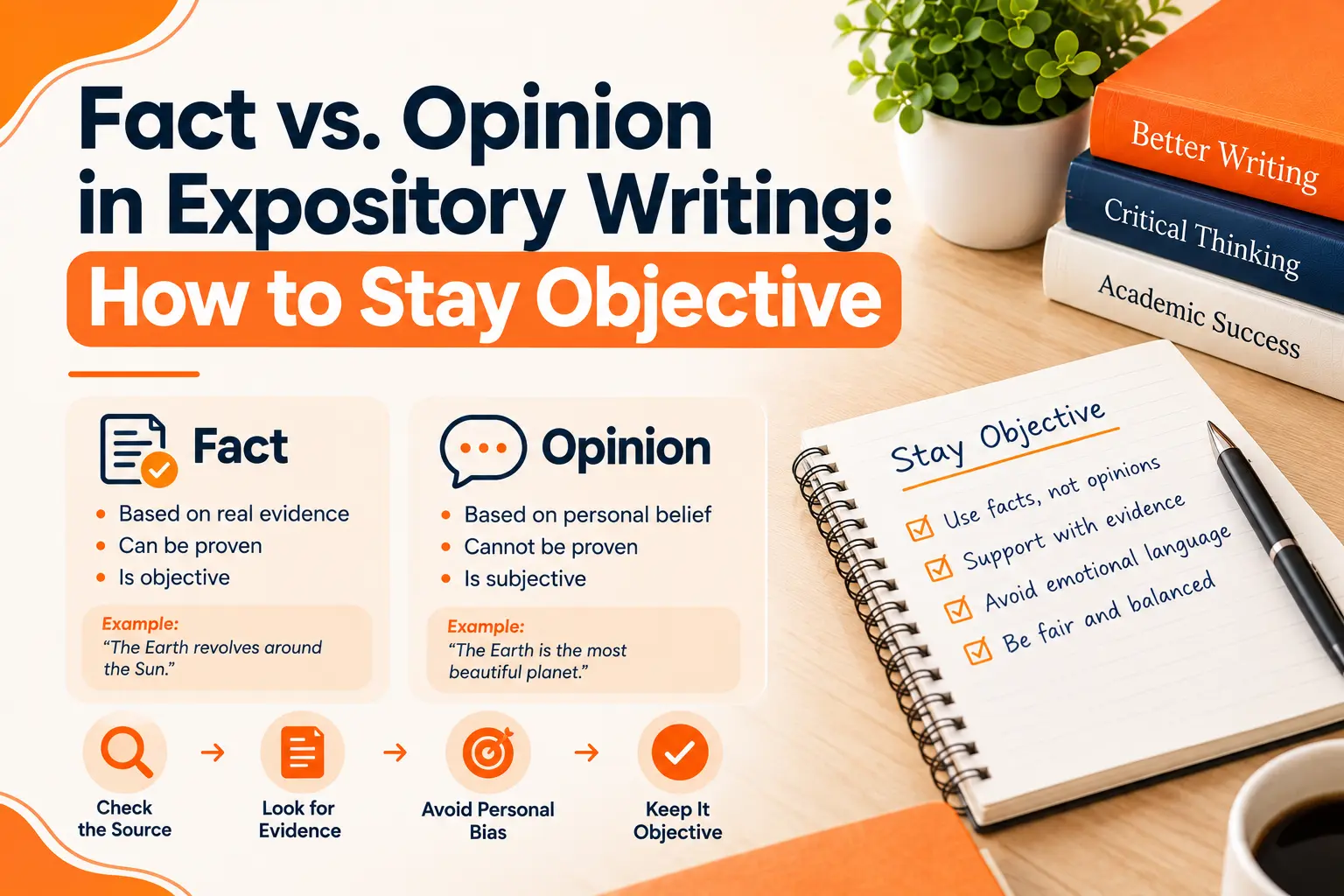
Why Objectivity Is the Whole Point of an Expository Essay
Expository writing exists to explain something to a reader who wants to understand a topic, not to be persuaded of your position on it. If your essay is doing anything other than presenting information and evidence, it has drifted into a different genre. Objectivity is not a stylistic preference here. It is the defining feature of the form.
What "expository" actually means
The word comes from expose, meaning to lay something out for view. An expository essay lays out information about a topic in a way that helps the reader understand it clearly.
Purdue's Online Writing Lab describes the expository essay as writing that investigates an idea, evaluates evidence, and presents that evidence in a clear and concise way. The writer is not the star of the piece. The information is.
How expository differs from argumentative and persuasive essays
An argumentative essay takes a debatable position and defends it with evidence. A persuasive essay goes further, using emotional appeals and rhetoric to move the reader toward action. An expository essay does neither.
The three forms overlap in structure but differ in purpose:
| Essay type | Writer's job | Reader's takeaway |
|---|---|---|
| Expository | Explain and inform | Understand the topic |
| Argumentative | Support a debatable claim with evidence | Consider a reasoned position |
| Persuasive | Convince through evidence and rhetoric | Agree with or act on the writer's view |
If a grader marks your expository essay as "too opinionated," what they usually mean is that it started behaving like one of the other two types.
Facts and Opinions in Academic Writing: What Actually Counts
The high school definition of fact vs opinion in essay writing is that a fact can be proven and an opinion cannot. That works for a fifth-grade worksheet. At the college level, the line is more useful when you break it into three categories, not two.
Facts: verifiable, sourced, and reproducible
A fact is a statement anyone can check against an outside reference. It survives independent verification. A date, a measurement, a legal definition, or a documented event all qualify.
Two markers help identify facts in your own writing. First, the statement points to something external, not internal. Second, someone who disagrees with you can go look it up.
Opinions: personal, evaluative, and unfalsifiable
An opinion is a statement of preference, value, or feeling that cannot be settled by evidence. It reflects the writer's inner response to the topic. "The novel is beautifully written" is an opinion because beautiful varies by reader.
Opinions are not wrong to hold. They are wrong to place inside an expository essay, because the reader has no way to test them.
The middle ground most students miss: interpretation and informed judgment
Between raw facts and pure opinions sits a third category that trips up most writers. An interpretation is a claim that goes beyond the raw evidence but is grounded in it. An informed judgment is an interpretation offered by qualified people whose reasoning can be traced.
"Industrialization accelerated urban migration in nineteenth-century Britain" looks like an opinion but is actually an interpretation historians defend with census data, wage records, and migration patterns. In an expository essay, you can include claims of this kind, but you must attribute them to the scholars or evidence that support them. Left unattributed, they read as personal opinion, even when they are not.
This distinction resolves the confusion many students feel: expository writing does not ban analysis. It bans unsourced analysis.
The Thesis Problem: Can an Expository Essay Even Have a Claim?
Yes, and it must have one. The confusion comes from thinking every thesis is an opinion. An expository thesis states what the essay will explain, not what the writer believes should be true.
Expository thesis vs. argumentative thesis
Compare these two thesis statements on the same topic:
Argumentative: "The Industrial Revolution did more harm than good to working-class families in Britain."
Expository: "The Industrial Revolution reshaped working-class British families through three main forces: factory employment, urban migration, and shifting gender roles at home."
The argumentative version asks the reader to accept a value judgment. The expository version asks the reader to follow an explanation. Both are focused. Only one takes a side.
Framing a claim as scope rather than stance
An expository thesis works as a scope statement. It tells the reader what territory the essay will cover and in what order.
A useful test: if your thesis contains words like should, better, worse, must, or the best, it has crossed into argumentative territory. Rewrite it to describe what the essay explains, not what the writer wants the reader to conclude.
How Opinion Sneaks Into an Expository Draft
Most opinion in student essays does not arrive through obvious "I think" statements. It leaks in through smaller language habits that feel neutral but carry a viewpoint.
Obvious signals: first- and second-person pronouns
I, me, my, we, our, and you usually pull the reader into a personal register that expository writing avoids. There are narrow exceptions, which the FAQ covers, but the default should be third person.
Evaluative adjectives and adverbs
Words like remarkable, alarming, disappointing, impressive, shocking, and tragic describe how you feel about the information, not the information itself. "Global temperatures are rising alarmingly" is an opinion. "Global temperatures rose 1.1 degrees Celsius between 1880 and 2020" is a fact.
Loaded verbs
Reporting verbs carry hidden judgment. Compare states, notes, reports (neutral) with claims, admits, exposes, insists, proves (loaded).
Writing that a researcher "claims" something quietly suggests you doubt them. Writing that they "admit" something implies wrongdoing. Choose reporting verbs that describe the action, not your view of it.
Intensifiers and hedges that imply certainty or dismissal
Clearly, obviously, undoubtedly, and of course pretend to add emphasis. What they actually do is signal that the writer expects agreement without evidence. If a statement were truly obvious, it would not need the word.
The same applies to dismissive hedges like merely, just, and only when placed in front of a competing view.
False-consensus phrases
Everyone knows, most people agree, and it is widely understood claim consensus without sourcing it. Unless you can point to a specific survey or study, these phrases are opinions dressed as facts.
Unearned comparatives and rankings
Words like better, worse, more important, and the best require a criterion. "Renewable energy is better than fossil fuels" is opinion until you specify: better by what measure? Cost per kilowatt-hour? Carbon emissions? Land use?
An expository essay names the metric and reports the comparison. It does not declare a winner.
A Quick Diagnostic: Is This Sentence a Fact or an Opinion?
When you are unsure about a sentence, run it through three quick tests.
The verification test
Can someone outside your head confirm this statement using evidence available to them? If yes, it is likely a fact or a citable claim. If no, it is opinion.
The disagreement test
Could a reasonable, informed person disagree with this statement without being factually wrong? If yes, the sentence carries opinion or interpretation, and it needs either revision or a citation.
The source test
Could you attach a specific source to this sentence right now? If the answer is no, and the sentence is making a substantive claim, you have a problem. Either find a source, or rewrite the sentence so it describes rather than judges.
How Objectivity Shifts Across Expository Sub-Types
Not every expository essay holds the objectivity bar at exactly the same height. Knowing where you sit changes what you need to watch for.
Definition and classification essays (highest bar)
These essays exist to explain what something is or how a category is organized. There is almost no room for interpretation. Stick to established definitions and cite the sources you draw them from.
Process essays
A process essay explains how something works or how to do it. Objectivity here means describing the steps without editorializing about which steps are easier, more enjoyable, or more important, unless you can point to a source that ranks them.
Compare-and-contrast essays
The trap is evaluative language. It is fine to write that two systems differ in cost, speed, or scope. It is not fine to write that one is superior without a defined criterion and evidence.
Cause-and-effect essays
The interpretation trap sits here. Causal claims almost always involve judgment, because real events have many causes. Attribute causal explanations to the scholars or studies that argue for them, and hedge where the evidence is contested.
A Sentence-Level Revision Protocol
Reading the whole draft looking for "opinion" rarely works. A repeatable four-step method does.
Step 1: Flag evaluative language
Move through the draft one paragraph at a time. Highlight every adjective, adverb, and verb that could carry judgment. Do not fix anything yet. Just mark.
Step 2: Ask whether the claim is verifiable
For each flagged sentence, ask: could this be checked against outside evidence? If yes, move to step three. If no, the sentence is opinion and needs rewriting.
Step 3: Cite, attribute, or neutralize
You have three options for each flagged sentence. Add a citation that supports the claim, attribute it to a named source, or rewrite it into a neutral factual description.
Step 4: Read the paragraph aloud for tone drift
After fixing individual sentences, read the paragraph out loud. Sometimes the sentences pass individually but combine into a tone that still leans one way. The ear catches this faster than the eye.
Worked example: rewriting an opinionated paragraph into an expository one
Before:
"Social media has clearly had a devastating impact on teenage mental health. Everyone knows that platforms like Instagram push young users toward unrealistic beauty standards, and studies have shockingly shown that depression rates among teens have skyrocketed since these apps became popular."
After:
"Research has examined the relationship between social media use and teenage mental health. A 2023 study published in JAMA Psychiatry found that adolescents who spent more than three hours per day on social media had roughly twice the risk of reporting symptoms of depression compared to lower-use peers (Riehm et al., 2019). Analyses of Instagram in particular have pointed to content patterns that emphasize appearance-based comparison."
The revised version keeps the topic, drops the judgment, adds attribution, and gives the reader something specific to evaluate.
Using Citations to Convert Opinion-Shaped Claims Into Defensible Facts
Citations do more than protect against plagiarism. They convert claims that would read as opinion into attributed statements the reader can trust and check.
Attributed claims vs. bare assertions
"The Cold War was primarily an economic conflict" reads as opinion. "The historian John Lewis Gaddis argues that the Cold War was primarily an economic conflict" reads as a documented scholarly position.
Attribution shifts the source of the claim from you to a named authority whose reasoning the reader can trace. For more on citation mechanics across styles, see our academic citation guide and the detailed APA in-text citation guide.
When paraphrasing shifts tone (and how to catch it)
Paraphrasing is where objectivity often quietly breaks. A source might write neutrally, but the paraphrase adds evaluative words the original did not use.
Compare your paraphrased sentence with the source passage side by side. If you have added adjectives, intensifiers, or reporting verbs the original did not contain, revise the paraphrase to match the source's neutrality.
Objective Language Habits That Compound Over an Essay
Small language choices repeated across a paper add up to overall tone.
Third-person default and when second-person is acceptable
Third person is the default for expository writing. Second person is acceptable in process essays that give instructions, such as a lab procedure or a how-to explanation, because the reader needs direct guidance. Outside that narrow case, avoid you.
Precise nouns over emotionally weighted ones
Protesters is neutral. Rioters and demonstrators carry different loads. Regulation is neutral; crackdown is not. When two nouns describe the same thing, pick the one that adds the least judgment.
Data and specifics instead of general impressions
"Many people" is weaker and more subjective than "63 percent of survey respondents." Specific numbers, dates, and named entities almost always improve objectivity, because they can be checked.
Common Grader Feedback and the Sentence Patterns That Trigger It
When teachers write comments in the margin, they are usually reacting to specific sentence patterns. Knowing which patterns trigger which comments helps you catch them before submission.
"Too personal" usually points to first-person pronouns or informal address.
"Unsupported claim" usually means a substantive statement with no citation or evidence.
"Biased tone" usually flags evaluative adjectives, loaded verbs, or dismissive hedges.
"Editorializing" usually means an unattributed interpretation, especially in cause-and-effect explanations.
"Where is your evidence?" usually points to a false-consensus phrase or an unearned comparative.
Reading a marked-up draft with this map in mind turns vague feedback into fixable patterns.
A Pre-Submission Objectivity Checklist
Run through this list before you submit.
- Are there any instances of I, me, my, we, or you outside a permitted context?
- Have you removed evaluative adjectives like remarkable, alarming, or disappointing?
- Are all reporting verbs neutral (states, notes, reports) rather than loaded (claims, admits)?
- Have you cut intensifiers like clearly, obviously, and undoubtedly?
- Do all substantive claims have citations or attributed sources?
- Have you removed false-consensus phrases like everyone knows?
- Do all comparatives specify the criterion for comparison?
- Does the thesis describe scope rather than take a side?
- Have you read the essay aloud for tone drift?
- Would a reader disagreeing with your view still find the essay fair?
If you cannot answer yes to all ten, revise before submitting.
When Your Essay Still Reads as Opinionated
Sometimes you can spot the problem but cannot see how to fix it, especially when a topic is emotional or a deadline is close. In that case, working with a subject-matter writer who edits for tone can save the grade. You can also buy essay online from a professional writer who will match the neutral, source-supported style expository essays require, or ask an existing draft to be revised for objectivity.
What Students Usually Ask Next
Can I use "I" in an expository essay?
Generally no. Most instructors expect third person throughout. The narrow exceptions are process essays that give direct instructions and personal reflection assignments that are technically expository but explicitly permit first person. When in doubt, check the assignment sheet.
Is a thesis statement an opinion?
Not in an expository essay. An expository thesis states the scope of what the essay will explain, not a position the writer wants the reader to accept. If your thesis contains words like should or better, it has drifted into argumentative territory.
What words should I avoid?
Evaluative adjectives and adverbs (remarkable, alarming, clearly, obviously), loaded reporting verbs (claims, admits, exposes), false-consensus phrases (everyone knows), and unearned comparatives (better, worse without a stated criterion). Also avoid first- and second-person pronouns outside permitted contexts.
How is objectivity different from having no perspective?
Objectivity is not the absence of a viewpoint. It is the discipline of grounding every substantive claim in evidence that others can check. Your essay still has a shape, a thesis, and an argument for what deserves attention. The difference is that you defend those choices with sources rather than personal feeling.
Are statistics always facts?
Statistics are facts only when they come from a reliable source and are cited accurately. A number without a source is not evidence; it is a claim. Always verify the statistic, check the methodology, and cite it properly in your chosen citation style.

 MyPremiumEssay