
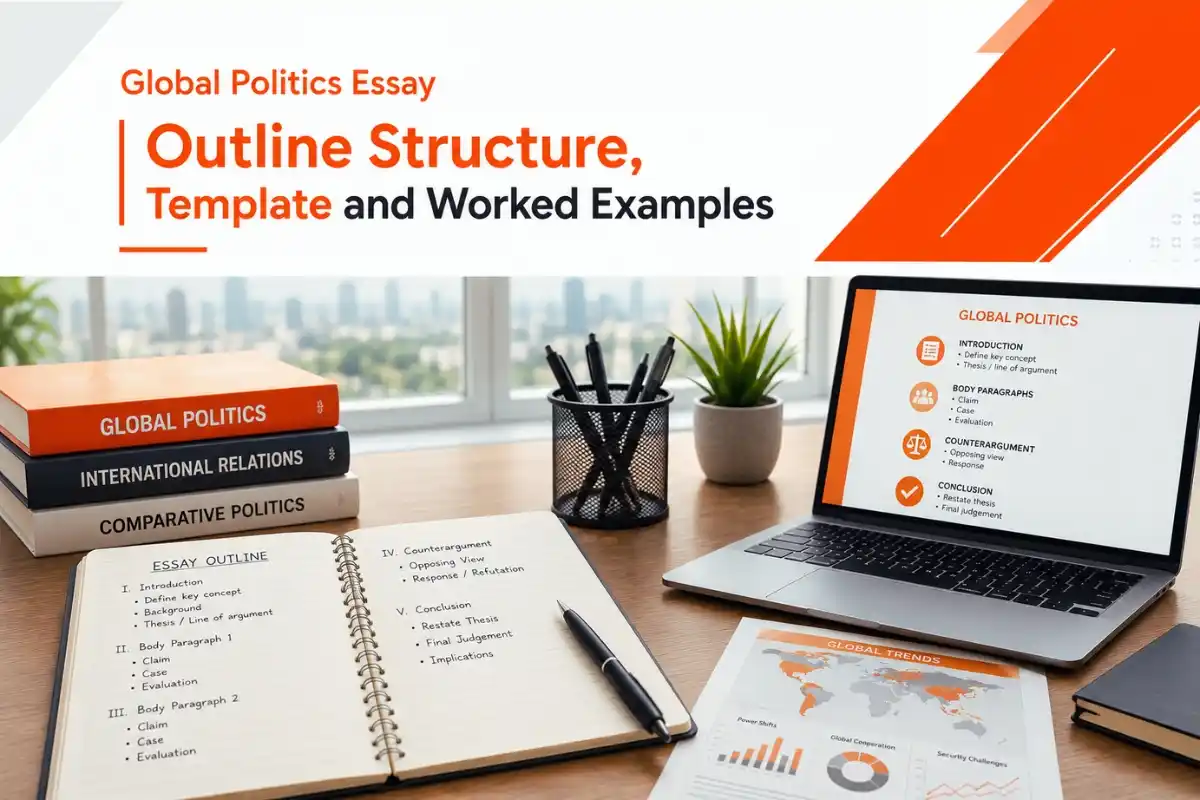
The counterargument tests your position, and the conclusion gives a clear judgement. What separates this from a general essay plan is the load on each paragraph. Every body paragraph must carry a concept, a case, and an evaluation together. This guide gives you the template, the word counts, and two worked IB examples.
- What Is a Global Politics Essay Outline?
- Paper 2 and the Extended Essay Need Different Outlines
- What Makes a Global Politics Outline Different
- The Standard Global Politics Essay Outline
- Word Count Allocation
- Match Your Outline to the Command Term
- Three Ways to Order Your Body Paragraphs
- Where Theory Belongs in the Outline
- Map Your Case Studies to the Core Units
- Worked Example: An Evaluate Question
- Worked Example: A Compare and Contrast Question
- Turn a Descriptive Paragraph Into an Analytical One
- Common Outline Mistakes
- Pre-Draft Checklist
- Turn Your Outline Into a Finished Essay With MyPremiumEssay
- Frequently Asked Questions
What Is a Global Politics Essay Outline?
A Global Politics essay outline is a plan that maps your argument before you draft. It sets out your claim, your cases, and your judgement in order.
The point is not to explain what happened. The point is to judge how power worked and who gained from it. IB students meet this task in two places, and each one needs a different plan.
Paper 2 and the Extended Essay Need Different Outlines
Most guides treat these as one task. They are not. A plan that suits a timed Paper 2 essay will not fit a 4,000-word Extended Essay. The table below shows why the same outline cannot serve both.
| Feature | Paper 2 essay | Extended Essay |
|---|---|---|
| Setting | Timed exam | Coursework |
| Length | 3 to 5 paragraphs | About 4,000 words |
| Timing | 1 hr 45 (SL), 2 hr 45 (HL) | Weeks of work |
| Focus | One tight argument | Deep, sourced research |
| Marked on | Argument and evaluation | Criteria A to D, 34 marks |
Pick the version that matches your task, then use the template below.
What Makes a Global Politics Outline Different
Most subjects let you plan around arguments alone. Global Politics does not. Your plan has to book space for four things before you write.
- Contested concepts. Terms like power, sovereignty, and legitimacy mean different things to different actors. Your plan needs a line showing which meaning you use.
- Real-world cases. Every claim needs a named example with a date and an outcome. A vague reference to "many countries" scores nothing.
- Multiple perspectives. Markers want the view from more than one actor. That means a state, an organisation, a group, or an affected population.
- Evaluation, not description. Explaining what happened is background. Judging how well it worked is the actual task.
If your plan has arguments but no cases, the essay stalls in the middle. Fixing that now takes ten minutes. Fixing it later means rewriting half the draft.
The Standard Global Politics Essay Outline
This template works for coursework, timed responses, and university essays. Adjust the number of body paragraphs to fit your word count.
Introduction
Open with the issue and why it matters now, in one sentence. Define the key concept and note that it is contested. Set your scope, meaning the time frame, regions, or actors you cover. State your line of argument, then signpost your two or three main points.
Body Paragraphs
Plan each body paragraph with four moves. This keeps every paragraph doing analysis rather than storytelling.
- Claim. One sentence stating what this paragraph proves
- Application. The named case, kept under a third of the paragraph
- Perspective. How a different actor or theory reads the same case
- Evaluation. How far the case supports your claim, and where it falls short
Write those four labels next to every paragraph in your plan. Any paragraph missing one is not ready to draft.
Counterargument
State the strongest opposing view in its fairest form. Give it a real supporting case, not a weak one chosen to be beaten. Explain the limits of that view with evidence. Then return to your line of argument and show why it holds.
Conclusion
Give a direct answer to the question asked. Show the condition on your answer, meaning when it holds and when it does not. Reference your strongest evidence briefly, without repeating whole paragraphs. Close on the wider meaning for global politics.
Word Count Allocation
Scope problems cost more marks than weak arguments. Set your paragraph budget before you plan the content.
| Essay length | Introduction | Body | Counterargument | Conclusion |
|---|---|---|---|---|
| 800 words | 100 | 2 paras at 200 | 150 | 150 |
| 1,500 words | 180 | 3 paras at 300 | 250 | 170 |
| 2,500 words | 250 | 4 paras at 350 | 450 | 400 |
| Timed exam | 5 min plan | 3 args, 1 case each | In the body | 5 min |
In timed conditions, fold the counterargument into each body paragraph. A separate section will cost you time you do not have.
Match Your Outline to the Command Term
The verb in the question decides the shape of your plan. Reading it right is the fastest mark gain on offer.
| Command term | What the outline needs |
|---|---|
| Evaluate | Points for, points against, then a weighted judgement |
| To what extent | A position on a scale, with limits shown |
| Discuss | Balanced coverage, your view held for the end |
| Examine | Assumptions and factors made visible |
| Compare and contrast | Themes, never one case then the other |
| Analyse | The parts separated, links between them explained |
| Assess | Value measured against a standard you name |
The common error is treating "evaluate" and "describe" as the same job. Evaluation needs a criterion. Decide what counts as success before you judge anything.
Three Ways to Order Your Body Paragraphs
Once you know your arguments, you still choose an order. Three structures work, and the question usually points to one.
Argument-Led
Each paragraph gives one reason for your line of argument. Use it when the question asks if something is true or effective.
Actor-Led
Each paragraph covers a different actor, such as states, organisations, and corporations. Use it for questions about responsibility or influence.
Level-Led
Each paragraph moves up a level, from local to national to global. Use it when the question is about scale.
Pick one and hold it. Essays that switch structure halfway through lose coherence marks.
Where Theory Belongs in the Outline
Theory is a lens you apply inside paragraphs, not a section at the front. A standalone paragraph on realism reads like revision notes.
Mark against each body paragraph which lens you use.
- Realism. States act on self-interest, so cooperation stays temporary
- Liberalism. Institutions and trade make cooperation last
- Constructivism. Identity and norms shape what actors want
- Critical and postcolonial views. Arrangements reflect past inequality, so who gains matters
Reading one case through two lenses is the fastest way to show diverse perspectives without adding length.
Map Your Case Studies to the Core Units
Most guides tell you to use case studies. Few show which cases fit which unit. This matrix does that work for you.
| Core unit | Example cases | Suits these terms |
|---|---|---|
| Power and sovereignty | Security Council vetoes, sanctions regimes | Evaluate, analyse |
| Human rights | The ICC, refugee protection | To what extent, assess |
| Development | The Sustainable Development Goals, aid programmes | Discuss, examine |
| Peace and conflict | UN peacekeeping missions, negotiated settlements | Evaluate, compare |
Use at least two cases from different regions. Include one that complicates your argument. Depth beats a list of names in passing.
Worked Example: An Evaluate Question
Question: To what extent are international organisations effective at resolving armed conflict?
Introduction
- Conflict stays concentrated where outside action has repeated rather than settled it
- Define effectiveness as ending violence, and note others define it as preventing return
- Scope it to intergovernmental organisations after 2000
- Line of argument: strong at containment, weak at settlement
Body one, claim: effective at limiting violence
- Case: a peacekeeping mission with a measured drop in civilian deaths
- Perspective: a liberal reading, since institutions supply what states will not
- Evaluation: containment held, but only while funding lasted
Body two, claim: weak where member interests split
- Case: a Security Council deadlock that blocked action
- Perspective: a realist reading, since institutions reflect powerful members
- Evaluation: the failure was structural, which limits how reform can fix it
Body three, claim: success depends on local legitimacy
- Case: a mission the host population saw as imposed
- Perspective: constructivist and postcolonial readings on who defines authority
- Evaluation: technical success beside political failure, which is why criteria matter
Counterargument
- The strongest opposing view is that conflicts would run longer without these bodies
- Case: a settlement brokered through an international organisation
- Limit: it held because regional powers wanted it, not because the body forced it
Conclusion
- Effective at containment, limited at resolution
- The condition: results rise when major powers agree and fall when they do not
- Wider point: judging these bodies against a resolution standard sets them up to fail
Worked Example: A Compare and Contrast Question
Question: Compare and contrast the influence of states and non-state actors on global environmental policy.
Organise by theme, never by actor in turn.
- Theme one, agenda setting. How each shapes what gets discussed, with one case per side
- Theme two, rule making. Where formal authority still sits with states, and where it does not
- Theme three, enforcement. The gap between promise and compliance for both
- Theme four, accountability. Who can be held responsible, and by whom
- Conclusion. Which actor matters more, and at which stage of the policy process
Splitting this into "states" then "non-state actors" gives two descriptions and no comparison. Themes force the contrast onto the page.
Once you've completed your outline and essay, learn how to write an essay conclusion that reinforces your key arguments and leaves a lasting impression.
Turn a Descriptive Paragraph Into an Analytical One
Marks are lost when a paragraph tells a story instead of making a case. Here is the same content, written both ways.
Descriptive version. The UN sent peacekeepers to the region in 2004. The mission lasted several years and involved thousands of troops. Fighting continued in some areas during this time.
Analytical version. The 2004 peacekeeping mission cut civilian deaths while its mandate held. This shows institutions can contain violence that states alone will not. Yet fighting returned once funding fell, which exposes the limit of containment without settlement.
The second version names the case, states a claim, and judges it. That shift from event to argument is what raises the mark.
Common Outline Mistakes
- Planning content, not argument. A list of topics is not an outline. Each paragraph needs a claim someone could dispute.
- Leaving cases unassigned. Choosing examples while drafting causes repetition and uneven coverage.
- Writing the introduction first. Plan the body, then write the introduction to match what you argued.
- Treating balance as neutrality. These essays need a position. Balance means fair treatment of other views, not the absence of a judgement.
- Overloading the plan. Four strong paragraphs beat seven thin ones at any length.
Understanding how to write an essay outline can make it much easier to organize complex global politics topics into a coherent, well-supported essay.
Pre-Draft Checklist
Run this before you write. It takes five minutes and prevents most rewrites.
- Does the introduction state a line of argument, not just a topic?
- Does every body paragraph have a claim, a case, a perspective, and an evaluation?
- Are your cases from at least two regions?
- Does the command term match the shape of your plan?
- Does the counterargument use the strongest opposing view?
- Does the conclusion answer the question with a condition attached?
- Are you inside the word budget for each section?
Any plan that clears all seven is ready to draft.
Turn Your Outline Into a Finished Essay With MyPremiumEssay
Build the plan first, assign your cases, then draft. An outline that already carries claims, cases, and evaluation makes the writing stage far easier.
If the deadline is close, our writers can build the outline or complete the essay for you. Explore our Essay Writing Service for original work with named cases and balanced perspectives.
Get your global politics essay planned and written on time.
Order NowFrequently Asked Questions
How many paragraphs should a Global Politics essay have?
Three to five body paragraphs suit most essays. Two arguments plus a counterargument work for short responses, and three work for longer ones.
How many case studies should I use?
At least two, from different regions. One case per body paragraph is the usual ratio, and each should be developed.
Should I state my argument in the introduction?
Yes. These essays reward a clear position early, followed by evidence that tests it. Holding your answer back weakens the structure.
What is the difference between a Global Politics essay outline and a general one?
A general outline plans arguments and evidence. This one also plans your concept definition, your actors, and the perspective each paragraph uses.
How do I plan an essay under exam conditions?
Spend five minutes on your line of argument, three claims, and one case each. If you cannot name a case for a claim, drop it and use another.
Can I use the same case twice in one essay?
Yes, if you read it through a different lens the second time. Repeating the same reading adds nothing and looks like thin preparation.

 MyPremiumEssay