
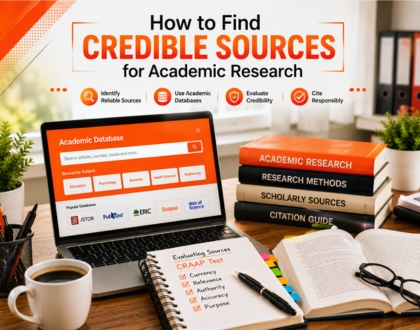
Every strong piece of academic writing rests on one thing: the quality of the sources behind it. A brilliant argument built on shaky evidence collapses the moment a professor or reviewer starts checking citations. Yet most students are never formally taught how to find credible sources. They're simply told to "use reliable research" and left to figure out the rest through trial and error.
This guide closes that gap. You'll learn exactly what makes a source credible, where to find reliable research sources for any subject, how to use academic databases effectively, and how to evaluate everything from websites to journal articles before you ever cite them in a paper.
What Makes a Source "Credible"?
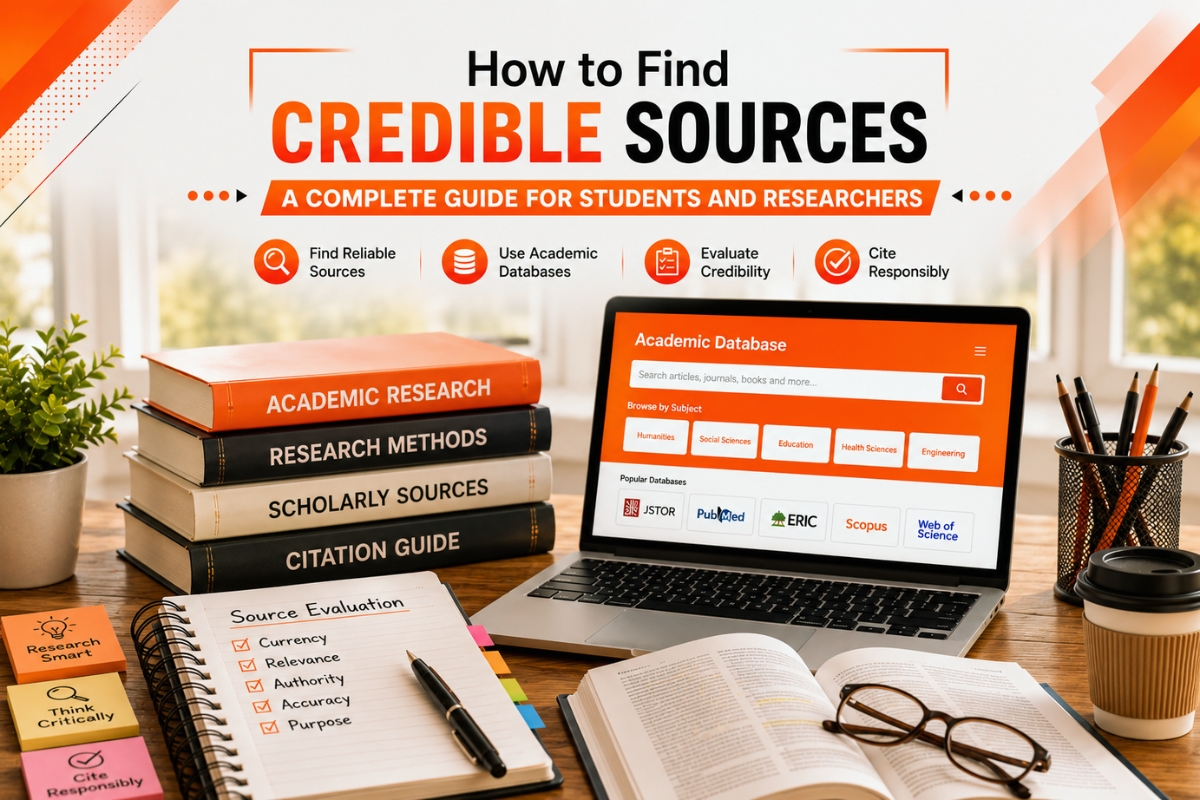
A credible source is one whose information you can trust to be accurate, current, and free from significant bias or self-interest. Credibility isn't a single yes/no switch. It's a combination of several factors working together. Before relying on any source, run it through these five checks.
-
1. Authority — Who Wrote It?
Look for an identifiable author with relevant expertise. A peer-reviewed article by a university professor in immunology carries more authority on a vaccine question than an anonymous blog post. Check the author's credentials, institutional affiliation, and publication history. If a source doesn't name an author or organization at all, treat it with caution.
-
2. Accuracy — Is the Information Verifiable?
Credible sources cite their own evidence: data, studies, statistics, or primary documents. If a claim can't be traced back to an original source, it's an opinion, not a fact. Cross-check surprising or specific statistics against at least one other reputable source before using them.
-
3. Objectivity — Is There a Hidden Agenda?
Every source has some point of view, but credible ones distinguish fact from interpretation and disclose funding or conflicts of interest. Be wary of sources funded by parties with a financial or political stake in the conclusion (for example, a study on sugar's health effects funded by a beverage company).
-
4. Currency — Is It Up to Date?
In fast-moving fields like medicine, technology, or law, a source published ten years ago may be outdated. Always check the publication or last-revised date, and for time-sensitive topics, prioritize research from the last three to five years unless you're specifically studying historical context.
-
5. Coverage — Is It Thorough?
A credible source treats its topic with appropriate depth rather than skimming the surface or cherry-picking facts that support one conclusion. Strong academic sources typically include a methodology section, a literature review, and citations of prior research.
The CRAAP Test: A Quick Evaluation Framework
The CRAAP test is the single most widely taught framework for evaluating sources, developed by librarians at California State University, Chico, and it remains the fastest way to vet a source before you cite it. The acronym stands for Currency, Relevance, Authority, Accuracy, and Purpose, and running through these five questions takes only a few minutes but catches the majority of red flags before they end up in your work.
Currency: When was it published or last updated?
Recency matters more in some fields than others, but it always matters. A 2012 statistic about smartphone adoption is essentially meaningless today, while a foundational philosophy text from the 1980s may still be entirely current. Check not just the original publication date but whether the source has been revised, retracted, or superseded by newer research. For fast-moving fields like medicine, law, or technology, a hard rule of thumb is to be skeptical of anything more than five years old unless it's cited as historical or foundational context.
Relevance: Does it actually address your research question, at the right depth?
A source can be impeccably accurate and still wrong for your purposes. A highly technical biochemistry paper might be too narrow for a general-audience article, while a broad overview piece might lack the rigor a graduate thesis requires. Ask whether the source speaks directly to your research question, or whether you're stretching it to fit.
Authority: Who is the author or publisher, and what are their qualifications?
Look for verifiable credentials: an institutional affiliation, a relevant degree, professional experience in the field, or a track record of other published work. Authority extends to the publisher too. A peer reviewed journal, a university press, or a government agency carries more institutional weight than an anonymous website. If you can't identify who wrote something or what qualifies them to speak on the topic, that's an immediate warning sign.
Accuracy: Is the information supported by evidence, traceable, and free of obvious errors?
Check whether claims are backed by data, citations, or verifiable methodology, rather than asserted without support. Look at the source's own reference list, if it has one. Spelling and grammar errors, unsupported statistics, or claims that contradict well-established consensus without strong evidence are all signs of weak accuracy. When possible, trace key facts back to their original source rather than trusting a secondhand summary.
Purpose: Why was this content created, and who benefits from you believing it?
Every source has an intent: to inform, persuade, sell, entertain, or advocate. None of these purposes automatically disqualify a source, but they should shape how much scrutiny you apply. A pharmaceutical company's white paper on its own drug, an op-ed arguing a political position, or a sponsored blog post all deserve closer evaluation of bias than a peer-reviewed clinical trial or a government statistical report. Identifying the purpose helps you separate the factual content from the framing around it.
Expert insight: If a source fails two or more of these checks, it's safer to find an alternative.
Primary vs. Secondary vs. Tertiary Sources
Understanding source types helps you choose the right evidence for the right purpose.
Primary sources are original, firsthand materials: research studies, experiments, historical documents, interviews, court records, and raw datasets. They're the strongest form of evidence because there's no interpretation layer between the data and your reading of it.
Secondary sources analyze, interpret, or summarize primary sources. Textbooks, review articles, and most journalism fall into this category. They're useful for context but should be checked against the primary research they reference.
Tertiary sources compile and condense information from primary and secondary sources, such as encyclopedias, almanacs, and Wikipedia. These are excellent starting points for background knowledge but generally shouldn't be cited directly in academic work; instead, use them to identify primary and secondary sources to investigate further.
Where to Find Reliable Research Sources
Knowing what credibility looks like is only half the job. You also need to know where to look. Here are the categories that consistently produce trustworthy material.
Academic Databases
Academic databases are curated, searchable collections of scholarly material. They remain the single best starting point for serious research. Here are the major ones worth knowing:
- JSTOR — A massive archive spanning over 75 disciplines, particularly strong in the humanities and social sciences, with complete runs of thousands of journals.
- PubMed and PubMed Central — Run by the U.S. National Library of Medicine, these are essential for anything related to medicine, biology, and life sciences. PubMed Central is open-access, meaning full-text articles are free.
- ProQuest — A broad, multidisciplinary database often available through university library subscriptions, covering dissertations, newspapers, and journal articles.
- EBSCOhost — Another widely used multidisciplinary database, commonly bundled into university library systems with filters specifically for "scholarly" or "peer-reviewed" content.
- Google Scholar — Free and accessible to anyone, Google Scholar indexes scholarly literature across disciplines. It's an excellent starting point, but unlike subscription databases, it doesn't always clearly indicate peer-review status, so each result still needs individual verification.
- IEEE Xplore and ACM Digital Library — The standard for engineering, computer science, and technology research.
- SpringerLink and Oxford Academic — Strong multidisciplinary publishers offering journal articles, books, and reference material, often accessible through university subscriptions.
- ScienceDirect and Scopus — Elsevier-run platforms widely used in the sciences, with Scopus also functioning as a citation-tracking tool to see how influential a given paper is.
Most universities provide free student access to several of these databases through the library website. Always check there before paying for individual articles.
Government and Institutional Sources
Government agencies and international organizations publish primary data that's rigorously vetted and rarely commercially biased.
- National statistics agencies (e.g., the U.S. Census Bureau, Bureau of Labor Statistics)
- Government health agencies (e.g., the CDC, WHO, NIH)
- Legislative and judicial records (e.g., Congress.gov, court opinions)
- International bodies (e.g., the United Nations, World Bank)
Domains ending in .gov or .int are generally reliable for raw data and official statements, though always check whether the document is presenting data or advocating a policy position.
University and Educational Sources
Sites ending in .edu often host faculty research, course materials, and institutional repositories. These can be excellent, but verify that you're looking at a faculty or library page rather than an unmoderated student blog hosted on the same domain.
Peer-Reviewed Journals
Peer review means independent experts in the field evaluated the research before publication, checking the methodology, data, and conclusions. This process is the strongest credibility signal in academic publishing. You can typically find peer-reviewed journals through your library's database subscriptions or directly through a publisher's website.
Reputable News and Reference Organizations
For current events or general background, established news organizations with editorial standards and fact-checking processes (major wire services, national newspapers of record) are more reliable than aggregator sites or opinion blogs. Use them for context and recent developments, not as a substitute for primary research in an academic paper.
How to Use Academic Databases Effectively
Having access to a database doesn't automatically produce good results. Search technique matters.
- Start with your research question, not a single keyword. Break it into core concepts and search each one separately before combining them.
- Use Boolean operators. Combine terms with AND, OR, and NOT to narrow or broaden results (e.g., "remote work AND productivity NOT pandemic").
- Apply filters. Most databases let you filter by publication date, peer reviewed status, subject area, and document type. Use these filters aggressively to eliminate irrelevant results.
- Follow the citation trail. When you find one strong source, check its reference list and see who has cited it since (Google Scholar's "Cited by" feature is useful here) to find related, credible research.
- Save and organize as you go. Use a citation manager like Zotero, Mendeley, or EndNote to keep track of sources and generate accurate citations later.
Need a professionally researched paper?
Let our skilled writers build your argument on credible research.
Elevate your grades today!
Red Flags That Signal an Unreliable Source
Train yourself to spot warning signs quickly:
- No identifiable author, date, or publisher
- Excessive grammatical errors or sensationalized language
- Claims with no supporting evidence or citations
- A domain mimicking a credible site (misspellings, unusual extensions)
- Content designed primarily to sell a product or push a single ideology
- Outdated statistics presented as current
- Information that can't be found or confirmed anywhere else
If a source trips more than one of these flags, don't cite it, even if its conclusion happens to support your argument.
Common Mistakes to Avoid When Finding Sources
Even experienced researchers fall into predictable traps. Watch for these:
- Relying on Wikipedia as a primary source. Wikipedia is editable by anyone, which makes it unreliable for direct citation in academic work. That said, it's not useless — the reference list at the bottom of a Wikipedia article often links to primary sources that are themselves citable.
- Treating all "scholarly-looking" content as credible. Predatory journals, publications that charge authors a fee to publish with little to no real peer review, have become a serious problem in academic publishing. Always verify a journal's reputation and review process, not just its appearance.
- Ignoring publication dates. A source can be excellent and still be outdated for your specific purpose. Always check currency against the pace of change in your field.
- Overlooking conflicts of interest. A study funded by a company with a financial stake in its outcome deserves extra scrutiny, even if it's published in a reputable journal.
- Stopping at the first few search results. Search engines and even academic databases rank by relevance algorithms, not necessarily by credibility. The fifth or tenth result may be more rigorous than the first.
- Using only one type of source. A research project built entirely on news articles, or entirely on one database, misses the broader picture that a mix of peer-reviewed research, government data, and expert analysis provides.
A Simple Workflow for Source Evaluation
When you're deep in research and need to move quickly without sacrificing rigor, follow this sequence:
- Identify the author and publisher; verify their credentials and reputation.
- Check the publication date for currency relative to your topic.
- Scan for citations or a methodology section that supports the claims.
- Run the CRAAP test if anything still feels uncertain.
- Cross-reference the central claim against one independent source.
- Record full citation details immediately so you don't lose track later.
Building this habit takes a few extra minutes per source, but it prevents the much larger cost of a paper built on weak or discredited evidence.
MyPremiumEssay Helps You Turn Research into Results
Learning how to find credible sources is not about memorizing a list of trustworthy websites. It is about developing a habit of critical evaluation and applying it consistently.
Academic databases, government publications, and peer reviewed journals will lead you to many reliable sources. However, the real skill lies in evaluating what you find. Always consider who wrote the source, when it was published, how the information was gathered, and whether the evidence is supported by credible references.
Develop this habit once, and it will benefit every research project you undertake, from a term paper due next week to work you will proudly stand behind for years.
Of course, even the strongest research deserves writing that does it justice. If you need a professional Research Paper Writing Service, MyPremiumEssay's academic writers can help you turn credible research into a polished, well argued paper. We help you structure your evidence, cite sources correctly, and present your findings with the clarity and authority they deserve.
Order NowFrequently Asked Questions
- Is Wikipedia ever acceptable as a source?
- Wikipedia is a tertiary source best used for background orientation and for mining its reference list, not for direct citation in academic work. Follow its footnotes to the primary and secondary sources it draws from.
- How many sources should I cite?
- There's no universal number. It depends on assignment length and scope. Prioritize source quality and relevance over hitting an arbitrary count; a paper with eight rigorously vetted sources is stronger than one with twenty weak ones.
- Are .org websites automatically trustworthy?
- No. The .org domain is open to any organization, including advocacy groups with a clear agenda. Evaluate .org sites with the same CRAAP criteria you'd apply to any other source.
- Can I cite a source I found through a general Google search?
- Yes, as long as it independently passes credibility checks. Many reputable government, academic, and institutional sites appear in general search results. The search engine itself isn't the issue. The source's authority, accuracy, and purpose are what matter.
- What's the difference between a credible source and a scholarly source?
- A scholarly source is written by experts and is typically peer reviewed, but credibility is a broader concept. A well vetted government report or reputable news investigation can be credible without being scholarly. Scholarly sources are a subset of credible sources, not the only valid kind.
- How do I know if a journal is actually peer-reviewed?
- Check the journal's "About" or "Author Guidelines" page, which usually states its review process explicitly. You can also search the journal title in Ulrichsweb or your library database's journal finder, which flag peer-reviewed titles directly.
- Is a source still credible if it's biased?
- Bias alone doesn't disqualify a source, but it means you should weigh its claims more carefully and balance them with sources from a different perspective. The bigger concern is whether a source discloses its bias or hides it behind a false appearance of neutrality.
- Can I use a source that contradicts my argument?
- Yes, and you often should. Engaging with credible sources that challenge your position, then explaining why your interpretation still holds, strengthens your argument far more than only citing sources that agree with you.
- What citation style should I use for online sources?
- It depends on your assignment, but APA is most common in the social sciences, MLA in the humanities, and Chicago in history and some publishing contexts. Whichever style you use, cite the author, publication date, title, and a stable URL or DOI whenever available.
- How do I find the original study behind a news article?
- Look for a hyperlink, journal name, or researcher name mentioned in the article, then search that directly in Google Scholar or PubMed. If the article doesn't name its source at all, treat its claims with extra skepticism until you can verify them elsewhere.
- Are preprints (like those on SSRN or arXiv) credible sources?
- Preprints share research before peer review, so they can be useful for very recent findings but should be flagged as unreviewed in your writing. Where possible, check whether a peer-reviewed version has since been published and cite that instead.
- How old is too old for a source?
- There's no fixed rule. It depends on the field. Fast-moving areas like technology or medicine generally call for sources from the last 3–5 years, while foundational theories, historical analysis, or classic literary criticism can remain valid and citable for decades.
 MyPremiumEssay