




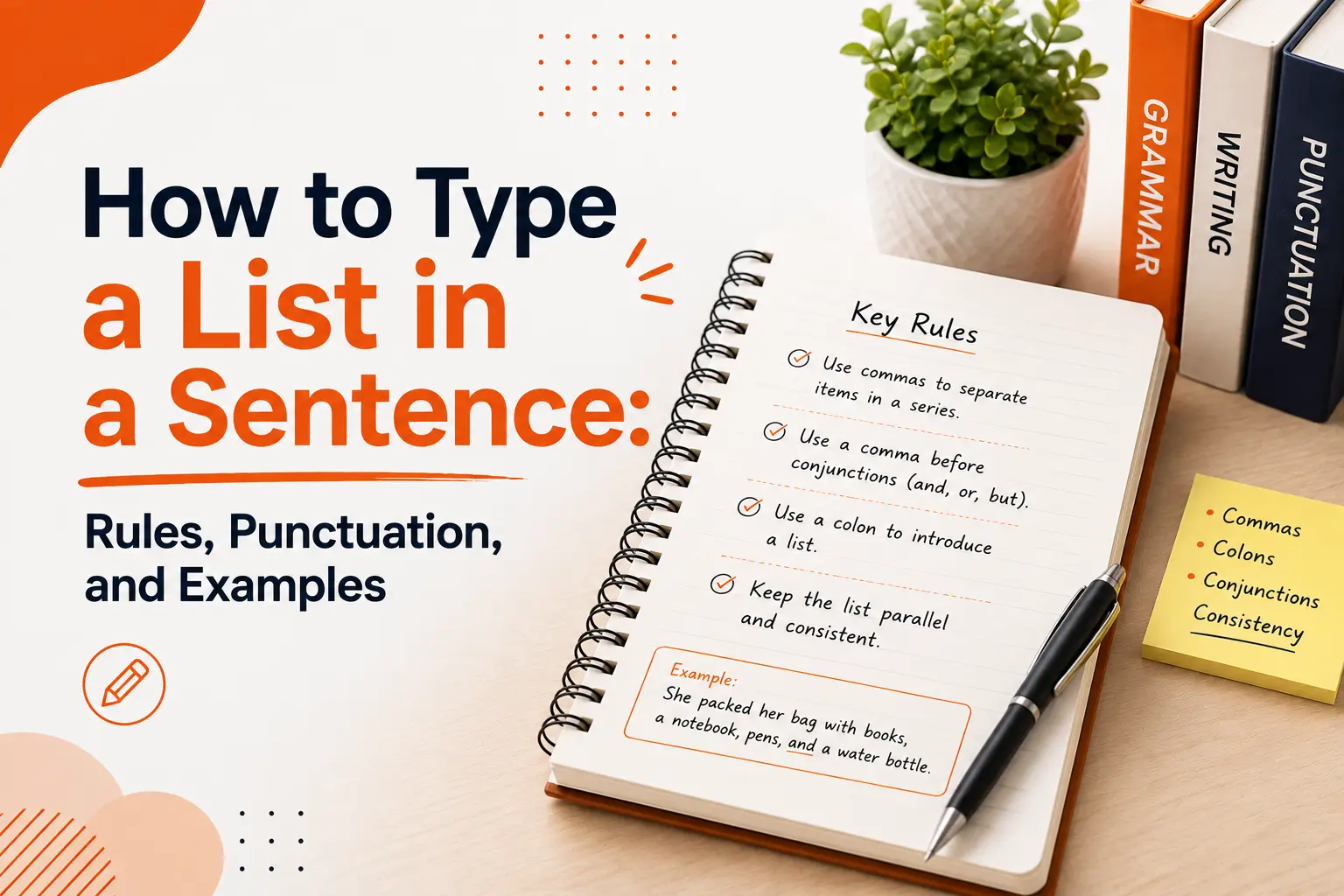
Keep every item in the same grammatical form, and use a serial comma before the final "and." That single set of rules handles almost every list you will write inside a sentence.
The rest of this guide shows each case with examples. It also adds three things the top-ranked pages leave out: a side-by-side comparison of what APA, MLA, Chicago, and AP each require, how to punctuate a list of citations, and the list errors that cost students marks.
What a Run-In List Is
A list written inside a sentence is called a run-in list. It reads horizontally, as an ordinary part of the sentence.
My three study spots are the library, a quiet café, and my kitchen table.
This differs from a vertical list, where each item sits on its own line with a bullet or number. Run-in lists suit short, simple series that a reader takes in at once. The choice between the two depends on how long and how complex your items are.
Separate Simple Items With Commas
When you have three or more short items with no inner punctuation, separate them with commas.
The workshop covered brainstorming, outlining, drafting, and editing.
A plain list like this needs no colon. The sentence flows straight into the items without one.
The Serial Comma
Put a comma before the final "and." This is the serial comma, also called the Oxford comma, and it removes confusion.
Without it: I thanked my roommates, a professor and a mentor.
With it: I thanked my roommates, a professor, and a mentor.
The first version can read as though the roommates are the professor and the mentor. The second cannot be misread. American writing usually keeps the serial comma, while British writing often drops it. Pick one habit and hold to it across the whole document.
Use Semicolons When Items Contain Commas
Commas stop working the moment an item carries its own comma. The reader can no longer see where one item ends. Switch to semicolons instead.
The program placed students in Lyon, France; Kyoto, Japan; and Cape Town, South Africa.
With commas alone, that sentence reads as six items rather than three cities. The rule is simple. If any single item holds a comma, separate every item with a semicolon.
How to List Several Citations in One Sentence
Academic writing hides a run-in list that most guides ignore: multiple sources in one set of parentheses. APA and MLA both separate these with semicolons, not commas.
Several studies report the same pattern (Brown, 2019; Lee, 2021; Patel, 2020).
In APA style, order the sources alphabetically inside the parentheses. In MLA style, list the author and page for each, again split by semicolons. This keeps a dense citation readable and matches the semicolon rule above.
Introduce a List With a Colon
A colon tells the reader a list is coming. You may use one only when the words before it form a complete sentence.
Correct, because a full sentence sits before the colon:
The scholarship requires three items: an essay, two references, and a transcript.
Incorrect, because the words before the colon cannot stand alone:
The scholarship requires: an essay, two references, and a transcript.
To test it, read only the words before the colon. If they form a complete thought, the colon is right. If something feels missing, remove it.
When a Colon Is Wrong
Do not put a colon after "such as," "including," "for example," or "like." These phrases do not finish a sentence, so no colon follows.
Do not place a colon between a verb and its objects. Write "my subjects are history, biology, and art," with no colon after "are." One exception exists in journalism: AP style allows a colon after a fragment, which APA and Chicago both reject.
Capital Letters in a Run-In List
Items in a run-in list stay lowercase, because they belong to the surrounding sentence.
She packed the basics: a laptop, a charger, and a notebook.
If a full sentence follows the colon, capitalization depends on your style guide, and the guides disagree. The next section lays out exactly who wants what.
How the Main Style Guides Differ
Most pages that rank for this topic follow one style guide and ignore the rest. Here is what the four common guides ask for when a list sits inside a sentence.
| Style guide | Serial comma | Capital after a colon | Letters or numbers for items |
|---|---|---|---|
| APA | Use it | Only if a full sentence follows | Lowercase letters in parentheses, such as (a), (b) |
| MLA | Use it | Only if two or more sentences or a question follow | Rare, usually plain prose |
| Chicago | Use it | Only if two or more sentences follow | Numbers or letters in parentheses allowed |
| AP | Drop it, add only for clarity | If a full sentence follows | Numerals, used sparingly |
Two takeaways sit inside that table. First, only AP drops the serial comma, so academic writers keep it. Second, APA capitalizes after a colon sooner than Chicago and MLA do, which is the difference students miss most.
Number or Letter Items Inside a Sentence
You can number items while keeping the list in the sentence. This helps when items run a little longer and you want each start to show. Wrap each marker in two parentheses.
The claim rests on three findings: (1) the contract was signed under pressure, (2) the terms stayed hidden, and (3) no payment ever arrived.
Use letters when the items carry equal weight and follow no set order.
A negligence claim must show (a) a duty of care, (b) a breach of that duty, and (c) resulting harm.
Always use both parentheses, so "(1)" and never "1)." Once items grow past a line each, move the list vertical.
Keep Every Item Parallel
Parallel structure means each item follows the same grammar. The list then reads cleanly against the words that introduce it.
Broken: This term I want to read more, exercise, and better sleep.
Fixed: This term I want to read more, exercise often, and sleep better.
Test it by reading the opening with each item alone. "I want to read more," "I want to exercise often," "I want to sleep better." If one pairing sounds wrong, rewrite that item.
List Mistakes That Cost Students Marks
Across student essays, the same three list errors show up again and again. Each one is easy to fix once you can spot it.
The first is a colon after a verb, as in "the reasons are: cost, time, and effort." The lead-in is not a full sentence, so the colon does not belong.
The second is a long list forced into one sentence. When five or more detailed items crowd a single line, readers lose track, and the sentence should become a vertical list.
The third is broken parallelism halfway through, where a writer starts with verbs and drifts into a noun. Graders notice, because the sentence stops reading smoothly.
When to Move the List Vertical
A run-in list works while it stays short. Move it to a bulleted or numbered list when any of these apply.
- The items are long or run past a few words each.
- There are more than about five or six items.
- Readers must follow the items as ordered steps, which call for numbers.
- You want the items to stand out for quick scanning.
A recipe or a set of instructions almost always belongs in a numbered vertical list. Do not press those into one sentence.
A Three-Question Decision Rule
When you are unsure how to punctuate a list, ask three questions in order.
- Does any item contain a comma? If yes, separate the items with semicolons.
- Is the lead-in a complete sentence? If yes, a colon is allowed. If no, skip it.
- Are the items long or ordered? If yes, move the list vertical.
Answer those three, and the punctuation falls into place every time.
Quick-Reference Cheat Sheet
| Situation | What to do | Example |
|---|---|---|
| Short, simple items | Commas plus a serial comma | red, white, and blue |
| An item holds a comma | Semicolons between all items | Paris, France; Rome, Italy; and Bern, Switzerland |
| Introducing the list | Colon only after a full sentence | She needs three things: time, focus, and coffee. |
| Numbering inside a sentence | Two parentheses per marker | (1) plan, (2) draft, (3) revise |
| Every list | Keep items parallel | to plan, to draft, and to revise |
| Long or ordered items | Move to a vertical list | use bullets or numbers |
Frequently Asked Questions
Do you use a colon before every list in a sentence?
No. Use a colon only when the words before it form a complete sentence. If the list flows from the sentence, as in "she bought apples, pears, and grapes," you need no colon.
When do you use semicolons instead of commas in a list?
Use semicolons when any item already holds a comma. This keeps the items apart, so the reader can see where each one ends.
How do you put numbers in a list within a sentence?
Wrap each number in two parentheses, such as (1), (2), (3), before each item. Add a colon only if the words before it form a complete sentence.
Should list items in a sentence start with a capital letter?
Usually no. Run-in list items belong to the surrounding sentence, so they stay lowercase unless an item is a proper noun.
What is a run-in list?
A run-in list is a list written across a sentence, separated by commas or semicolons, rather than shown vertically with bullets or numbers.
Get Your Writing Checked
Punctuating a list well is a small skill that makes an essay read like careful work. If you want an expert to check your punctuation, or to write and edit a full essay for you, our academic writers can help.

 MyPremiumEssay