
A book report is not just a school assignment. It is an exercise in reading carefully, thinking critically, organizing ideas, and communicating clearly. These are skills that serve people for a lifetime, in college, careers, and everyday life. So the real value of a book report lies not in the grade, but in the lifelong skills it helps students develop.
In this guide, you will learn the purpose of a book report, its key components, and a step by step process for writing one successfully.
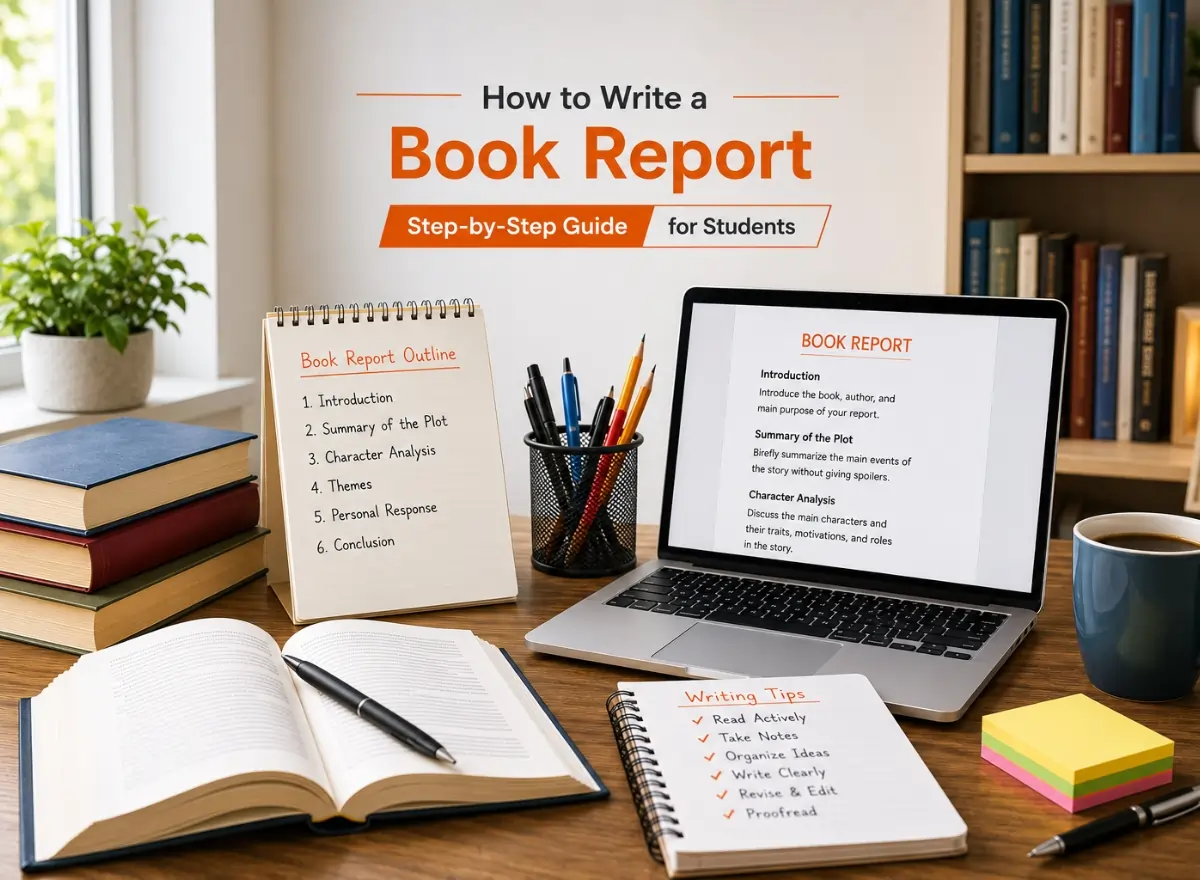
What Is a Book Report, and Why Does It Matter?
A book report is a structured written summary and analysis of a book. It tells your reader what the book is about, who the key characters are, what happens in the story, and what you think about it. Depending on the grade level and the teacher's requirements, a book report may lean more toward summary (common in elementary and middle school) or more toward analysis and personal response (common in high school and college).
A book report is not a book review in the journalistic sense. You are not writing for a magazine or trying to convince a stranger whether to read it. You are demonstrating to your teacher that you read the book, understood it, and can think and write about it in an organized way.
Why does this matter beyond the grade? Because writing a book report trains you to do several things simultaneously: read actively rather than passively, identify what is important versus what is background detail, organize your thoughts into a logical sequence, and express your ideas clearly in writing. Every one of these skills transfers directly into academic and professional success.
Step by Step Guide to Writing a Book Report
Writing a book report becomes much easier when you break the process into manageable steps.
Step 1: Read the Book — But Read It Actively
This sounds obvious, but it is where most book reports either succeed or fall apart. There is a significant difference between reading a book and reading it with the purpose of writing about it.
Active reading means:
- Reading with a pen or sticky notes nearby. As you read, mark passages that seem important, moments of conflict, character revelations, turning points in the plot, or lines that stand out.
- Paying attention to characters. Who are the main characters? What do they want? What gets in their way? How do they change from the beginning of the book to the end?
- Noticing the structure. Where does the story begin? What is the central problem or conflict? When do things reach a peak of tension? How does it resolve?
- Asking "why" questions as you read. Why did the author include this detail? Why does this character behave this way? Why does this scene matter?
- Writing brief notes at the end of each chapter. Just two or three sentences capturing what happened and anything that felt significant. These notes will be invaluable when you sit down to write.
If you have already finished the book without taking notes, do not panic. Skim back through it before you start writing, pausing at chapters you remember as important and refreshing your memory on key details. A strong book report depends on accurate, specific detail, not vague impressions.
Step 2: Understand the Assignment Requirements
Before writing a single sentence, read your assignment instructions carefully. Book report requirements vary significantly depending on the grade level, the subject, and the teacher. Getting this wrong can cost you points even if your writing is excellent.
Key questions to answer before you start:
- What is the required length? (Word count or page count)
- Should this be a summary, an analysis, or both?
- Are you required to include a personal response or opinion section?
- Does your teacher want specific sections or headers?
- Is there a particular formatting style required (font size, spacing, margins)?
- Is there a specific theme, character, or element you are being asked to focus on?
- What is the due date, and do you need to submit a draft before the final version?
If any of these are unclear, ask your teacher before you start writing. It is always better to clarify upfront than to redo significant work after the fact. Teachers appreciate students who ask thoughtful questions; it signals engagement and care.
Step 3: Gather Your Basic Information
Every book report begins with the same foundational information. Before you write your introduction, make sure you have the following details ready:
- The full title of the book
- The author's full name
- The publication year
- The genre (fiction, nonfiction, historical fiction, biography, fantasy, etc.)
- The general subject matter or setting
This information typically appears in the opening paragraph of your report and anchors everything that follows. It also signals to your reader and your teacher that you are organized and have read the book carefully.
Step 4: Plan Your Structure
A well-organized book report follows a clear and logical structure. While exact formats vary, most book reports share the same essential architecture:
- Introduction
- Summary of the Plot
- Character Analysis
- Themes and Key Ideas
- Personal Response and Evaluation
- Conclusion
Think of these sections as rooms in a house. Each one has a distinct purpose, and together they make the whole thing livable. Trying to write without this structure is like building without a blueprint. It might come together, but the chances of something going wrong are much higher.
Before you start writing, jot down three to five bullet points for each section. What will you say in the introduction? Which plot events are essential to mention? Which characters deserve analysis? This outlining step takes fifteen minutes and saves hours of staring at a blank page mid-essay.
Step 5: Write a Strong Introduction
Your introduction is your first impression. A weak introduction, one that starts with "This book report is about...", signals to your reader that things may not improve from there. A strong introduction does several things at once: it identifies the book, provides essential context, and gives the reader a reason to keep reading.
A strong introduction includes:
- The title and author of the book, ideally worked into a natural sentence rather than announced bluntly
- A brief statement about the genre and general subject
- An interesting hook, a compelling question, a striking detail from the book, or a statement about why the book matters
- A thesis statement: one to two sentences that preview what your report will argue or explore
Example of a weak opening: "This book report is about Charlotte's Web by E.B. White. I am going to summarize the plot and talk about the characters."
Example of a stronger opening: "In E.B. White's beloved classic Charlotte's Web, a barnyard spider and a young pig form one of the most unlikely friendships in children's literature, and in doing so, explore timeless questions about loyalty, mortality, and what it means to truly value another living being. Published in 1952, this deceptively simple story continues to resonate with readers of all ages precisely because its emotional depth far exceeds its humble setting."
Notice the difference. The second version identifies the book and author, hints at the themes, and creates genuine interest, all in two sentences.
Step 6: Summarize the Plot — Without Retelling Everything
The plot summary is where many students make their biggest mistake: they retell the entire story in exhaustive detail, leaving no room for analysis or opinion. A book report is not a transcript of the book. It is a curated, purposeful summary that covers the essential arc of the story.
What to include in your plot summary:
- The setting: where and when does the story take place?
- The main character or characters and their central goals or desires
- The central conflict: what is the main problem or challenge the story is built around?
- Two to four key events that move the story forward
- The climax: the moment of highest tension or turning point
- The resolution: how does the story end?
What to leave out:
- Minor subplots that do not affect the main story
- Detailed scene-by-scene descriptions
- Dialogue, unless a specific quote is especially important
- Your own opinions in this section (save those for later)
A useful rule of thumb: if someone who has never read the book would understand the core story from your summary alone, you have done your job. If they would need additional explanation of events you skipped, you may need to add a little more. If you have included details that do not affect the main arc, consider trimming.
Step 7: Analyze the Main Characters
Character analysis elevates a book report from a simple summary to genuine literary engagement. This section asks you to look beyond what characters do and consider who they are, why they behave as they do, and what role they play in the story's larger meaning.
For each major character you discuss, consider:
- What does this character want, and what prevents them from getting it?
- What are their most defining personality traits? Can you point to specific scenes that illustrate these traits?
- How does this character change from the beginning to the end of the book? What causes that change?
- What does this character represent in the broader context of the story? Are they a symbol of something, such as courage, corruption, hope, or loss?
You do not need to analyze every character. For most book reports, a thorough analysis of one or two main characters is far more effective than a surface-level mention of five or six. Depth over breadth is almost always the right choice in literary analysis.
Step 8: Explore the Themes
Themes are the big ideas beneath the surface of a story, the questions the author is really asking and the truths they are trying to illuminate. Every meaningful book has at least one central theme, and most have several.
Common themes in literature include: the nature of friendship, the loss of innocence, the struggle for identity, the corrupting influence of power, the importance of family, the conflict between justice and mercy, and the human need for belonging.
To identify themes in your book, ask:
- What is this story really about beneath the plot?
- What questions does the book seem to be asking without necessarily answering?
- What does the ending suggest about how the author views the world or human nature?
- Are there repeated images, symbols, or ideas that show up throughout the book?
When writing about themes, always connect your observation to specific evidence from the text. Do not simply state "the theme of this book is friendship." Show how friendship is developed, tested, and defined through specific events and character choices.
Step 9: Write Your Personal Response
This is the section that many students either rush through or skip entirely, which is a missed opportunity. Your personal response is where your voice, your perspective, and your genuine engagement with the book come through. It is also, for many teachers, one of the most revealing parts of the report.
Your personal response might address:
- Did you enjoy the book? Why or why not? Be specific. "It was good" is not an analysis.
- Was there a character you particularly connected with, admired, or found frustrating? Why?
- Did the book change the way you think about something? Did it introduce you to a world, an experience, or a perspective you had not encountered before?
- Was there anything that surprised you, confused you, or stayed with you after you finished reading?
- Who would you recommend this book to, and why?
The key to a strong personal response is specificity. The more precisely you can connect your reaction to particular moments in the book, the more compelling and credible your response becomes.
Step 10: Write a Purposeful Conclusion
Your conclusion is not just a place to stop; it is a place to land with intention. A strong conclusion does three things: it briefly restates your main points without simply repeating them word for word, it reinforces your overall assessment of the book, and it ends with a sentence or two that gives your reader something to think about.
A weak conclusion: "In conclusion, Charlotte's Web is a good book and I liked it. It had interesting characters and a sad ending."
A stronger conclusion: "Charlotte's Web endures not because it tells a happy story, but because it tells an honest one. E.B. White does not shy away from loss, and in doing so, creates a work that honors both the brightness and the fragility of the connections we form in our lives. For young readers encountering questions of mortality for the first time, and for older readers returning to the story after years away, the book offers something rare: genuine emotional truth in a simple, beautiful form."
Notice that the stronger conclusion does not introduce new information. It synthesizes what came before and closes with a thought that resonates.
Step 11: Revise, Edit, and Proofread
The first draft is never the final draft. Once you have completed your report, set it aside for at least a few hours, ideally overnight, before revising. Distance gives you perspective. When you return to it, read it as if someone else wrote it.
Revision checklist:
- Does your introduction clearly identify the book and set up what your report will cover?
- Does your plot summary cover the essential events without becoming a retelling of every chapter?
- Does your character analysis go beyond description and engage with meaning?
- Have you identified and discussed at least one central theme with evidence?
- Does your personal response express genuine, specific reactions?
- Does your conclusion bring the report to a satisfying close?
- Is every paragraph focused on one main idea?
- Are your transitions between sections smooth and logical?
Editing and proofreading checklist:
- Check for spelling errors, especially character names and the author's name
- Check for grammatical errors: subject-verb agreement, run-on sentences, comma splices
- Check for consistency in verb tense (book reports are typically written in the present tense: "Charlotte saves Wilbur," not "Charlotte saved Wilbur")
- Read your report aloud. Your ear will catch awkward phrasing that your eye misses
- Check that your formatting meets the assignment requirements
Common Book Report Mistakes to Avoid
Even strong writers fall into predictable traps when writing book reports. Here are the most common ones, and how to sidestep them:
- Retelling the entire plot. Your teacher has read the book. They do not need you to recap every scene. Summarize strategically and move toward analysis.
- Starting with "This book report is about..." This opener signals a lack of confidence and effort. Begin with something more compelling.
- Vague opinions without evidence. "I liked this book because it was interesting" tells your reader nothing. Always connect your opinion to a specific moment, character, or idea in the text.
- Waiting until the night before. A book report written in a single panicked session almost always shows the rushed thinking. Give yourself at least three to four days: one for outlining, one for drafting, one for revising, one for final proofreading.
- Ignoring the assignment instructions. Length, format, and specific requirements exist for a reason. Read them carefully and follow them precisely.
- Plagiarism. This deserves a direct mention. Copying a summary from the internet or using someone else's analysis is academic dishonesty with serious consequences. Beyond the risk, it also robs you of the genuine skill building the assignment is designed to provide. Write your own report. You are more capable than you think.
Get Professional Book Report Writing Support with MyPremiumEssay
A well-written book report is an opportunity to showcase your reading comprehension, analytical thinking, and writing abilities. By understanding the key components, following a clear writing process, and revising carefully, you can turn any book report assignment into a chance to strengthen valuable academic skills.
Academic success starts with the right support. If you need assistance with planning, writing, editing, or proofreading your book report, MyPremiumEssay offers expert guidance tailored to your needs. Our Essay Writing Services are designed to help students produce high-quality, well-structured assignments while strengthening their academic skills and confidence. Our goal is to help you submit work that reflects your best effort and academic potential.

 MyPremiumEssay