
A persuasive essay combines intellectual rigor with emotional resonance and personal authority to convince the reader to adopt a specific viewpoint or take a particular action.
This guide walks you through the complete process, along with the rhetorical tools, structure, and writing habits that separate a good persuasive essay from one that actually moves people.
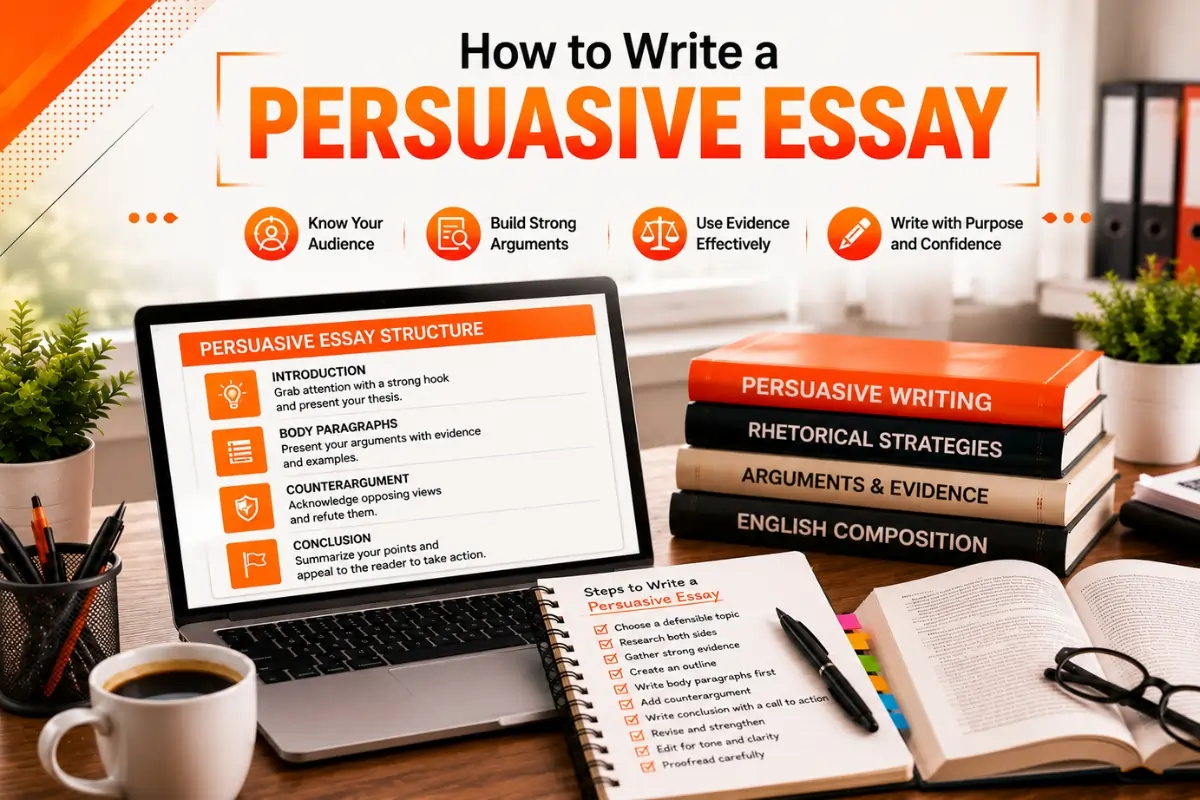
What Is a Persuasive Essay?
A persuasive essay is a type of essay that presents logical arguments combined with emotional appeal in order to convince readers to adopt a particular point of view or take a specific action. It begins with a writer forming their own strong opinion on a topic and then walking the reader through a carefully structured case for why that opinion is correct and why acting on it matters.
Persuasive writing is everywhere beyond the academic classroom. Political speeches, charitable campaigns, product advertising, journalistic opinion columns, legal briefs, and public health communications are all forms of persuasive writing. The ability to craft a persuasive argument is among the most transferable skills in education, used daily by lawyers, activists, executives, teachers, and anyone who has ever needed to change someone's mind.
What distinguishes a persuasive essay from a simple opinion piece is structure and evidence. Stating that you believe something is an opinion. Building a systematic, well evidenced case for why your reader should believe it too, that is persuasion. The essay must engage the reader's reason, move their emotions, and earn their trust simultaneously.
What Is the Foundation of Persuasive Writing?
More than 2,300 years ago, Aristotle identified three key ways to persuade an audience: Ethos (credibility), Pathos (emotion), and Logos (logic). These principles still form the foundation of effective persuasive writing today. Strong persuasive essays use all three. Rely too much on just one, and your argument can become unbalanced. Emotion without evidence feels manipulative, logic without emotion feels detached, and credibility without strong support lacks impact.
Ethos
The Appeal to Credibility
Ethos establishes why the reader should trust you. You build ethos by citing reputable sources, using precise and accurate language, demonstrating that you understand the complexity of the issue, and acknowledging limitations or opposing views honestly. It answers the silent reader's question: "Why should I listen to this person?"
In practice
"According to a 2025 peer reviewed study published in The Lancet, researchers confirmed that..." signals credibility through precise sourcing.
Pathos
The Appeal to Emotion
Pathos targets the reader's emotional response, creating empathy, urgency, hope, outrage, or compassion. It makes arguments memorable and personally meaningful. Used through vivid imagery, personal anecdotes, powerful narratives, and language that puts the reader inside the human reality of the issue.
In practice
"Imagine a child waking up in a hospital bed, breathing in recycled air, wondering if today is the day they run out of options..." creates immediate emotional presence.
Logos
The Appeal to Logic
Logos grounds the essay in reason, facts, and structured argument. It uses statistics, evidence, cause and effect reasoning, and historical precedent to show that your position is the most rational one. Without logos, a persuasive essay is sentimental but undefendable. Logos is what makes the argument survive scrutiny.
In practice
"Countries that implemented early screening programmes reduced late stage diagnoses by 40%, demonstrating that prevention is not only morally sound but economically rational."
Balance is everything. The most common persuasive essay failure is an overreliance on one appeal at the expense of the others. An essay built entirely on emotional anecdotes feels manipulative to a thoughtful reader. An essay built entirely on statistics feels like a research report, not a call to action. Weave all three appeals throughout your essay, let each reinforce the others.
Persuasive Essay Structure: A Complete Breakdown
A well structured persuasive essay guides the reader from initial engagement through the full force of your argument to a memorable, action oriented conclusion. The structure is not a rigid formula, it is a framework for strategic communication. Here is what each section must accomplish:
Introduction
~10%
Hook → Context → Thesis
Open with a powerful hook that commands attention. Provide brief context orienting the reader to the issue and why it matters. Close with your thesis, your specific, urgent position. The introduction sets the emotional and intellectual tone for everything that follows.
Body Para 1
Strongest point
Topic Sentence → Evidence → Rhetoric Appeal → Analysis
Lead with your most compelling argument. State the point clearly, back it with specific evidence, deploy the most appropriate rhetorical appeal (ethos, pathos, or logos), and explain explicitly how this supports your thesis. Each body paragraph argues exactly one main point.
Body Para 2–3
Supporting arguments
Additional arguments, vary your rhetorical appeals
Subsequent body paragraphs add new dimensions to the argument. Vary your rhetorical approach: if Body 1 used a logical appeal (logos), use an emotional story in Body 2 (pathos) and a credibility building expert citation in Body 3 (ethos). Variation keeps the reader engaged and makes the overall argument feel multidimensional.
Counterargument
Required
Acknowledge the Opposition → Concede What Is Fair → Overcome It
Present the strongest version of the opposing view fairly and honestly. Concede any merits, this builds trust and ethos. Then show why, despite these points, your position remains the stronger one. An essay that pretends opposing views don't exist is far less persuasive than one that confronts and defeats them.
Conclusion
~10%
Restate Thesis → Synthesise → Call to Action
Restate your thesis in fresh, stronger language, informed by all the evidence you've presented. Synthesise the key arguments into a unified final impression. Close with a call to action or a broader implication that lingers with the reader. The conclusion is your last chance to move them, use it.
The Persuasive Essay Writing Process: Step by Step
A persuasive essay is most effective when every stage of the writing process is approached strategically. Follow these steps to build a clear, compelling argument that resonates with readers and drives action.
Step 1: Understand the Prompt
Before writing a single word, read the prompt carefully. Identify what you are being asked to persuade someone of, the expected tone, format requirements, and word count. If you misread the prompt, no amount of good writing will save the essay.
Step 2: Know Your Audience
Ask yourself, who is reading this? What do they already believe? What values, fears, or motivations drive them? Persuasion only works when it speaks directly to the specific person you are trying to convince. A letter written for parents uses different examples than one written for policymakers, even on the same topic.
Step 3: Choose a Strong, Specific Topic
Pick a topic that is genuinely debatable, personally meaningful, and specific enough to argue within your word limit. Avoid topics that are too broad ("climate change") or too one sided. The best persuasive topics are those where you have a genuine, strong opinion, your conviction shows in every sentence.
Step 4: Research Both Sides
To persuade effectively, you must understand the opposition as well as your own position. Research what critics, skeptics, and opponents argue. This prepares you to refute counterarguments and strengthens your credibility with readers who are not already on your side.
Step 5: Gather Your Evidence
Collect the specific evidence that will power your argument, statistics, expert quotes, case studies, historical examples, and human stories. Record your sources accurately as you go. Strong persuasive essays use a variety of evidence types, not just facts or just anecdotes.
Step 6: Decide Your Rhetorical Balance
Before outlining, decide how you will deploy the three rhetorical appeals across your essay. Which argument calls for Logos (logic and data)? Where does Pathos (emotion and story) have the most impact? How will you establish Ethos (credibility) throughout? Planning this in advance prevents an essay that leans too heavily on one appeal.
Step 7: Write Your Thesis Statement
Craft a thesis that is specific, debatable, and urgent. Your thesis is not just a position, in a persuasive essay, it implies that something should be believed, changed, or done. It should be clear enough that your reader knows exactly what you are arguing from the very first paragraph.
Step 8: Choose Your Hook
Decide how you will open the essay. The six most effective persuasive hooks are: a striking statistic, a provocative question, a vivid anecdote, a bold statement, a powerful quote, or a scenario that places the reader inside the reality of your topic. Choose the hook that best matches your topic and audience.
Step 9: Build Your Outline
Map the full structure before you write a word of the draft:
Introduction: Hook → Context → Thesis
Body Paragraph 1: Strongest argument
Body Paragraph 2: Second argument (different rhetorical appeal)
Body Paragraph 3: Third argument (builds on the previous two)
Counterargument: Acknowledge → Concede where fair → Refute
Conclusion: Restate thesis → Synthesise → Call to action
Step 10: Write the Body Paragraphs First
Start drafting with the body paragraphs, not the introduction. Writing the body first clarifies your arguments and makes writing the introduction much easier. Each body paragraph follows four moves:
Topic sentence → Evidence → Rhetorical appeal → Link back to thesis.
Step 11: Write the Introduction
Now that you know exactly what your essay argues, write the introduction. Open with your chosen hook, provide the brief context the reader needs to understand the issue, and close with your thesis statement. The introduction should make the reader feel the urgency of what follows.
Step 12: Write the Counterargument Section
Present the strongest version of the opposing view honestly and fairly. Acknowledge any genuine merit in the opposing position, this builds trust. Then refute it clearly, showing why your position prevails despite the objection. Never distort or dismiss the counterargument, defeat it fairly.
Step 13: Write the Conclusion
Restate your thesis in fresh, stronger language, informed by all the evidence you have presented. Synthesise the key arguments into a unified final impression. Close with a specific, compelling call to action that gives your reader somewhere to go with their agreement.
Step 14: Revise for Persuasive Power
Read the full draft and ask after every paragraph: "Does this move my reader closer to my position?" Check that Ethos, Pathos, and Logos are balanced throughout. Strengthen weak arguments, sharpen the hook, and make sure the call to action is specific and emotionally compelling.
Step 15: Read Aloud
Persuasive writing has rhythm and momentum. Read the entire essay aloud and mark every place where you stumble, stall, or lose energy. Those are the passages your reader will feel too. Fix every rough patch before moving to the final edit.
Step 16: Edit for Tone and Style
Ensure the tone is confident, direct, and consistent throughout. Remove language that sounds uncertain ("I think," "maybe," "possibly"). Replace absolute overreaches ("everyone agrees," "it is obvious") with precise, defensible claims. Cut every word that does not advance your argument.
Step 17: Proofread
Check spelling, grammar, and punctuation carefully. Read slowly, your brain autocorrects familiar text at normal reading speed. Use a grammar checker as a support tool, not a substitute for careful reading.
Step 18: Check Citations and Formatting
Verify that every source is cited accurately in the required format. Confirm word count, font, spacing, margins, and any other submission requirements. A well argued essay submitted incorrectly loses marks it did not need to lose.
How Do You Choose a Strong Persuasive Essay Topic?
A powerful persuasive essay begins with the right topic, one that is genuinely debatable, genuinely important, and genuinely interesting to you. Trying to persuade someone of something you personally find boring is an uphill battle. Your conviction (or lack of it) bleeds through every sentence.
Strong persuasive essay topics tend to share three characteristics:
Genuine controversy: Thoughtful people disagree about it. If everyone already agrees, there is nothing to persuade.
Tangible impact: The issue affects real people in real ways. Readers are more easily moved when the stakes are human and visible.
Arguable specificity: "Technology" is not a persuasive topic. "Social media companies should be held legally liable for the mental health consequences of algorithmic content on users under 18" is.
Common persuasive essay domains include education policy, environmental ethics, criminal justice, healthcare access, technology regulation, social equality, economic policy, and media responsibility. Whatever the domain, the goal is to find an angle specific enough to argue compellingly, not so broad that your essay becomes a survey of existing opinions.
How Do You Write a Persuasive Thesis Statement?
Your thesis is the anchor of your persuasive essay, the clear, direct statement of what you are arguing and, often, why it matters or what should be done about it. A persuasive thesis goes one step further than an argumentative thesis: it does not just state a position, it often implies an urgency or a call to action.
Three things make a persuasive thesis strong:
it takes a clear, specific position;
it is genuinely debatable (someone could reasonably disagree);
and it carries moral or practical urgency that makes the reader feel why this matters beyond mere intellectual exercise.
✍️
Weak thesis: "Social media has both positive and negative effects on teenagers." This is a statement of obvious fact, not a position.
Strong thesis: "Social media platforms that use algorithmically driven content feeds should be legally prohibited from operating without verified parental consent for users under 16 because the documented mental health consequences represent a public health emergency that voluntary industry regulation has failed to address."
Notice how the strong thesis is specific, takes a clear side, explains the reason, and carries urgency.
How Do You Write a Hook That Captures Attention?
Your hook is the first sentence your reader encounters, and in persuasive writing, first impressions are decisive. A weak opening signals a weak argument before you've made one. A powerful hook establishes emotional connection, intellectual curiosity, or urgency that pulls the reader forward.
6 Techniques That Work
Striking Statistic
Lead with a number that shocks or reframes the reader's understanding of the issue's scale.
"Every 40 seconds, someone dies by suicide, that's more than 700,000 lives lost each year to a largely preventable cause."
Provocative Question
Ask a question the reader cannot easily answer or that challenges a comfortable assumption.
"If you knew that what your child was scrolling through right now would increase their risk of anxiety by 40%, would you hand them the phone anyway?"
Vivid Anecdote
A brief, specific human story that puts a face on the issue and creates immediate emotional investment.
"At 16, Maya was a straight A student. By 17, she hadn't left her bedroom in three months. The only thing that changed was her access to a smartphone."
Powerful Quote
An authoritative or unexpected quote that reframes the issue and lends immediate credibility.
"'We have created a monster,' admitted former Facebook vice president Chamath Palihapitiya. He helped build the platform, and he's kept his own children off it."
Bold Statement
Make a direct, confident declaration that takes an immediate position and dares the reader to disagree.
"Allowing social media companies to self regulate children's content is like asking tobacco companies to set their own advertising standards for schools."
Scenario / Imagine
Invite the reader to visualise a specific situation that makes the stakes of your argument immediate and personal.
"Imagine sitting in a doctor's office and being told your child's depression is directly linked to three years of algorithmically served content, and that it was entirely preventable."
How Do You Write Effective Persuasive Body Paragraphs?
Each body paragraph in a persuasive essay should advance exactly one argument in support of your thesis. The structure follows a reliable four part pattern, but unlike a purely analytical essay, persuasive body paragraphs also consciously choose which rhetorical appeal to activate at each moment.
The four moves of a persuasive body paragraph are:
Topic sentence: State the argument clearly and confidently, this is the one point this paragraph will prove.
Evidence: Provide a specific, credible piece of support, statistic, expert citation, case study, or illustrative example.
Rhetorical appeal: Amplify the evidence with the appropriate appeal. If the evidence is emotional, lean into the human stakes. If it's statistical, reinforce the logical implications. If it's an expert source, connect their authority to why the reader should trust the conclusion.
Link to thesis: Close by explicitly connecting this argument to your overall position. Do not assume the reader sees the connection, state it.
🔗
Use transitions as persuasive tools. Words like "more importantly," "consider the evidence," "what this reveals is," and "the implication is clear" don't just connect paragraphs, they guide the reader's interpretation of the evidence. Strategic transitions tell the reader not just what the next point is, but why it matters and how it builds on what came before. Transition words are the steel cables that hold your argument's bridge together.
How Can You Turn Counterarguments Into a Strength?
The counterargument section is where many persuasive essays lose their power, or dramatically gain it. Writers who skip counterarguments produce essays that feel one sided and naïve. Writers who handle them masterfully produce essays that feel intellectually honest, confident, and impossible to easily dismiss.
Addressing counterarguments does not weaken your position, it strengthens it. When you acknowledge the strongest objection to your thesis and refute it convincingly, you demonstrate that you have thought through the full complexity of the issue and that your position survives scrutiny. Readers who were leaning toward the opposing view feel heard, and are therefore more open to being persuaded.
The three move counterargument strategy works for persuasive essays as well as argumentative ones:
Acknowledge fairly: "Critics argue that..." or "Those opposed to this position contend that..." represent the opposing view clearly and without distortion.
Concede where genuine: If there is merit in the opposing view in certain contexts, acknowledge it honestly. This is an ethos move, it builds trust.
Override with your stronger argument: Show why, despite any partial validity, your position ultimately prevails, using evidence, logic, or a demonstration of the stakes.
🎯
Place your counterargument strategically. Most persuasive essays position the counterargument after the supporting body paragraphs and before the conclusion, meaning your strongest arguments land first, build momentum, and the counterargument becomes the final obstacle your thesis overcomes before the powerful closing. This structure ensures the reader's last substantive experience is watching your position triumph over opposition.
8 Persuasive Writing Tips That Actually Move Readers
Use these proven techniques to strengthen your persuasive writing.
1. Know your audience before you write a word
Persuasion is audience specific. A letter to parents about standardised testing uses different examples than an essay for policymakers on the same topic. Identify who you are writing for and tailor your appeals, examples, and tone accordingly.
2. Research both sides- argue one convincingly
To anticipate and refute objections, you need to understand them fully. Research the opposing view as seriously as your own. The best persuasive writers know the counterarguments better than their opponents do.
3. Be specific in every claim
Vague claims feel weak. "Many studies show" is less persuasive than "A 2025 study by the University of Oxford, published in Nature Human Behaviour, found that..." Specificity is credibility.
4. Let your passion show carefully
Unlike formal argumentative essays, persuasive writing benefits from authentic conviction. Readers feel disengagement. Let your genuine belief in your position come through, through word choice, urgency, and the examples you choose to highlight.
5. Use repetition and rhythm deliberately
The most memorable speeches use deliberate repetition ("Yes we can," "I have a dream"). In essay form, returning to your thesis language and key images throughout the piece creates structural resonance that stays with the reader.
6. End with a call to action
Unlike argumentative essays that conclude with synthesis, persuasive essays often close with a specific call to action. What should the reader think, feel, or do after reading your essay? Give them a clear next step or a powerful final image that stays with them.
7. Read your essay aloud before submitting
Persuasive writing has a rhythm, a cadence that moves the reader forward. Reading aloud reveals where the momentum stalls, where sentences feel clunky, and where an emotional beat lands flat. If it doesn't move you, it won't move your reader.
8. Revise for persuasion, not just correctness
After correcting grammar and structure, read once more asking: "Is every sentence advancing my case? Does every paragraph move the reader closer to my position?" Cut anything decorative that doesn't serve the argument.
Looking for ways to meet your assignment's required word count? Read Tips on How to Extend Essay Length for effective methods that enhance your essay rather than simply making it longer.
Common Persuasive Essay Mistakes
Even strong arguments can lose impact if these common errors are overlooked.
MISTAKE 01
Relying entirely on emotion
A persuasive essay that is all pathos and no logos feels manipulative rather than persuasive to an educated reader. Emotional appeals need the support of evidence and logic to be credible and lasting.
MISTAKE 02
A weak or vague thesis
"Social media is harmful" is not a persuasive thesis, it's a vague opinion. Your thesis must state exactly what you are arguing, why it matters, and ideally what should be done. Vagueness signals unclear thinking and produces an unfocused essay.
MISTAKE 03
Ignoring the counterargument
Readers who disagree with your position will notice immediately if you have not addressed their objections. Skipping counterarguments makes your essay feel incomplete and unconvincing to the very readers you most need to persuade.
MISTAKE 04
Using absolute language carelessly
"Everyone agrees," "It is obvious that," and "No one could argue against" are rhetorical overreaches that thoughtful readers immediately challenge. Qualify your claims accurately, "evidence strongly suggests" is more credible than "it is an undeniable fact."
MISTAKE 05
Losing sight of the audience
Persuasion only works when it speaks to the specific person you are trying to convince. An essay that argues to no particular reader, citing evidence, using examples, and making appeals that don't connect to who is actually reading, persuades no one.
MISTAKE 06
A conclusion that only summarises
Restating your arguments in the conclusion without amplifying them or landing a final emotional or logical punch is a missed opportunity. The conclusion should leave the reader feeling compelled, not just informed that the essay is over.
Many students ask, Is It Legal To Buy Essays Online? Our comprehensive guide explores the facts, common misconceptions, and important factors to consider before using a writing service.
Need a Professionally Written Persuasive Essay?
Every great persuasive essay starts with one thing: the genuine belief that your reader's mind can be changed. Trust that belief. Then give it the structure, evidence, and humanity it needs to succeed.
If you need extra support along the way, MyPremiumEssay is here to help. Whether you're facing a tight deadline or tackling a challenging topic, our expert academic writers can deliver custom, plagiarism free persuasive essays that are well researched, professionally structured, and ready to make an impact. If you're looking to buy essays online, MyPremiumEssay provides reliable academic assistance tailored to your needs.

 MyPremiumEssay