
Strong analysis transforms information into insight through critical thinking and evidence-based reasoning. In this guide, you'll learn everything you need to know about writing an analytical essay, including essay structure, thesis development, evidence integration, analytical techniques, common mistakes to avoid, and a step-by-step writing process. By the end, you'll have a clear framework for transforming observations into insights and ideas into compelling arguments.
What Is an Analytical Essay?
An analytical essay is a form of academic writing in which the author examines a subject, a text, an event, a concept, a work of art, a policy, or a dataset, and constructs an argument about it based on careful, evidence driven reasoning. The goal is not to summarise or describe the subject, but to interpret it: to identify patterns, reveal underlying mechanisms, evaluate claims, or expose the significance of details that are not immediately obvious.
Analytical essays are assigned across almost every academic discipline. In literature classes, students analyse how an author's stylistic choices create meaning. In history, students analyse the causes or consequences of events. In economics, students analyse market data and policy effects. In philosophy, students analyse arguments for logical validity. The subject changes, but the intellectual operation, the commitment to evidence based interpretation and rigorous reasoning, remains constant.
An analytical essay is not a report on what happened; it is a carefully reasoned argument about what it means, why it matters, and how it works.
What Are the Different Types of Analytical Essays?
Analytical essays take different forms depending on the subject matter and discipline. Knowing which type you are writing helps you focus your approach and choose the right analytical tools.
1. Literary Analysis
Examines how an author's craft, imagery, structure, tone, character, creates meaning in a text. The most common type in English and humanities courses.
2. Historical Analysis
Investigates the causes, context, or consequences of historical events. Considers competing interpretations, primary sources, and historiographical debates.
3. Rhetorical Analysis
Examines how a speaker or writer uses rhetorical strategies (ethos, pathos, logos, structure) to persuade an audience in a specific context.
4. Process Analysis
Breaks down a complex process or procedure, biological, mechanical, social, to explain how it works and why each step is necessary.
5. Causal Analysis
Explores the causes and effects of a phenomenon, why something happened or what its consequences have been. Common in social science and policy writing.
6. Comparative Analysis
Examines two or more subjects side by side to reveal similarities, differences, and what those patterns mean. Used across all disciplines.
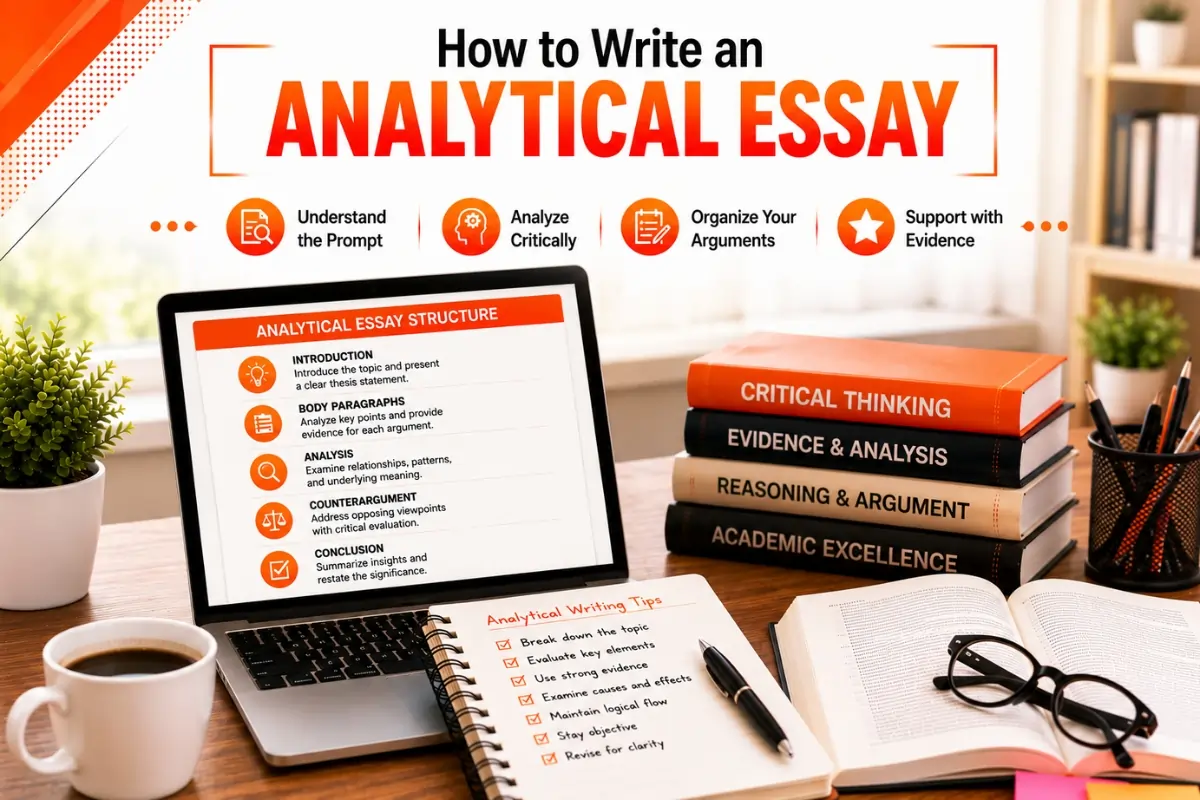
What Is Analysis Essay Structure?
The structure of an analytical essay follows the classic academic format, introduction, body, conclusion, but each section carries specific analytical responsibilities. Each section plays a key role in developing a strong, logical argument.
Introduction
Hook → Context → Thesis
Open with a compelling hook (a striking observation, a provocative question, or a key quotation from your subject). Provide the essential context your reader needs to understand the subject and the significance of your analysis. End with a clear, focused thesis statement that makes your interpretive claim explicit.
Body ¶ 1
First Analytical Point: Topic Sentence → Evidence → Analysis → Link
Each body paragraph supports one component of your overall thesis. Begin with a topic sentence that makes an analytical claim. Present your evidence. Analyse it in detail. Link back to the thesis.
Body ¶ 2–N
Subsequent Points: Building Cumulative Argument
Each body paragraph should build on the previous one. Use transitions that signal logical progression: "Furthermore," "However," "This pattern is complicated by," "Building on this," "Most significantly." Your body paragraphs should feel like steps in a chain of reasoning, not a collection of isolated observations.
Conclusion
Synthesis → Wider Significance → Final Insight
Do not simply summarise your body paragraphs. Synthesise your argument, show how your analytical points together establish something larger than each point alone. Then zoom out: what are the broader implications of your analysis? Why does this interpretation matter? End with a final insight that resonates beyond the boundaries of the essay itself.
The TEAL Paragraph Method
One of the most reliable frameworks for structuring individual analytical body paragraphs is the TEAL method: Topic Sentence → Evidence → Analysis → Link. The topic sentence states the analytical claim of the paragraph. The evidence provides textual, empirical, or historical support. The analysis unpacks the evidence; this is the most important and usually the most underdeveloped part of students' writing. The link returns to the thesis and, where appropriate, transitions to the next paragraph.
⚠ The Most Common Structural Problem
In most student analytical essays, the analysis section of each paragraph is too short. Students quote or describe their evidence and then move immediately to the next point, without spending adequate time explaining what the evidence means, how it works, and why it supports the thesis. As a rule, your analysis of each piece of evidence should be at least twice as long as the evidence itself.
Step-by-Step Writing Process
The following steps will guide you through the process of creating a focused and well-supported analytical essay.
1. Understand Your Assignment Fully
Before you read or research, read your assignment prompt carefully. What type of analysis is required? What is the word count and format? Are you expected to use secondary sources? Misunderstanding the task is the most avoidable cause of a weak grade. Annotate the prompt and identify the key analytical task (analyse, evaluate, compare, interpret, assess).
2. Read and Annotate Your Source(s)
Read your primary source actively, annotating, flagging patterns, noting moments of tension or significance. Do not simply read for plot or content; read for how the text works. For longer texts, a second, focused reading with your thesis question in mind is essential.
3. Generate a Working Thesis
Based on your reading, formulate a working thesis. At this stage it does not need to be final, but it needs to be specific enough to direct your research and writing. Ask: what is the most interesting interpretive claim I can make about this subject that the evidence can support?
4. Gather and Organise Evidence
Collect the specific pieces of evidence, quotations, data, examples, that best support your thesis. Organise them by the analytical point each supports. At this stage, also look for counterevidence: evidence that complicates or challenges your argument. Plan how you will address it.
5. Create a Detailed Outline
Map out your essay before you write. For each body paragraph, write the topic sentence (analytical claim), the evidence you will use, and a note on your analysis. A strong outline prevents the most common structural problems: underdeveloped paragraphs, illogical ordering, and repetition.
6. Write the First Draft
Write from your outline. Do not aim for perfection in the first draft, aim for completeness. Get your analytical argument down on paper. Focus particularly on the analysis sections of each body paragraph: resist the temptation to quote and move on. Explain. Interrogate. Push further than feels comfortable.
7. Refine Your Thesis
After completing your first draft, return to your thesis. Does it accurately reflect the argument your essay actually makes? Drafting often clarifies or changes your thinking. A thesis that perfectly captures your essay's argument is almost always written after the first draft, not before it.
8. Revise for Analytical Depth
In revision, identify every paragraph where the analysis section is underdeveloped. Ask each piece of evidence: What does this mean? How does it function? Why does this support my thesis? What is surprising, significant, or non obvious about this? Push your analysis deeper at every opportunity.
9. Edit for Clarity, Flow, and Academic Register
Polish your prose. Ensure your transitions create logical flow between paragraphs. Replace vague language with precise academic vocabulary. Vary your sentence structure. Ensure your conclusion synthesises rather than merely summarises.
10. Proofread and Cite
Check for grammatical errors, punctuation, and spelling. Verify that all citations are correctly formatted in the required style (MLA, APA, Chicago). Check that every quotation is accurately reproduced and properly attributed. A rigorously analytical essay weakened by careless errors loses credibility.
How Can You Use Evidence Effectively in an Analytical Essay?
Evidence is the raw material of analytical writing. Without it, your interpretive claims are merely opinions. With it, properly introduced, accurately cited, and rigorously analysed, your claims become arguments that a reader can evaluate, test, and be persuaded by. Knowing how to select and use evidence is one of the most critical skills in analytical essay writing.
Types of Evidence
The appropriate type of evidence depends on your discipline and essay type. In a literary analysis, evidence is typically direct quotation from the primary text, supported by secondary critical sources. In a historical analysis, evidence includes primary sources (documents, speeches, statistics) and scholarly secondary sources. In a scientific analysis, evidence is empirical data, experimental results, and peer reviewed literature. In all cases, evidence must be specific, credible, and directly relevant to the claim it supports.
The ICE Method for Evidence Integration
A reliable method for integrating evidence into analytical writing is the ICE method: Introduce → Cite → Explain. First, introduce the evidence by providing context, who said it, where it appears, or what situation it emerged from. Then cite it, present the actual evidence, whether that is a direct quotation, a statistic, or a specific event. Finally, and most critically, explain it: unpack what this evidence means, how it functions, and why it supports your analytical argument. Never drop evidence into a paragraph without explanation; unexplained evidence is useless evidence.
Example: Evidence Without and With Analysis
Weak
"Fitzgerald writes that Gatsby's parties 'glittered and gleamed.' This shows that Gatsby is wealthy."
Strong
"Fitzgerald's description of Gatsby's parties as places that 'glittered and gleamed' is significant not merely as an indicator of wealth, but as a deliberate choice of verbs that suggest artificiality, light produced by reflection rather than by any genuine source. Gatsby's world, this language implies, is a world of surfaces: dazzling, yes, but illuminated only by borrowed light. This aligns with Fitzgerald's central critique: that the American Dream, as Gatsby pursues it, is always a simulacrum, never the real thing."
Counterevidence and Concession
The strongest analytical essays acknowledge evidence that appears to challenge the thesis and then address it. Ignoring inconvenient evidence makes your argument seem selective and weak. Engaging with it and explaining why your interpretation remains more convincing despite it makes your argument seem rigorous and intellectually honest. A brief concession ("While it might be argued that... this view overlooks...") followed by a rebuttal significantly strengthens your analytical credibility.
What Are the Key Techniques of Analytical Writing?
Strong analytical essays rely on specific techniques that help writers examine evidence, develop arguments, and communicate insights effectively. The following techniques can help you build deeper analysis and stronger academic arguments.
Close Reading
In literary and rhetorical analysis, close reading is the foundational technique. It means attending with great care to the precise language of a text, not just what is said, but how it is said: the connotations of specific word choices, the effect of syntax, the implications of what is omitted or left unstated. Close reading resists the impulse to paraphrase and insists on staying with the actual words long enough to discover what they are doing.
Claim Evidence Reasoning (CER)
Across all disciplines, effective analytical writing operates through the Claim Evidence Reasoning structure. The claim is the analytical assertion. The evidence is the specific data, text, or observation that supports it. The reasoning is the logical bridge that explains how the evidence supports the claim and why this connection holds. Students most commonly shortchange the reasoning step, but it is the reasoning that constitutes the actual analysis.
Synthesis vs. Summary
A critical distinction in analytical writing is between summary and synthesis. Summary restates what your sources say. Synthesis weaves multiple sources or pieces of evidence together to reveal a pattern, a tension, or an insight that no single source expresses alone. Strong analytical essays synthesise; they bring evidence from multiple points in a text, or from multiple scholars, into productive dialogue to illuminate something larger. If you find yourself moving mechanically through your sources one at a time, you are probably summarising. Stop and look for the connections between them.
Hedging and Academic Precision
Analytical writing requires intellectual precision about the scope of your claims. Avoid sweeping assertions like "this proves that" or "clearly shows" unless the evidence is genuinely unambiguous. Use hedged but confident language: "this suggests," "this implies," "it is plausible that," "the evidence is consistent with." Hedging does not make your argument weaker; it makes it more accurate, and therefore more credible.
✓ Analytical Vocabulary to Build
For interpretation: implies, suggests, reveals, indicates, demonstrates, illustrates, reflects, underscores, reinforces
For structure: Furthermore, In contrast, This is complicated by, Building on this, Crucially, Most significantly, This pattern suggests
For evidence: As evidenced by, This is apparent in, Particularly notable is, A striking example appears in
To see analytical and persuasive writing techniques in action, explore Should Homework Be Banned?, where we discuss the potential benefits and drawbacks of homework assignments.
Common Mistakes to Avoid
Even strong arguments can lose their impact when these common analytical writing errors occur.
1. Summarising Instead of Analysing
The most widespread and damaging error in analytical essay writing is the substitution of summary for analysis. Summary tells your reader what the text says or what happened. Analysis tells your reader what it means, how it works, and why it matters. If your body paragraphs mostly paraphrase your source material, you are writing a report, not an analytical essay. At every paragraph, ask: "Am I just describing, or am I interpreting and arguing?"
2. A Thesis That Is Too Vague or Too Broad
Vague theses produce vague essays. "This essay will analyse the themes of power in Macbeth" is not a thesis; it is a topic description. Your thesis must make a specific interpretive claim that is arguable, falsifiable, and supported by the evidence in your essay. The more specific your thesis, the more focused and convincing your essay will be.
3. Letting Evidence Speak for Itself
No evidence speaks for itself. A quotation, a statistic, or an example only becomes analytical evidence when the writer explains its significance and connects it to the broader argument. Students frequently quote their sources and then move on, assuming the connection to the thesis is self-evident. It rarely is. Explain every piece of evidence as though your reader is intelligent but does not share your interpretation.
4. Ignoring Counterarguments
An analytical essay that acknowledges no complicating evidence or opposing interpretation appears intellectually immature. The best analytical writers engage with the strongest objections to their thesis and demonstrate why their interpretation remains more compelling. A single well managed concession and rebuttal dramatically improves the persuasive authority of an analytical essay.
5. Writing a Conclusion That Only Summarises
A conclusion that simply restates the body paragraphs adds nothing and leaves the reader with no sense of why the analysis matters. Your conclusion should synthesise your argument, show how the analytical points combine to prove something larger, and then address the broader significance. Why should someone who has never encountered this text, event, or subject care about your analysis? The conclusion is where you answer that question.
6. Weak or Vague Transitions
Analytical arguments are only as strong as the logical connections between their parts. Weak transitions such as "Another point is...", "Also...", and "In addition..." suggest that your body paragraphs are a list of separate observations, not a coherent chain of reasoning. Use transitions that signal the logical relationship between your points: contrast, causation, elaboration, qualification, or culmination.
Students seeking academic support can learn more by reading Can I Buy Essays Online, a comprehensive guide covering quality, originality, confidentiality, and the ordering process.
Transform Analysis into Academic Excellence with MyPremiumEssay
A strong analytical essay does more than examine a subject. It uncovers deeper meanings, challenges assumptions, and presents evidence-based insights that demonstrate critical thinking and academic rigor.
The key to successful analytical writing is curiosity. Ask questions, explore patterns, evaluate evidence, and look beyond the obvious. The more deeply you engage with your subject, the stronger and more compelling your analysis will become.
If you need expert guidance at any stage of the writing process, MyPremiumEssay is here to help. Our academic specialists can help you craft analytical essays that are clear, persuasive, and built for success. Students seeking comprehensive academic writing support can also Buy Essays Online through MyPremiumEssay and receive professionally written, customized papers tailored to their academic needs and deadlines.

 MyPremiumEssay