
Every strong piece of writing depends on strong body paragraphs. This is where you develop your ideas, present evidence, and build your argument. Yet many writers struggle with paragraphs that are either underdeveloped, unfocused, or disconnected from the main point.
This guide walks through each element of PEEL in depth, a full worked example, common mistakes to avoid, transitions between paragraphs, and how the method adapts across academic, persuasive, and blog writing.
What Is a Body Paragraph?
Before diving into structure and technique, it helps to define what a body paragraph actually is and what job it performs in a piece of writing.
A body paragraph is any paragraph that appears between the introduction and the conclusion of an essay, article, or report. Its job is to develop, support, and expand on the thesis or central argument of the piece. Each body paragraph focuses on one main idea, and together, the body paragraphs form the backbone of your argument.
Think of your essay like a building. The thesis statement is the foundation. The conclusion is the roof. The body paragraphs are the walls. They provide structure, support, and substance. Without strong walls, no building can stand.
A typical body paragraph contains three to six sentences, though this can vary depending on the complexity of the point being made. What matters is not the length but the completeness: every body paragraph should introduce its idea, develop it with evidence, explain the evidence, and tie it back to the larger argument.
The PEEL Paragraph Method: An Overview
The PEEL paragraph method is one of the most widely used frameworks for teaching and writing structured body paragraphs. It is popular in schools, universities, and professional writing because it provides a clear, logical sequence that ensures no important element is missed.
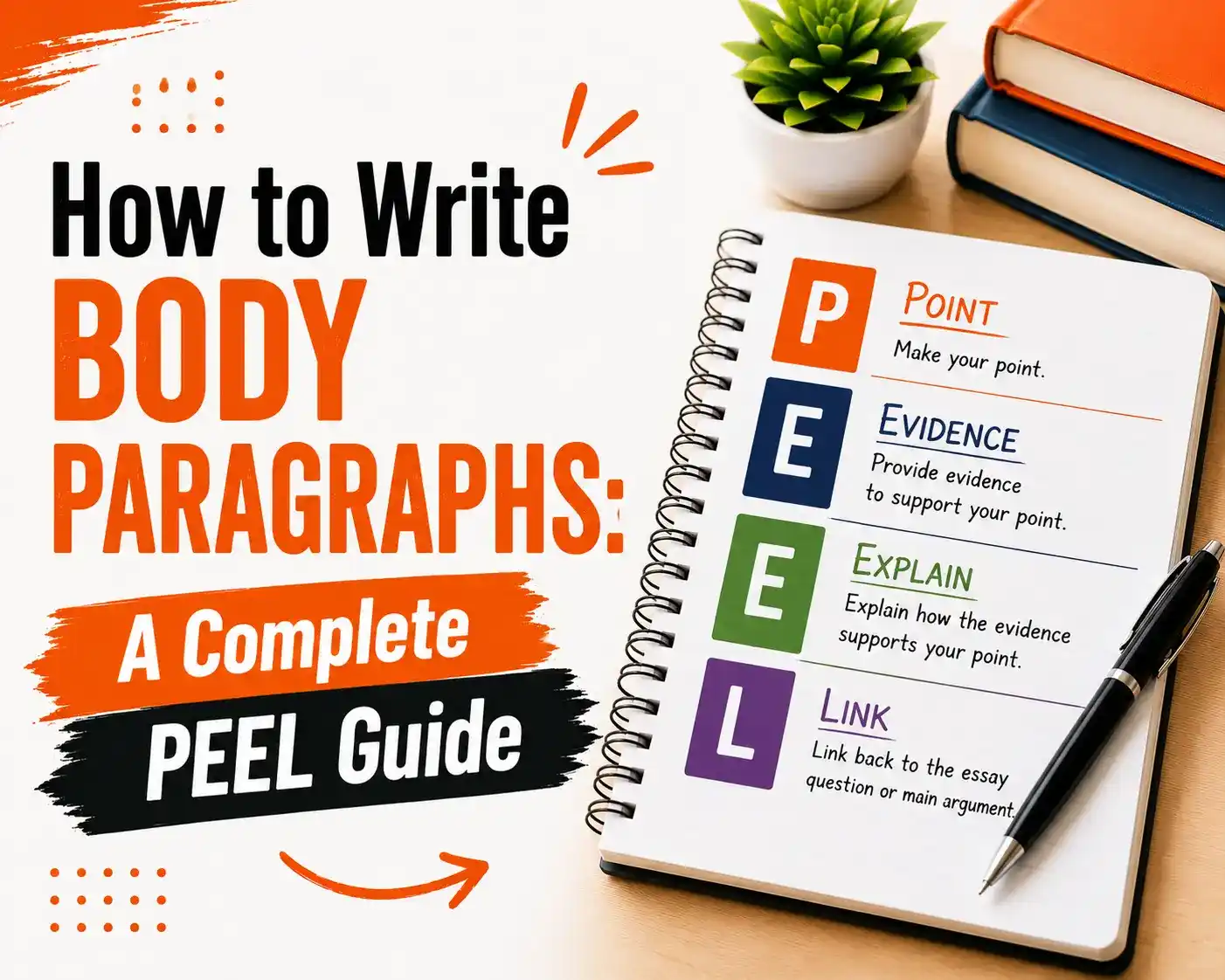
PEEL stands for:
- P — Point
- E — Evidence
- E — Explanation
- L — Link
Each letter represents a distinct component of the paragraph, and each component plays a specific role in building a complete, convincing argument. Let us explore each element in depth.
How the PEEL Paragraph Structure Works
The PEEL method provides a simple framework for developing clear, focused, and persuasive body paragraphs.
P — Point: Your Topic Sentence
The Point is the opening sentence of your body paragraph, also known as the topic sentence. This is the most important sentence in the paragraph because it tells the reader exactly what the paragraph is about.
A strong topic sentence does three things simultaneously. First, it identifies the main idea of the paragraph. Second, it connects that idea to your overall thesis or argument. Third, it signals to the reader what kind of evidence and explanation will follow.
A weak topic sentence: "Social media has a lot of effects on teenagers."
A strong topic sentence: "Excessive social media use significantly undermines the mental health of teenagers by fostering unrealistic social comparisons and reducing face-to-face interaction."
Notice the difference. The strong version is specific, argumentative, and tells the reader precisely what the paragraph will argue and why. It does not just state a topic. It takes a clear position on that topic.
Tips for writing strong topic sentences:
- Avoid starting with broad, vague statements like "There are many reasons why..."
- Do not start with a quotation or evidence. That comes later.
- Keep it focused: one paragraph, one main idea
- Make sure it directly supports your thesis statement
- Use assertive language that signals an argument, not just a description
E — Evidence: Supporting Your Point
Once you have established the point, you need to support it. This is the first "E" in PEEL, and it refers to the evidence you bring in to back up your topic sentence.
Evidence can take many forms depending on the type of writing you are doing. In academic writing, evidence often includes statistics, research findings, quotations from experts, historical facts, or case studies. In persuasive writing, it might include examples, analogies, or documented events. In literary analysis, it typically means quotations from the text being analyzed.
Types of evidence you can use:
- Direct quotations from experts or source texts
- Statistics and data from credible studies
- Real-world examples and case studies
- Historical events or documented facts
- Personal anecdotes (appropriate in some writing styles)
- Survey results or findings from reputable organizations
How to introduce evidence effectively:
Never dump evidence into a paragraph without introduction. Use a signal phrase to smoothly incorporate it. For example:
- "According to a 2023 study published in the Journal of Adolescent Health..."
- "As researcher Dr. Jane Morrison argues..."
- "Data from the World Health Organization confirms that..."
- "A striking example of this can be found in..."
Signal phrases do two things: they give credibility to the evidence, and they make the transition from your own argument to outside support feel natural and authoritative.
A common mistake to avoid: Do not use multiple pieces of evidence one after another without explanation in between. One strong, well-explained piece of evidence is almost always more effective than three pieces thrown together with no analysis.
E — Explanation: Analyzing Your Evidence
This is the most critical and most commonly neglected part of a body paragraph. The second "E" in PEEL stands for Explanation, and this is where you analyze and interpret the evidence you have just presented.
Many student writers and even experienced writers make the mistake of presenting evidence and then simply moving on, as though the evidence speaks for itself. It almost never does. The reader needs you to explain what the evidence means, why it matters, and how it supports the point you made in your topic sentence.
This is where your thinking becomes visible. The explanation section is your opportunity to demonstrate that you understand the material at a deep level, not just that you found a relevant fact or quotation.
Ask yourself these questions when writing your explanation:
- What does this evidence prove or demonstrate?
- How does this evidence connect to the point I made in my topic sentence?
- What does this tell us about the wider issue or argument?
- Why is this evidence significant?
- What would happen if this evidence were absent?
An example of weak explanation:
"According to the Pew Research Center, 45% of teenagers report feeling overwhelmed by social media. This shows social media is bad for teenagers."
An example of strong explanation:
"According to the Pew Research Center, 45% of teenagers report feeling overwhelmed by social media. This suggests that the pressure created by these platforms is not an isolated issue but a widespread experience. Features such as infinite scrolling, public metrics like likes and follower counts, and algorithms designed to maximize engagement can contribute to increased stress and anxiety among young users."
The strong explanation does not just say "this shows social media is bad." It unpacks the evidence, explores the implications, and demonstrates analytical thinking. This is what separates average writing from excellent writing.
L — Link: Connecting Back to the Bigger Picture
The final element of the PEEL paragraph method is the Link. This is the closing sentence (or occasionally two sentences) of your paragraph, and its purpose is to tie your paragraph back to the thesis statement or the broader argument of the essay.
The Link performs two functions simultaneously. It signals to the reader that this paragraph is drawing to a close, and it reinforces the relevance of everything you have just argued to the overall point of your piece. Think of it as a mini-conclusion for each individual paragraph.
A strong link does more than simply restate the topic sentence. It synthesizes the point, evidence, and explanation together and shows why this paragraph matters in the grand scheme of your argument.
Weak link: "Therefore, social media is clearly harmful to teenagers."
Strong link: "The overwhelming sense of pressure experienced by nearly half of all teenagers, driven by the deliberately anxiety inducing architecture of social media platforms, makes it evident that the mental health crisis among young people cannot be addressed without directly confronting the structural design of the platforms themselves, a conclusion that demands urgent policy intervention and greater corporate accountability."
A strong link elevates your paragraph from a self-contained unit into a piece of a larger, compelling argument.
A Full PEEL Paragraph Example
Here is a complete body paragraph using the PEEL method, written on the topic of renewable energy:
Point: The widespread adoption of solar energy represents the most cost-effective long-term solution to reducing global carbon emissions in the electricity sector.
Evidence: According to the International Renewable Energy Agency (IRENA), the cost of solar photovoltaic electricity fell by 89% between 2010 and 2022, making solar power cheaper than fossil fuel electricity generation in most regions of the world for the first time in history.
Explanation: This dramatic reduction in cost fundamentally changes the economic calculus of energy policy. For decades, the primary argument against transitioning to renewable energy was that it was prohibitively expensive compared to coal, gas, and oil. Now that solar power has not only reached cost parity but surpassed fossil fuels in affordability, governments and corporations no longer face a financial trade off between environmental responsibility and economic efficiency. Instead, investing in solar energy is simultaneously the environmentally sound choice and the fiscally rational one, a convergence that removes one of the most persistent barriers to the global energy transition. Furthermore, as manufacturing scales continue to improve and battery storage technology matures, these costs are projected to decline even further, reinforcing solar energy's position as a leading energy source of the 21st century.
Link: The collapse of solar energy's cost barrier, once considered the greatest obstacle to its widespread adoption, signals that the global energy transition is no longer a question of economic feasibility but one of political will and strategic investment, making the case for aggressive solar policy more compelling than ever before.
Common Mistakes to Avoid When Writing Body Paragraphs
Even with a clear framework like the PEEL method, writers can still fall into predictable traps. Here are the most common mistakes and how to avoid them:
1. Starting a Paragraph With Evidence Instead of a Topic Sentence
Your reader needs orientation before they receive information. Always lead with your point.
2. Writing One-Sentence Paragraphs
A single sentence cannot constitute a fully developed argument. Every body paragraph needs a point, evidence, explanation, and a link to be complete.
3. Forgetting the Explanation
Many writers present evidence and assume the connection is obvious. It rarely is. Always explain what the evidence means and why it matters.
4. Going Off-Topic Within a Paragraph
Each paragraph must remain focused on its single main idea. If you find yourself moving in a new direction, start a new paragraph.
5. Weak or Missing Transitions
Body paragraphs should not feel like isolated islands. Use transitional phrases to connect paragraphs to each other and to the thesis.
6. Overloading a Paragraph With Too Much Evidence
One well-explained piece of evidence is stronger than five unexplained ones. Quality always trumps quantity.
How to Transition Smoothly Between Body Paragraphs
Strong essays do more than present good ideas. They connect those ideas in a way that feels natural and easy to follow. This is where transitions between body paragraphs become important. Transitions act like bridges, helping readers move smoothly from one point to the next without feeling lost or confused.
There are several ways to create effective transitions. One of the simplest is to use transition words and phrases such as "Furthermore," "In addition," "However," "On the other hand," or "By contrast." These signal how the new paragraph relates to the previous one. Another approach is to briefly refer to the point you just discussed before introducing the next idea. This helps create a clear connection between paragraphs. When presenting an opposing viewpoint or a different perspective, you can use a transition that highlights the shift in direction.
The goal is to ensure that your essay flows logically from one paragraph to the next. Readers should feel guided through a clear, connected argument rather than moving between unrelated ideas.
Adapting PEEL for Different Writing Contexts
While the PEEL paragraph method was originally developed for academic essay writing, it is flexible enough to be adapted across many different writing contexts.
In blog writing, the Point becomes your subheading or the opening claim of a section. The evidence might be an anecdote, a statistic, or an expert opinion. The Explanation is your analysis or commentary. The Link often transitions the reader to the next section.
In persuasive writing, the Point is your argument, the Evidence is your proof, the Explanation is where you connect the proof to your argument emotionally and logically, and the Link reinforces the call to action.
In report writing, the PEEL structure maps neatly onto professional writing conventions, with findings, data, analysis, and recommendations following the same logical sequence.
The underlying logic of PEEL, claim, support, analysis, and synthesis, is universally applicable because it mirrors the way human reasoning actually works.
Applying PEEL consistently naturally develops your paragraphs further, which also helps if you're trying to hit a word count without padding. For more strategies on this, read Phrases To Make Your Essay Longer.
Advanced Tips for Stronger Body Paragraphs
Once you have a solid grip on the basic PEEL structure, here are some advanced techniques to elevate your body paragraphs to the next level:
Vary Your Sentence Length
Short sentences create emphasis. Longer sentences allow you to develop complex ideas with the nuance they deserve. A mix of both creates rhythm and keeps reading engaging.
Use Hedging Language Appropriately
In academic writing especially, avoid absolute claims unless they are fully supported. Phrases like "suggests," "indicates," "points to," and "provides evidence for" demonstrate intellectual precision.
Acknowledge Counterarguments
The strongest arguments anticipate objections. A brief acknowledgment of an opposing view, followed by a well-reasoned rebuttal, significantly strengthens your credibility.
Use Precise, Specific Language
Vague language weakens arguments. Replace "many people think" with "research consistently demonstrates." Replace "a lot of harm" with "measurably higher rates of depression and anxiety."
Applying these techniques effectively takes time, practice, and careful attention to detail. If you're working under a tight deadline or need professional support, check out Can I Buy Essays Online? for a detailed overview of your options.
Reach Your Academic Goals with MyPremiumEssay
Strong body paragraphs are the foundation of effective writing. Strong writing is built on a simple principle: make a clear point, support it with credible evidence, explain why it matters, and show how it contributes to your overall argument.
The PEEL method provides a simple and reliable framework for doing exactly that. By following the structure of Point, Evidence, Explanation, and Link, you can create paragraphs that are focused, organized, and persuasive.
With practice, writing strong body paragraphs becomes much easier. Start with one paragraph at a time, follow the PEEL structure, and focus on developing your ideas clearly. Over time, these small improvements will make a significant difference in the quality of your writing.
If you find yourself struggling with essay structure, evidence integration, or paragraph development, you do not have to tackle it alone. At MyPremiumEssay, our experienced academic writers and editors provide personalized support to help students create well researched, logically organized, and academically strong papers. Whether you need expert guidance or want to buy essays online, our team is here to help you achieve your academic goals with confidence.

 MyPremiumEssay