
Dialogue works best in narrative, personal, reflective, and admissions essays, where it helps show a scene or a moment. It does not belong in argumentative or expository essays, which need evidence and quoted sources instead of made-up conversation. And if you are quoting speech from a book or play rather than writing your own, you follow your citation style, such as MLA or APA, not the narrative rules.
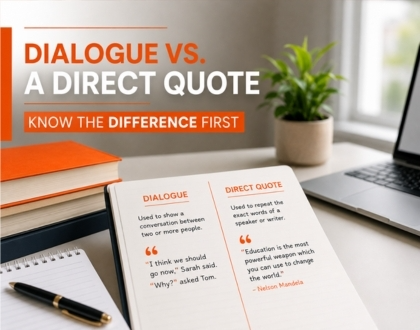
Dialogue vs. a Direct Quote: Know the Difference First
This is the mix-up that costs students the most marks, so it's worth clearing up before anything else.
Dialogue is a conversation between people, written as part of a story. You use it in narrative and personal writing to bring a scene to life. It might be something you remember happening, or something you're recreating from memory.
A direct quote is someone's exact words taken from a source, like a book or an article, used to back up a point.
The easiest way to tell them apart is to ask what the words are doing. If they build a scene, it's dialogue. If they prove a point, it's a quote.
Look at these two lines:
My coach pulled me aside and said, "You're not running for the medal. You're running for the person next to you."
That's dialogue. It shows a moment.
According to Dr. Lee, "sleep loss affects memory more than most students realize."
That's a quote. It supports an argument. The two look almost the same on the page, but they do very different jobs.
The two kinds of essay dialogue
Even after you know it's dialogue, there are still two versions of the job:
- Writing your own dialogue, when you're telling a story and the characters speak. This is what most people mean.
- Quoting dialogue from a text, when you're analyzing a novel or play and need to quote a character as evidence.
These two follow different formatting rules. We'll cover writing your own first, then come back to quoting from a text later on.
When Should You Use Dialogue in an Essay?
Dialogue fits some essays and works against others. Check what kind of essay you're writing before you add a single line.
Narrative and personal essays. This is where dialogue belongs. A few lines of speech at the right moment can show character or build tension better than a long description. You don't need much. One or two short exchanges usually beat a full conversation.
Reflective essays. Use it, but lightly. Reflective writing is mostly you thinking on the page. A short line of speech works as an example of something that stuck with you. Say it, then get back to the reflection.
College and admissions essays. A line of dialogue makes a strong opening and shows your voice. Just keep it real. Admissions readers can tell when a scene has been invented to sound good.
Literary analysis essays. Any speech you include here is a quote from the text, cited properly. That's a different skill, covered further down.
Argumentative and expository essays. This is where students slip up. In an essay built on a claim, made-up dialogue makes you look weaker, not stronger. If you need to reference what someone said, quote them as a source instead:
Weak: My friend told me, "Recycling doesn't even work."
Better: Critics argue that current recycling systems recover far less material than people assume.
A simple rule: if your essay makes a claim, use quotes and evidence. If your essay tells a story, use dialogue.
How to Write Dialogue in an Essay: Step by Step
Once you know dialogue fits, here's how to add it.
1. Set the scene first. Give a little context before anyone speaks. Where are they? Who's there? One line of setup keeps the dialogue grounded.
2. Write only what's worth saying. Skip the hellos and the small talk. Start where the real moment begins. Every line should reveal something or push the scene forward.
3. Start a new paragraph for each speaker. When someone new talks, drop to a new line. This is how readers keep track of who's speaking.
4. Add a tag when you need one. Words like he said or she asked show who spoke. You don't need one on every line. If it's already clear, leave it out.
5. Read it out loud. This is the fastest way to catch lines that sound fake. If you trip over it, so will your reader.
Here's a short example that follows those steps:
The hallway was empty except for the two of us. I held the failed test against my chest so no one could see the red ink.
"You can retake it, you know," Maria said.
"That's not the point." I didn't look up. "I studied for a week."
She shrugged. "Then you'll study for two."
There's no small talk, each speaker gets a new line, and not every line needs a tag.
Dialogue Punctuation Rules (With Examples)
Good punctuation is what makes dialogue look clean instead of confusing. These examples use U.S. English with double quotation marks. If your school uses British English, single marks are fine. Just pick one and use it through the whole essay.
Spoken words go inside quotation marks.
"I'll be there by six," she said.
Commas and periods go inside the closing mark.
Correct: "Let's go home," he said.
Wrong: "Let's go home", he said.
When a tag follows, use a comma, not a period.
"I already finished it," she replied.
Question marks and exclamation points stay inside if they belong to the speech.
"Are you serious?" he asked.
"Watch out!" she yelled.
After a question mark or exclamation point, the tag starts with a small letter. It's still part of the same sentence.
Correct: "Where are you going?" she asked.
Wrong: "Where are you going?" She asked.
When the tag comes first, put the comma before the quote.
He turned around and said, "I forgot my keys."
Use single quotation marks for a quote inside dialogue.
"Did she really say, 'I quit'?" he asked.
Start a new paragraph for each speaker. Even a one-word reply gets its own line.
Use an em dash for an interruption and dots for a line that trails off.
"But I thought you—"
"I know what you thought," she cut in.
"I guess this is goodbye..."
If you remember only two rules, make them punctuation inside the quotes and a new paragraph for each speaker. Those two fix most mistakes.
How to Quote Dialogue From a Book or Play
If your essay analyzes a text, you're quoting the author's words as evidence, so citation matters.
Short prose dialogue. Put it in quotation marks and add the page number.
When Gatsby says, "Can't repeat the past? Why of course you can!" he shows how trapped he is by what came before (Fitzgerald 110).
Longer quotes. In MLA, once a quote runs about four lines or more, set it off as a block quote. Indent it, drop the quotation marks, and put the citation after the final punctuation.
Quoting a play. Use the character names in capitals the way the script shows them, and cite act, scene, and line numbers instead of a page.
When a character quotes someone else. Keep the character's words in double quotes and the person they quote in single quotes.
The main thing to remember: when you quote a text, follow your citation style, not the narrative rules above. Check whether your instructor wants MLA, APA, or Chicago, since the details change between them.
When NOT to Use Dialogue
Dialogue is a tool, not decoration. Cut it when:
- It's just filler. Greetings, weather talk, and um and uh add nothing.
- It's padding the word count. Graders notice when a page of back-and-forth is really a few sentences stretched thin.
- Your essay is an argument. Made-up conversation weakens a claim-based essay.
- It takes over. If the dialogue runs so long that the point of the essay disappears, you've drifted into a short story.
A quick test: delete a line of dialogue and see if anything is lost. If nothing is, it wasn't pulling its weight.
Common Dialogue Mistakes (and How to Fix Them)
1. Writing out every word people say. Real speech is messy and slow on the page. Fix: keep only the lines that matter.
2. Using names too often. People rarely say each other's names mid-conversation.
Wrong: "Well, Sarah, I think, Sarah, that you're right."
Fix: drop the names unless someone is getting attention or making a point.
3. Punctuation outside the quotes.
Wrong: "I'm tired". Fix: "I'm tired."
4. Fancy tags on every line. He exclaimed, she declared, he proclaimed. These pull readers out of the scene. Fix: said and asked are almost invisible, so use them most of the time.
5. Adverbs stuffed into tags.
Weak: "Get out," she said angrily.
Fix: let the words and the action carry the feeling: "Get out." She didn't look up.
6. Mixing single and double quotes. Pick one and stay with it through the whole essay.
7. Treating dialogue like evidence. Made-up conversation can't do the job of a real source. Know which one your essay needs.
A Few Tips That Take Dialogue From Fine to Good
Let a line say more than it says. The best dialogue carries a second meaning underneath. "I'm fine" can mean the opposite when the reader already knows what's going on. You don't have to spell everything out.
Give people their own way of talking. A nervous character speaks in short, broken sentences. A calm one takes their time. Small differences make people feel real.
Cut the hellos and goodbyes. Start where the interesting part begins. Readers assume the greeting already happened.
Read it aloud every time. It's the single most useful habit. Your ear catches what your eye misses.
Quick Checklist Before You Submit
- Does this essay type actually call for dialogue?
- Am I writing my own dialogue or quoting a source, and did I format it the right way?
- New paragraph for each speaker?
- Punctuation inside the quotation marks?
- Cut the small talk and filler?
- Used said and asked instead of fancy tags?
- Read it out loud at least once?
Tick all of those and your dialogue is doing its job.
Frequently Asked Questions
How do you write dialogue in an essay?
Put the spoken words in quotation marks, start a new paragraph each time a different person speaks, and keep the punctuation inside the quotes. Set the scene briefly, cut the small talk, and use simple tags like said and asked.
How do you format dialogue in a narrative essay?
Each speaker gets their own paragraph. Wrap their words in quotation marks, add a tag only when it's needed for clarity, and keep commas, periods, and question marks inside the closing quote.
What's the difference between dialogue and a quotation?
Dialogue is conversation used to build a scene in a story. A quotation is someone's exact words from a source, used to support a point. Same quotation marks, different jobs.
Can you use dialogue in an argumentative essay?
Usually not. Argumentative essays need evidence, so it's better to quote experts or sources than to add made-up conversation. Save dialogue for narrative and personal writing.
How do you quote dialogue from a book in MLA?
Put short quotes in quotation marks with the page number in parentheses. For longer passages, use an indented block quote with no quotation marks. For plays, use the character names in capitals and cite act, scene, and line numbers.
Do periods go inside or outside quotation marks in dialogue?
In U.S. English, periods and commas always go inside the closing quotation mark.
Is it okay to make up dialogue in a personal essay?
You can recreate a conversation from memory, since no one records real life word for word. Keep it honest to what actually happened, and don't invent scenes just for effect, especially in admissions essays, where it tends to show.

 MyPremiumEssay