
The first framework, from Common Core, names argument, informative, and narrative essays. The second, drawn from classical rhetoric, lists narrative, expository, and persuasive essays instead.
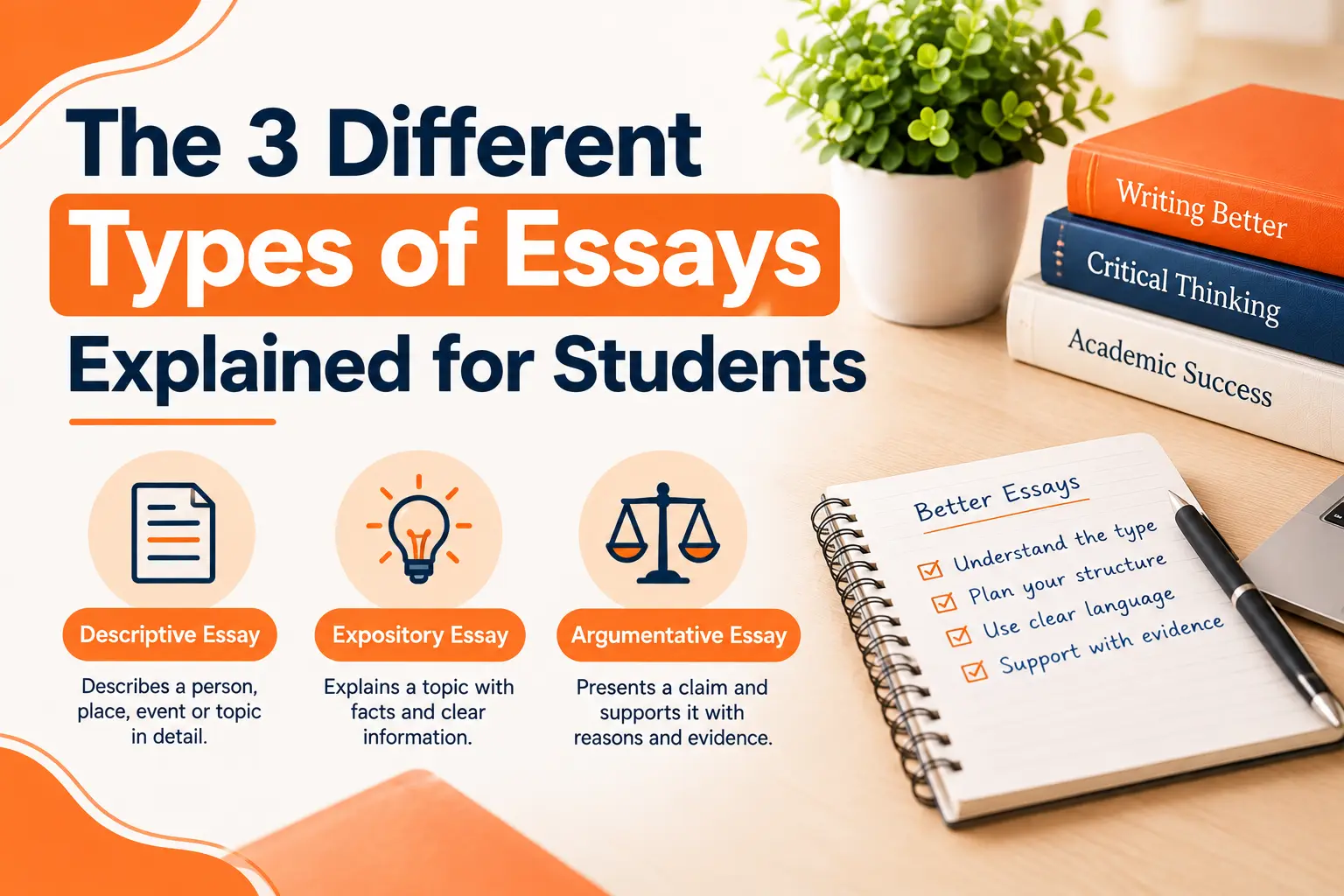
Why the Number of Essay Types Keeps Changing
Search this topic online and you will find guides listing four, seven, or fifteen essay types. The shorter and longer versions can both be defended with reasonable logic.
Some writers split expository essays into subtypes such as compare-and-contrast, cause-and-effect, and process. Counting each one on its own is how a list stretches to seven or more entries.
Others treat descriptive writing as a separate category, which pushes the total to four. The three-type frameworks leave it out because description usually works as a technique inside other essays.
For students, the honest answer is to follow whichever framework your teacher uses. The rest is a debate between writing scholars that will not affect your grade.
Framework One: The Common Core Three Text Types
The Common Core State Standards outline three writing types under anchor standards W.1 through W.3. Most American public schools have used this model for well over a decade.
Argument Essays
An argument essay takes a defensible stance on a debatable topic. You back that stance with reasoning and evidence drawn from trustworthy sources.
The essential parts include a sharp thesis, cited evidence, and honest treatment of counterclaims. Each source you bring in should connect directly back to your main point.
Sample prompt: Should high schools begin the school day later in the morning? Defend your position using two of the provided sources.
Graders reward a specific arguable thesis and evidence that genuinely supports it. They also want at least one opposing view addressed with fairness rather than dismissal.
Informative or Explanatory Essays
An informative essay delivers accurate information about a topic without arguing a side. You act as a guide for the reader, not an advocate for any position.
The essential parts include clear organization, precise definitions, useful facts, and a neutral tone. Your job is to teach, not to convince anyone of a viewpoint.
Sample prompt: Explain the process by which a bill becomes law in the United States.
Graders look for accurate details, logical flow, and no personal opinions creeping in. Common structures include chronological order, categories, or a step-by-step breakdown.
Narrative Essays
A narrative essay tells a real or imagined story built around a clear sequence of events. Meaningful detail is what makes the moment come alive on the page.
Strong narratives use setting, characters, sensory description, and a reason for telling the story. That final piece is what most students forget, and their grades suffer for it.
Sample prompt: Write about a time you faced a hard decision and describe what you learned.
Graders reward vivid detail, a coherent sequence, and a clear takeaway. Without a point behind it, the story feels more like a journal entry than an essay.
Framework Two: The Classical Triad
This older framework comes from classical rhetoric and continues to appear in many places. You will still see it in college composition courses, ESL programs, and older writing textbooks.
Narrative
The narrative essay here works the same way as in the Common Core version. It tells a story to reveal a lesson, an insight, or an emotional truth.
Expository
An expository essay explains, describes, or informs on a chosen subject. Subtypes include definition, compare-and-contrast, cause-and-effect, and process essays.
The Common Core informative type is essentially the modern name for expository writing. The work behind it is the same, but the label was updated for newer standards.
Persuasive
A persuasive essay works to move the reader toward a position or an action. It tries to change minds, shape opinions, or nudge readers into making a specific choice.
The distinction most people miss matters here. Persuasive writing may use emotional appeal and personal credibility alongside straight facts and hard evidence.
Comparing the Three Types Side by Side
| Feature | Narrative | Expository or Informative | Persuasive or Argument |
|---|---|---|---|
| Purpose | Tell a meaningful story | Explain a topic clearly | Convince the reader |
| Voice | Usually first person | Third person, neutral | Third person, sometimes first |
| Thesis | Implicit theme | Focus statement | Explicit arguable claim |
| Evidence | Sensory detail, dialogue | Facts and definitions | Facts, reasoning, counterclaim |
| Structure | Chronological with a turn | Logical or by category | Claim, evidence, rebuttal |
| Tone | Personal and reflective | Objective and informative | Confident and measured |
If you are short on time or juggling several assignments, some students choose to buy essay help from professional writers who understand these frameworks well. Just make sure any support you use fits your school's academic honesty policy.
Decoding the Prompt to Pick the Right Type
Prompt wording is the biggest clue you have. Circle the main verbs in your assignment before you sit down to plan your essay.
| If the prompt says… | It is asking for… |
|---|---|
| Describe a time, tell about, recount | Narrative |
| Explain, define, describe how, illustrate | Expository or Informative |
| Argue, defend, take a position, justify | Argument |
| Convince, persuade, why should | Persuasive |
| Compare and contrast, analyze the causes | Expository subtype |
When a prompt uses two of these verbs, the dominant one wins. Still, work the second verb into your structure or approach somewhere along the way.
The Real Difference Between Argumentative and Persuasive
Most short guides get this distinction completely wrong. Understanding it properly will push your grade higher on nearly any writing assignment.
An argumentative essay proves a claim through solid evidence. It cites sources, engages the opposing view with respect, and depends mostly on logic.
A persuasive essay pushes the reader toward a position or an action. Evidence still plays a role, but emotional storytelling and personal credibility are welcome tools.
If your rubric says argument, lead with evidence and address counterarguments early on. If it says persuasive, you have more space to appeal to values and emotion.
For a deeper look at building a strong stance, our complete guide to writing an argumentative essay walks through structure, evidence, and counterargument in detail.
Where Descriptive Essays Actually Fit
Descriptive writing gets listed as a fourth type in many guides, and it can stand alone as an assignment. In the three-type frameworks, though, it works as a mode rather than a type.
Description shows up inside narrative essays through sensory detail. It also plays a role in expository essays when you describe how something works or looks.
If a teacher assigns a descriptive essay, write focused image-heavy prose about a single subject. When description appears inside a larger prompt, treat it as a tool instead.
A Four-Question Test to Pick Your Essay Type
Use these questions whenever a writing prompt feels open-ended or unclear. They should help you settle on the right type in under a minute.
- Am I telling a true or imagined story with a beginning, middle, and end? Choose narrative.
- Am I explaining how, what, or why something works without picking a side? Choose expository or informative.
- Am I taking a debatable position I need to defend with evidence? Choose argument.
- Am I trying to shift minds or move readers to act, with room for emotion? Choose persuasive.
If you answer yes to more than one question, look for the strongest verb in your prompt. That verb reveals which type your teacher genuinely wants to see.
Common Questions Students Ask About Essay Types
What are the 3 main types of essays?
Under Common Core, they are argument, informative, and narrative. Under the older classical model, they are narrative, expository, and persuasive.
Is descriptive an essay type?
It can be assigned on its own in some courses. But the three-type frameworks treat description as a technique used within other essays.
Are argumentative and persuasive essays the same thing?
They are not. Argumentative essays depend on evidence and require counterarguments, while persuasive essays may also draw on emotion and credibility.
What are the three types of writing in Common Core?
Common Core standards W.1 through W.3 name argument, informative, and narrative writing. This is the framework used in most U.S. public schools today.
How do I know which type my teacher wants?
Read the verbs in the prompt with care. Argue or defend points to argument, explain or define signals expository, and recount or tell about means narrative.
What if my assignment asks for a five-paragraph essay without naming a type?
Five-paragraph is a structure, not a type of essay. You can apply it to any of the three types. Match the type to the prompt verbs, then use the structure to organize your ideas.

 MyPremiumEssay