
That means you stop summarizing your achievements and start showing them happen. This guide walks you through each step, from choosing the moment to writing the final line.
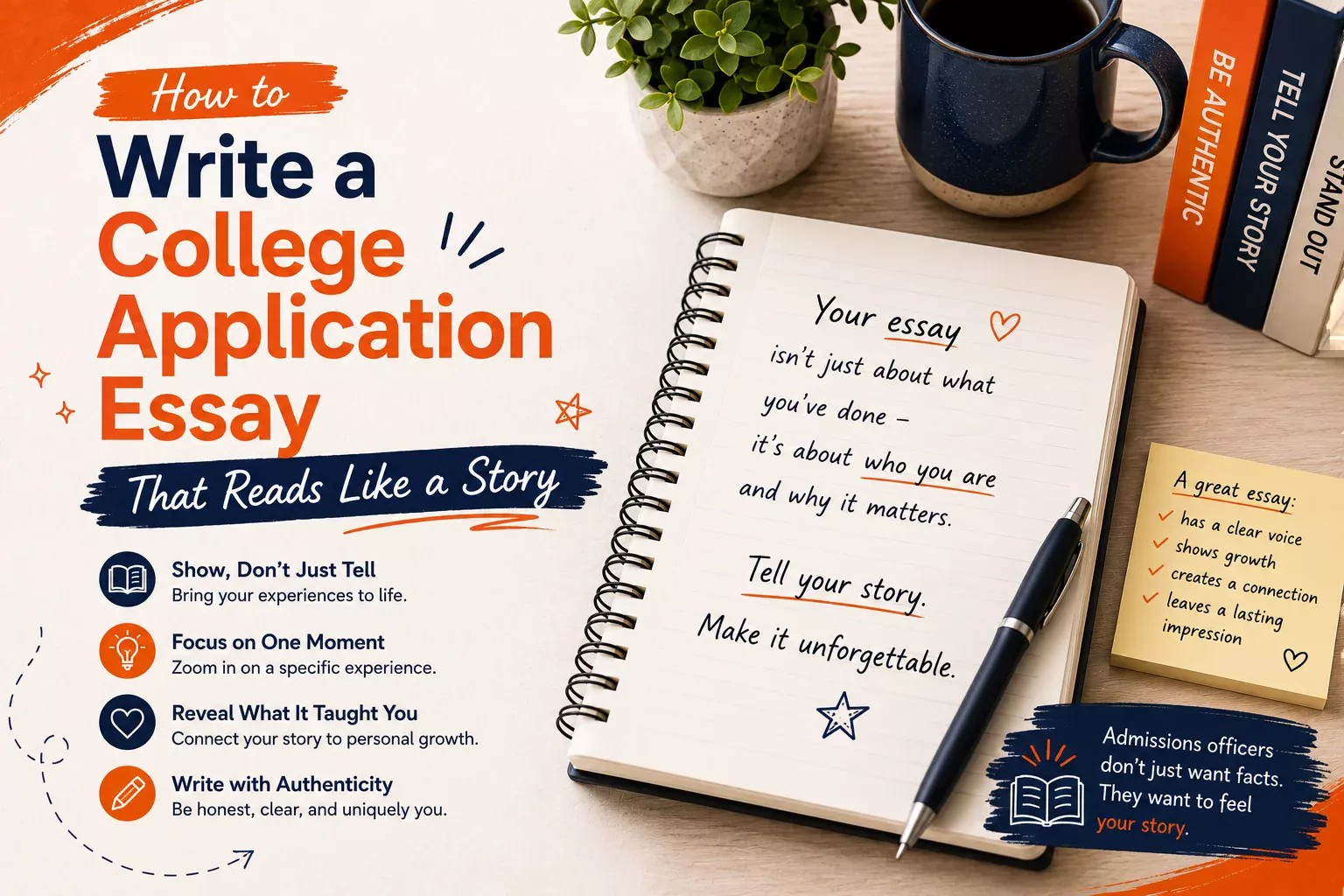
What "Reads Like a Story" Actually Means
A story has a person, a place, a moment, and some kind of movement. Something shifts between the start and the end. A list of accomplishments has none of that.
Compare these two openings.
Version A: Playing on my debate team taught me preparation, teamwork, and thinking on my feet. Over three years, I grew into a confident team captain.
Version B: Twenty seconds before I had to speak, my note cards were still in alphabetical order. My partner had reorganized them in the car.
Version A summarizes three years in one sentence. Version B drops you into forty seconds of real time.
Only one makes you want to keep reading. The writer of Version B has not yet mentioned growth or leadership. Those ideas will come out through what happens next.
Storytelling vs. Telling Your Achievements
Your activities list already covers your achievements. The essay should not repeat them. When you write that something taught you perseverance, you are summarizing a story you have not told yet.
Here is the shift in mindset. Your job is not to explain who you are. Your job is to give a scene specific enough that the reader works it out.
Telling: I care deeply about my grandmother.
Showing: Every Sunday I brought her Saturday's crossword, because she said the answers came easier once the ink had dried.
The second sentence never uses the word care. It does not need to.
How to Choose a Story Worth Telling
The most common question is what to write about. The most common mistake is thinking the answer has to be big. It does not.
A strong college essay story usually has three things.
A specific, narrow moment you can picture clearly. Not "my summer abroad" but "the afternoon my host father took me to buy shoes."
Some tension, confusion, or turning point. It does not need drama, only something you were figuring out.
A real link to how you think. Not a lesson stapled on, but a genuine connection to who you are.
A few prompts help you find these moments.
- A time you changed your mind about something small.
- A regular activity that means more than it looks from outside.
- A moment you were wrong or unsure, and how you handled it.
- Something you do that nobody asked you to do.
- A conversation you keep thinking about.
Notice what is missing. No national awards, no tragedy, no dramatic transformation. A story about running your family laundromat can beat a state championship essay. The laundromat essay puts us in the room. The championship essay just lists results.
Building the Narrative Around One Experience
Once you pick your moment, resist the urge to cover everything around it. The Common App essay caps at 650 words. Most first drafts try to do far too much.
Use the moment as your center of gravity. Let everything else orbit it.
- The scene itself. Where you are, what happens, what is at stake.
- A little backstory. Just enough for the moment to make sense.
- Your thoughts in the moment. Your doubts and small observations.
- What shifted. Externally, internally, or both.
- What you understand now. Your reflection, kept short and specific.
If you find yourself summarizing a whole year, zoom in. Pick the one afternoon that stands for the year.
Writing the Opening Scene
Your opening has one job. It should make the reader want the next sentence. It does not need to be clever. It needs to be specific.
Weak openings sound like the start of a five-paragraph essay.
Throughout my life, I have always been passionate about music. From a young age, playing the piano was more than a hobby.
Strong openings drop you into a moment.
My piano teacher stopped the metronome and said, "You are playing the notes. You are not playing the music." I was twelve, and I nodded like I understood.
The strong opening trusts the reader. It does not announce the theme. The theme grows out of the next few paragraphs.
A few techniques that work well.
- Start mid-action. You are already doing the thing.
- Start with dialogue. Someone speaks, and we are inside the scene.
- Start with one concrete image. A specific object, gesture, or sound.
- Start with a contradiction. Something that surprised or embarrassed you.
Whatever you choose, cut the throat-clearing. Delete anything before the sentence where the essay truly begins.
Using Specific Details
Specific details are the biggest thing separating memorable essays from forgettable ones. Vague writing could be about anyone. Specific writing could only be about you.
Vague: I helped out at my dad's restaurant a lot growing up.
Specific: By ninth grade I carried four plates on one arm and knew Mr. Halloran wanted his eggs over medium.
The specific version is barely longer, but you can see it. And you already know something about how the writer watches people.
Here is a simple rule. When you write a general statement, ask what it would look like. Then write that instead.
Showing Personality and Voice
Voice is what makes the essay sound like you wrote it. It comes from small choices. How you would describe something to a friend, the observations only you would make.
Students often flatten their voice because they think an essay must sound formal. It does not. It should sound like a thoughtful version of you talking out loud.
A quick test. Read your draft aloud. Anywhere you would never say the sentence in real life, rewrite it.
Using Dialogue Naturally
One line of dialogue can do more work than a paragraph of description. It shows character in the way people actually speak. It also creates a real sense of scene.
But dialogue only works when it sounds like a real person. Forced dialogue is worse than none.
Forced: "Sarah," my mother said solemnly, "you must always remember that hard work is the key to success."
Natural: "You are not going to bed until this is done," my mom said, pushing the calculator back across the table.
Use dialogue when it captures something a summary could not. A specific way someone talks, a line you actually remember. If you are inventing what a person would have said, you probably do not need it.
There are also formatting rules that trip up many students. Where the quotation marks go, how to punctuate around tags, when to start a new line. If you plan to use dialogue, it helps to read a short guide on how to write dialogue in an essay before you draft.
Building Tension, Reflection, or Emotional Movement
Something has to happen in your essay. Not always an event. Sometimes the movement is internal, a change in how you understood something.
But if you end thinking exactly as you did at the start, there is no story yet. The shift can be small.
- You believed one thing and left believing another.
- You misread a person, then saw them differently.
- You wanted something, tried, and the result surprised you.
- You noticed something you had walked past a hundred times.
Track that shift honestly. Readers can tell when a transformation is faked. A small, real change beats a big, invented one every time.
Connecting the Story to Personal Growth
Reflection is where students most often lose the thread. After a great scene, they end with the moral of a fable.
This experience taught me that I am resilient, hardworking, and ready for any challenge college brings.
That paragraph could sit at the end of any essay in the pile. It says nothing.
Good reflection is specific, honest, and often quiet. It ties back to a detail from your story.
I still cannot play that piece the way she wanted. But now I stop hearing the notes for a second and try to hear what sits underneath them.
The reflection returns to the piano lesson. It admits something honest. It names a habit of mind without announcing it.
Balancing Storytelling with Reflection
One common failure is all scene and no reflection. The writing is lovely, but the reader is unsure what to make of it. The opposite is all reflection and no scene.
Here is a rough working balance to aim for.
| Element | Target Range |
|---|---|
| Scene and detail | 50 to 65 percent |
| Context (brief backstory and what you were thinking) | 15 to 25 percent |
| Reflection (what shifted and what you understand now) | 15 to 25 percent |
These are not fixed rules. But if your draft is mostly the meaning of things with barely any actual things, that is the problem.
Avoiding Manufactured Drama
The urge to sound important works against you. It leads to writing that feels forced.
- Metaphors that try too hard, like "life is a river carving through adversity."
- Vocabulary that is not yours, like "I embarked on an odyssey of self-discovery."
- Sweeping claims, like "that moment changed everything about me."
- Hardship exaggerated for effect.
Readers see this constantly and spot it fast. Understatement almost always wins. If the moment mattered, write it well enough that we feel it without being told.
Do not invent hardship either. A real, ordinary moment handled honestly beats a dramatic one packed with cliches.
Ending the Essay Naturally
Endings are hard because students feel they must be profound. They do not. The best endings usually do one of three things.
- Return to an image from the opening, now carrying new meaning.
- Land on a small, specific observation that captures the shift.
- Show you in the present, still doing the thing.
Endings should almost never summarize the essay or list your qualities. The essay itself is the argument for you.
Weak ending: In conclusion, debate shaped me into a leader ready to make a difference in college.
Reflective ending: My note cards are still a mess. But the ten seconds before you speak are the only ones that truly belong to you.
A Simple Framework You Can Use
If you are staring at a blank page, try this six-part structure. It is not the only way, but it works for most narrative essays.
- The moment. Drop us into a scene. One short, specific paragraph.
- The context. A few sentences so the moment makes sense.
- The scene continued. Return to the moment and what you were thinking.
- The turn. Something shifts, an insight or a decision.
- The wider connection. A short paragraph tying it to how you think.
- The landing. One or two lines that echo the opening.
Draft it in that order. Then rearrange, cut, and rewrite. Your final essay will not follow this cleanly, and it should not have to.
Common Storytelling Mistakes
A few patterns weaken narrative college essays again and again.
- Starting too early. The essay takes three paragraphs to reach the moment.
- Covering too much time. A whole year in one page. Zoom in instead.
- Naming your qualities. Any "I am someone who" line is a summary you can cut.
- Explaining the metaphor. Trust the reader to get it.
- Adding a lesson at the end. Delete "I learned that" and see if the rest holds.
- Making it about someone else. Mentors can appear, but you are the lead.
A Short Before-and-After
Before:
Volunteering at the animal shelter taught me responsibility and compassion. Even small actions can make a difference. This experience shaped the person I am today.
After:
The first dog they gave me was Biscuit. He had been there fourteen months. For three Saturdays I sat on the floor and read out loud from whatever book was in my bag.
On the fourth Saturday he put his head on my knee. A family adopted him in March. I still check the shelter site some nights, to see who has been there longest.
The second version is about the same length. It never claims responsibility. But you know exactly what kind of person wrote it.
Choose My Premium Essay for Professional Essay Writing Assistance that Delivers Results.
A college essay that reads like a story is not fiction. You choose a real moment, write it with the detail it deserves, and trust the reader to understand what it says about you.
Need help turning your story into a polished application essay? My Premium Essay connects you with professional essay writers who can help with planning, drafting, and editing.
Order NowFrequently Asked Questions
Does every college essay have to be a story?
No. Some students write reflective essays that work well. But for most, a story is the easiest way to sound specific and memorable.
Can I use a small, ordinary moment?
Yes, and it is often the better choice. An honest, specific small moment beats a dramatic one filled with cliches.
How much dialogue is too much?
There is no fixed number. If more than a third of your essay is dialogue, the conversation may be doing work the narration should do.
Should I write in present or past tense?
Either works. Present tense feels immediate. Past tense suits reflection. Some essays switch between them on purpose.
How do I know if my essay reads like a story?
Read it aloud, then ask a friend to read it. If they can describe a specific scene back to you, the story is landing.
Is it okay if there is no clear lesson?
Yes. Strong essays can end on a question or an image. The essay must show movement, not package a moral.

 MyPremiumEssay