
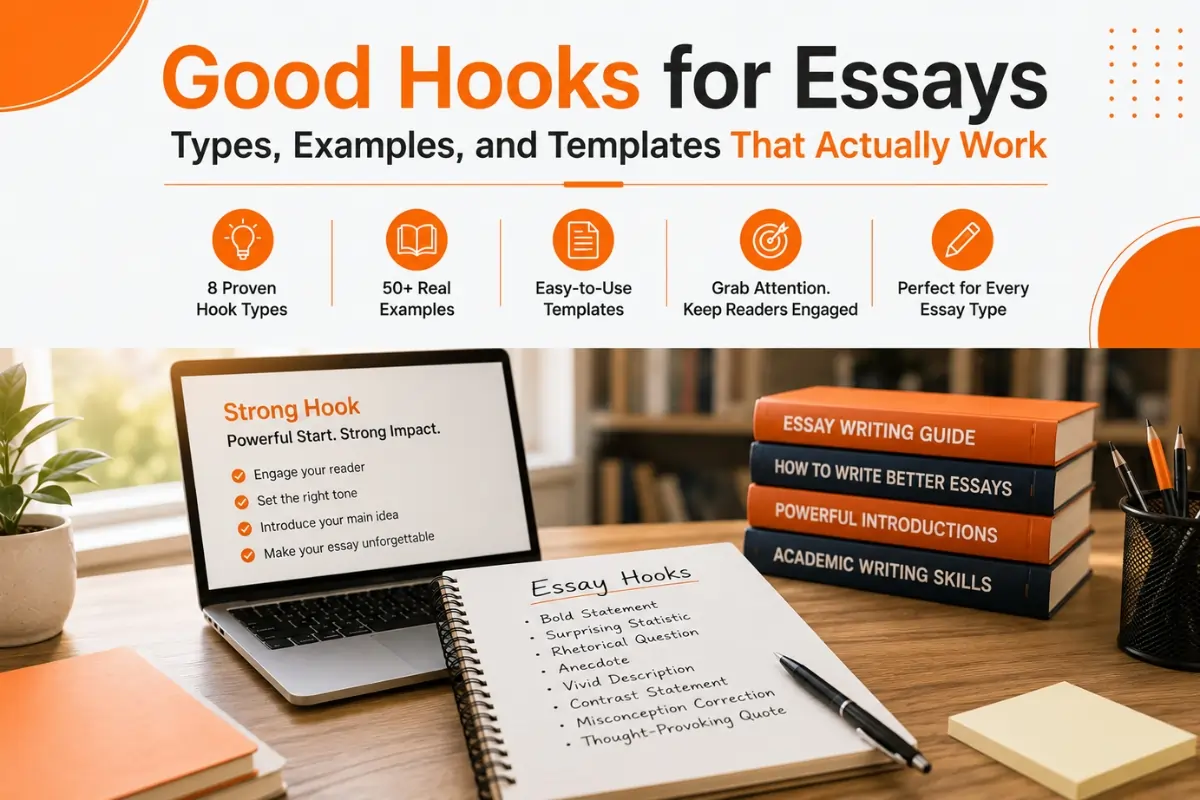
Whether you're writing an argumentative essay, narrative essay, expository essay, or college application essay, a strong hook can make a powerful first impression. It sparks curiosity, sets the tone, and smoothly leads readers into your main idea.
In this guide, you'll learn how to write effective essay hooks, explore 8 proven hook types, see 50+ examples, and use simple templates that actually work.
What Is an Essay Hook?
An essay hook is the opening sentence (or two) of your introduction. Its only job is to pull the reader in to make them curious, challenged, or emotionally invested enough to keep reading.
A hook is not:
- A vague generalization ("Throughout history, humans have faced challenges.")
- A dictionary definition ("According to Merriam-Webster, justice is defined as...")
- An announcement ("In this essay, I will discuss climate change.")
A hook is a sharp, specific, intentional opening that earns the reader's attention before you've made a single argument.
Simple rule: If your opening sentence could appear at the beginning of any essay on any topic, it's not a hook. It's filler.
How Long Should an Essay Hook Be?
Most hooks are one to three sentences long, depending on the statement. The goal is to grab attention without delaying the thesis statement.
| Hook Type | Ideal Length |
|---|---|
| Bold statement | 1 sentence |
| Surprising statistic | 1 sentence |
| Rhetorical question | 1 sentence |
| Thought-provoking quote | 1 sentence + 1 context sentence |
| Anecdote | 2–3 sentences (max) |
| Vivid description / scene-setting | 2–3 sentences (max) |
| Common misconception | 1–2 sentences |
| Contrast/paradox | 1–2 sentences |
The golden rule: If your hook runs longer than three sentences, it's no longer a hook — it's a paragraph that delays your argument. Cut it.
The Hook-to-Thesis Bridge: The Step Everyone Skips
Here's where most students fail, not in the hook itself, but in the transition from hook to thesis. A great hook that floats disconnected from your argument confuses the reader.
You need a bridge: 1–3 sentences that connect your hook to your thesis statement.
Structure of a complete introduction:
[Hook — 1–3 sentences]
↓
[Bridge — 1–3 sentences of context/background]
↓
[Thesis statement — 1–2 sentences]
Example (complete introduction):
Hook: Every year, over 800,000 people die by suicide more than die in wars and homicides combined.
Bridge: Despite these numbers, mental health education remains absent from most school curricula, leaving young people without the vocabulary or resources to recognize warning signs in themselves or others.
Thesis: Mandatory mental health education in secondary schools is not a privilege but a public health necessity, one that could reduce youth suicide rates, reduce stigma, and save lives.
The bridge is what makes the hook feel earned rather than random. Without it, even the best hook feels like a trick.
Types of Good Hooks for Essays (With Examples and Templates)
1. The Bold Statement Hook
What it is: A confident, assertive claim that challenges the reader's assumptions or states something that sounds wrong until they read on.
Why it works: It creates cognitive dissonance. The reader thinks, "That can't be right", and reads on to find out why you believe it.
Best for: Argumentative essays, persuasive essays, opinion pieces
Template:
"[Widely accepted belief] is [wrong / a myth / the opposite of what most people think]."
Examples:
| Topic | Hook |
|---|---|
| Education | "The most dangerous thing happening in schools today isn't violence, it's boredom." |
| Technology | "Smartphones haven't made us more connected. They've made us experts at performing connection." |
| Leadership | "The best managers are the ones their teams barely notice." |
| Climate | "Recycling, as most people practice it, is closer to a ritual than a solution." |
| Mental health | "Telling someone to 'just talk about it' is not mental health support, it's a performance of caring." |
Weak
Social media has both positive and negative effects on teenagers."
Strong:
"We designed social media to be addictive, and then we acted surprised when teenagers got addicted."
2. The Surprising Statistic Hook
What it is: A specific, verifiable data point that reframes the reader's understanding of your topic before you've made a single argument.
Why it works: Numbers feel credible and immediate. A well-chosen statistic communicates the scale of a problem faster than a paragraph of explanation.
Best for: Argumentative essays, expository essays, research papers, and informative essays
Template:
"[Specific number or percentage] [surprising fact that challenges assumptions] a reality that [brief implication]."
Examples:
| Topic | Hook |
|---|---|
| Sleep | "Forty percent of adults regularly sleep fewer than seven hours a night, the threshold below which cognitive performance begins to measurably decline." |
| Reading | "By age five, children from higher-income households have heard 30 million more words than their lower-income peers, a gap that shapes academic outcomes for the next 13 years." |
| Prison | "The United States holds 5% of the world's population but 25% of its prisoners." |
| Food waste | "One-third of all food produced globally is never eaten enough to feed every hungry person on Earth twice over." |
| Exercise | "A single 20-minute walk produces the same short-term anxiety relief as a low-dose anti-anxiety medication." |
Weak
Many people don't get enough sleep.
Strong:
Sleeping fewer than six hours a night for two weeks produces the same cognitive impairment as being legally drunk yet most people never notice the decline."
Important: Only use statistics you can verify. A statistic that turns out to be wrong destroys your credibility for the rest of the essay.
3. The Rhetorical Question Hook
What it is: A question you pose not for an answer, but to plant a thought in the reader's mind that your essay will then develop.
Why it works: Questions activate the brain. A reader who is mentally engaging with a question is already invested in finding the answer.
Best for: Argumentative essays, persuasive essays, analytical essays
Template:
"What would [situation] look like if [reframing assumption or condition]?" "If [accepted norm] is [true], why does [contradicting reality] exist?"
Examples:
| Topic | Hook |
|---|---|
| Justice | "If the justice system exists to rehabilitate, why does the United States have the highest reincarceration rate in the developed world?" |
| Education | "What if the skills schools spend the most time teaching are the ones that matter least after graduation?" |
| Privacy | "At what point does convenience become surveillance, and have we already crossed it?" |
| Work | "If productivity has never been higher, why do more workers report burnout than at any point in recorded history?" |
| Diet | "If personal responsibility explains obesity, why did obesity rates triple in three decades when human willpower didn't change?" |
Weak
"Have you ever wondered about the effects of social media?" (answerable with yes/no, too vague)
Strong
"If social media platforms are free to use, what exactly are we paying with?"
Avoid: Questions with obvious yes/no answers. "Do you want to be healthy?" is not a hook. It's a platitude.
4. The Anecdote Hook
What it is: A brief, vivid story personal or third person that drops the reader into a specific moment connected to your essay's theme.
Why it works: Stories trigger empathy. A reader who feels something in your opening is emotionally anchored to your argument before your thesis even arrives.
Best for: Narrative essays, personal essays, college application essays, reflective assignments
Template:
"[Set the scene in one sentence]. [What happened or what was realised]. [Bridge to the broader point this moment illustrates]."
Examples:
| Context | Hook |
|---|---|
| College essay | "The morning I quit the debate team, I finally understood what I was actually good at." |
| Persuasive | "In 2003, a Toronto nurse named Sheela Basrur identified the first SARS case in North America, not because of a government protocol, but because she trusted her instincts over the official checklist." |
| Reflective | "My grandmother kept every letter she ever received. When she died, we found 400 of them. Not one was a text message." |
| Argumentative | "In 2018, a 12-year-old in Ohio was suspended for drawing a picture of a gun. That same week, the school's security cameras were broken and unfixed." |
| Personal | "I failed my driving test four times. The fifth time, I passed and understood for the first time that competence and confidence are not the same thing." |
Weak
I remember when I was young, and my teacher told me to always try my best." (vague, cliched)
Strong
The first time I stood in front of a class to present, I forgot every word I had prepared — and in that silence, I learned more about communication than any lesson had taught me.
5. The Vivid Description / Scene-Setting Hook
What it is: A sensory opening that paints a picture, placing the reader inside a moment, place, or situation before making any argument.
Why it works: Descriptive detail activates the imagination. It creates atmosphere and signals to the reader that this essay will be engaging, not dry.
Best for: Narrative essays, descriptive essays, personal statements, creative nonfiction
Template:
"[Sensory detail: what was seen/heard/felt]. [The moment or scene that matters]. [What this environment reveals about the larger topic]."
Examples:
| Topic | Hook |
|---|---|
| Environment | "The river outside my childhood home ran clear until I was eight. By the time I was twelve, it ran brown." |
| Poverty | "The food bank opens at 7 a.m. By 6:45, the line stretches around the building, mostly people in work clothes who came before their shifts." |
| War | "In the archive photograph, the soldier is smiling. Behind him, an entire city is on fire." |
| Education | "In a classroom of thirty students, six have no desk. They sit on the floor, textbooks balanced on their knees in a school built the same year as the iPhone." |
| Aging | "At 84, my grandfather could still name every player on the 1962 World Cup roster. He couldn't always remember mine." |
6. The Common Misconception Hook
What it is: Open by correcting a widely held belief, positioning your essay as the truth behind a popular myth.
Why it works: Readers are drawn to the feeling of being let in on something most people get wrong. It positions you as authoritative from the very first sentence.
Best for: Expository essays, research papers, analytical essays, informative writing
Template:
"Most people believe [common misconception]. The reality is [accurate, specific correction] — and the difference matters more than you'd think."
Examples:
| Topic | Hook |
|---|---|
| Memory | "Most people believe memory works like a recording. It doesn't. Every time you recall a memory, you're reconstructing it, and the reconstruction changes it slightly each time." |
| Success | "Talent is widely credited for exceptional achievement. Research consistently suggests it accounts for far less than practice, environment, and timing." |
| Multitasking | "Multitasking feels efficient. Neuroscience shows it reduces the quality of both tasks by up to 40%.” |
| Sugar | "Fat was blamed for the obesity epidemic for four decades. The evidence now points to something else entirely." |
| History | "Columbus is credited with discovering America. He never set foot on the North American mainland." |
7. The Contrast / Paradox Hook
What it is: Open with two contradictory facts, ideas, or images placed side by side; the tension between them becomes the engine of your essay.
Why it works: Paradox is intellectually irresistible. The human brain is wired to resolve contradictions, and your essay promises the resolution.
Best for: Analytical essays, argumentative essays, compare-and-contrast essays
Template:
"[Fact A]. And yet, [contradicting Fact B] a paradox that [brief implication]."
Examples:
| Topic | Hook |
|---|---|
| Wealth | "The United States is the wealthiest nation in human history. It is also the only developed nation without universal healthcare." |
| Technology | "We live in the most connected era in human history. Rates of loneliness have never been higher." |
| Education | "Student loan debt in America exceeds $1.7 trillion. Employer surveys consistently show new graduates lack the skills companies need most." |
| Environment | "Solar panel prices have fallen 90% in a decade. Global carbon emissions hit a record high last year." |
| Productivity | "We have more productivity tools than any generation in history. We also report less time for deep work than any generation before us." |
8. The Thought-Provoking Quote Hook
What it is: Open with a short, well-chosen quote from a credible or unexpected source, then immediately use it as a springboard into your argument.
Why it works: A well-chosen quote signals intelligence and context. It tells the reader your essay is grounded in something larger than your opinion alone.
Best for: Literary analysis, argumentative essays, philosophical essays, history essays
Template:
"[Short, precise quote]" [Name, context]. [One sentence connecting the quote to your essay's argument]."
Examples:
| Topic | Hook |
|---|---|
| Justice | "'Injustice anywhere is a threat to justice everywhere.' Martin Luther King Jr. Sixty years after those words, the ZIP code you're born into still determines your likelihood of going to prison." |
| Education | "'Education is not preparation for life; education is life itself.' John Dewey. Most school systems still haven't figured out the difference." |
| AI | "'The real problem is not whether machines think but whether men do.' B.F. Skinner. That question has never been more urgent." |
| Leadership | "'The task of leadership is not to put greatness into people, but to elicit it.' John Buchan. Most performance reviews do the opposite." |
Weak
As Albert Einstein once said, 'Imagination is more important than knowledge.'" (overused, vague connection to essay)
Strong
Use lesser-known, specific quotes with a direct, visible connection to your argument. The quote should feel inevitable, like you couldn't have opened any other way.
Rules for quote hooks: Keep it under 20 words. Always verify the attribution. Never drop a quote without a bridge sentence explaining its relevance.
Hook Selector: Which Hook Works for Which Essay Type?
| Essay Type | Best Hook Types | Avoid |
|---|---|---|
| Argumentative | Bold statement, surprising statistic, rhetorical question, paradox | Anecdote (unless very relevant), vague quote |
| Analytical / Literary | Thought-provoking quote, misconception, paradox | Personal anecdote, emotional scene |
| Expository / Informative | Surprising statistic, misconception, rhetorical question | Bold opinion, personal story |
| Narrative / Personal | Anecdote, vivid description, bold statement | Statistics, formal quotes |
| Compare & Contrast | Paradox, misconception, rhetorical question | Long scene-setting description |
| College Application | Anecdote, vivid description, bold personal statement | Generic quotes, dictionary definitions |
| Research Paper | Surprising statistic, misconception, rhetorical question | Emotional anecdote, vague description |
How to Write a Hook: Step-by-Step
Don't write your hook first. Write it last.
The most common hook mistake is writing the opening before you know what you're arguing. By the time you've written the body of your essay, you know exactly which angle is most compelling, and that's when you write the hook.
Step 1: Finish your body paragraphs. Know your argument completely before opening it.
Step 2: Ask "What's the most surprising, uncomfortable, or counterintuitive thing about my topic?" That's almost always your best hook angle.
Step 3: Write three different hooks using three different types. Try a bold statement, a statistic, and a question. Pick the one that best matches your essay's tone.
Step 4: Write the bridge. Connect your hook to your thesis in 1–3 sentences. No hook should stand alone.
Step 5: Read the full introduction aloud. If the hook and thesis feel like they belong to the same essay, you're done. If there's a tonal gap, revise the bridge.
Hook Mistakes That Kill Strong Essays
1. The Vague Generalization
"Throughout history, people have always faced challenges." This sentence could open a paper about literally anything. It says nothing.
2. The Dictionary Definition
"According to Merriam-Webster, courage is defined as..." Overused to the point of parody. It signals the writer had no better idea for an opening.
3. The Obvious Yes/No Question
"Have you ever felt stressed?" The reader answers, moves on, and feels nothing. A rhetorical question must be unanswerable with a simple yes or no.
4. The Irrelevant Hook
Opening a climate change essay with a personal story about your dog. If the hook doesn't connect directly to your thesis, it confuses more than it engages.
5. The Overlong Anecdote
A five-sentence backstory before you've made a single relevant point. Hooks earn attention, they don't spend it. Two sentences maximum for an anecdote.
6. The Overused Quote
"As Albert Einstein once said, 'The definition of insanity is doing the same thing over again...'" Professors have read this hook thousands of times. It signals a lack of original thinking.
7. The Announcement
"In this essay, I will discuss the effects of social media on mental health." This is a table of contents, not a hook. Tell the reader something; don't describe what you're about to tell them.
Hook Templates: Fill-in-the-Blank by Type
| Hook Type | Template |
|---|---|
| Bold statement | "[Assumed truth] is [the opposite / more complicated / a myth]. Here's why." |
| Statistic | "[Specific number] [surprising fact] a reality most people [don't know / refuse to accept / can't explain]." |
| Rhetorical question | "If [accepted norm] is [supposedly true], why does [contradicting reality] keep happening?" |
| Anecdote | "In [year/moment], [person] [did/said/discovered something]. It changed [what] forever." |
| Misconception | "Most people believe [wrong assumption]. The reality backed by [evidence] is [accurate correction]." |
| Paradox | "[Fact A] and yet [directly contradicting Fact B]. The gap between them is exactly where [your essay topic] lives." |
| Description | "[Sensory detail that places reader in a scene]. [What this moment reveals about the larger issue]." |
| Quote | "'[Short quote]' [Name]. [One sentence making the direct connection to your argument]." |
Hooks Beyond the Essay: Why This Skill Transfers
The ability to open with a hook isn't just an academic skill it's one of the most transferable writing tools you'll ever develop.
- Cover letters: The first sentence of a cover letter is a hook. "I've been using your product for three years. Here's the bug I found that your team hasn't." That gets read.
- Emails: Subject lines and opening sentences are hooks. The difference between a cold email that gets a reply and one that doesn't is almost always the first sentence.
- Presentations: Every keynote speaker opens with a hook. It's not a coincidence. It's a technique.
- Job interviews: The strongest answer to "Tell me about yourself" is structured exactly like an essay opening: hook → context → thesis (your value proposition).
Master essay hooks, and you've mastered the most important sentence in almost every form of professional writing.
Beyond essays, knowing how to write a position paper can help you communicate a clear, evidence-based position on important issues.
Quick Checklist: Is Your Hook Working?
Before you submit, run your opening through this test:
- Is it specific, not vague or generalised?
- Does it connect directly to your thesis?
- Is it 1–3 sentences maximum?
- Does it avoid clichés, dictionary definitions, and announcements?
- Is there a bridge sentence connecting it to the rest of the introduction?
- Could it only appear at the beginning of this essay, not any essay?
- Did you write it after finishing your body paragraphs?
If every box is checked, your hook is working.
Want to put these hooks into practice? Learn how to write an expository essay that explains ideas clearly and effectively.
Choose My Premium Essay for Professional Essay Writing Assistance that Delivers Results.
Writing a great hook is a skill. Executing an entire polished essay under deadline pressure is another challenge entirely. My Premium Essay connects you with professional essay writers who do it all. Strong hook. Clear argument. Polished finish.
Don't let a weak opening undermine a strong argument. Get Your Essay Written by an Expert at My Premium Essay
Order NowFrequently Asked Questions
What is a hook in an essay?
A hook is the opening sentence or two of your essay introduction. Its purpose is to grab the reader's attention immediately and make them want to keep reading. A good hook is specific, relevant to your thesis, and matched to your essay type and audience.
What are the best hooks for essays?
The best hooks depend on your essay type. Bold statements and surprising statistics work best for argumentative essays. Anecdotes and vivid descriptions work best for narrative and personal essays. Rhetorical questions and paradox hooks work well for analytical and persuasive writing. The best hook is always the one most relevant to your specific argument.
How long should an essay hook be?
Most hooks are one sentence. Anecdote and scene-setting hooks can run to two or three sentences. Never longer. The hook's job is to capture attention quickly, not to tell a complete story before the essay begins.
Can a hook be a question?
Yes, but only if it's a rhetorical question that cannot be answered with a simple yes or no. "Have you ever felt tired?" is not a hook. "If sleep deprivation produces the same cognitive effects as being drunk, why do we celebrate working late?" is a hook.
Should I write the hook first or last?
Last. Write your body paragraphs first, so you know exactly what you're arguing. Then write the hook based on the most compelling, counterintuitive, or powerful angle in your essay. A hook written before the body often doesn't match the essay's actual argument.
What hooks should I avoid?
Avoid dictionary definitions, vague generalizations ("Throughout history..."), obvious yes/no questions, overused quotes (Einstein, Churchill), irrelevant anecdotes, and announcements ("In this essay, I will discuss..."). These signal lazy writing and disengage the reader before the argument begins.
What is the difference between a hook and a thesis statement?
A hook opens the introduction and captures attention. A thesis statement closes the introduction and states your central argument. The hook makes the reader want to continue; the thesis tells them what they'll be reading. Both are essential; neither replaces the other.
How do I connect my hook to my thesis?
With a bridge of 1 to 3 sentences of context or background that transitions from the hook's opening idea to the specific claim of your thesis. A hook without a bridge feels disconnected. A bridge without a strong hook feels slow. Together, they make an introduction that earns the reader's commitment.
 MyPremiumEssay