
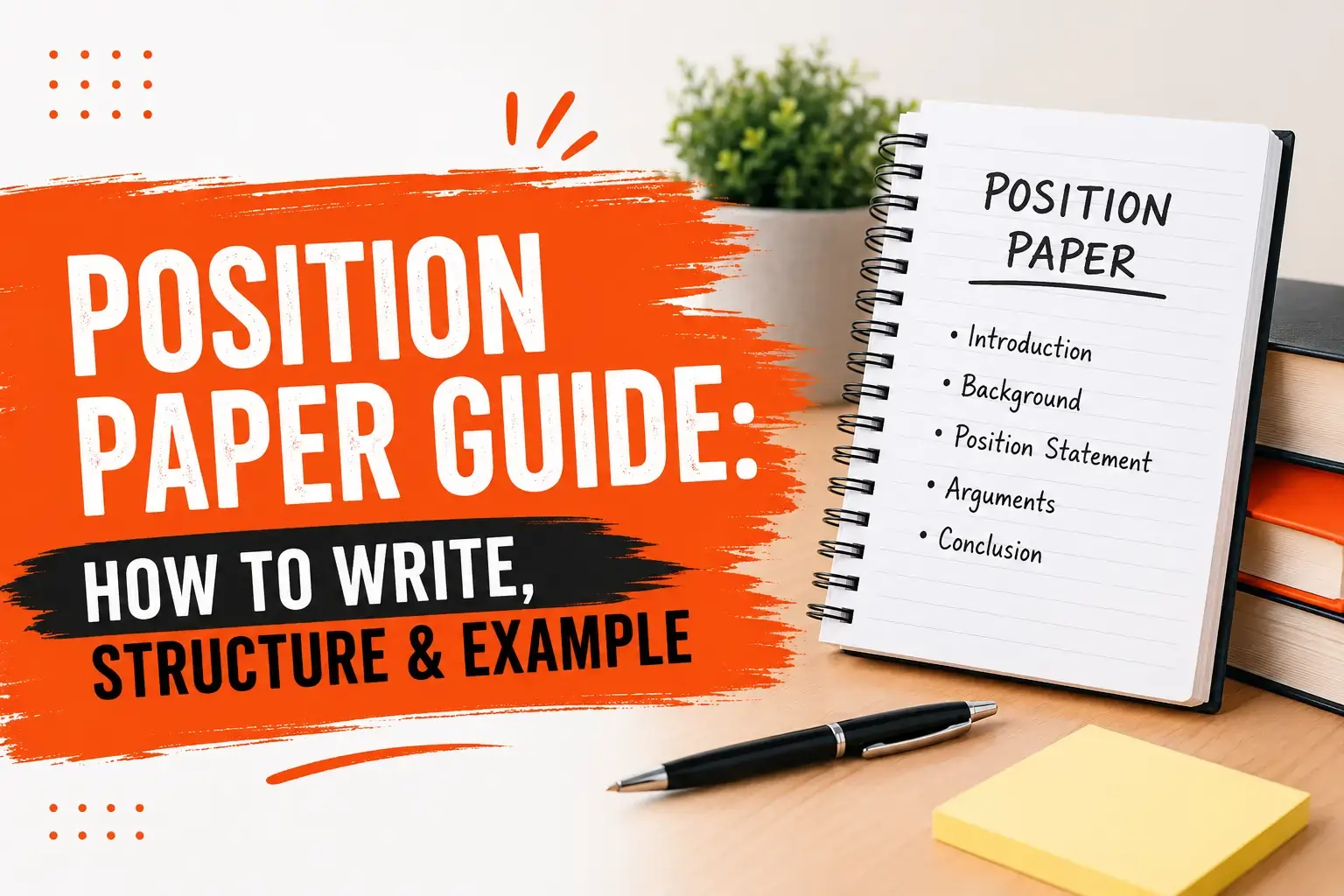
This guide explains how to write a clear, well-structured, and persuasive position paper for a class, Model UN conference, policy debate, or professional setting.
- What Is a Position Paper?
- What Makes a Good Position Paper Topic?
- Position Paper Structure
- How to Write a Position Paper: Step by Step
- Position Paper Template
- Mini Example: Position Paper in Action
- Common Position Paper Mistakes to Avoid
- How to Write a Model UN Position Paper
- Get Your Position Paper Written by My Premium Essay's Expert Writers
- Frequently Asked Questions
What Is a Position Paper?
A position paper is a formal essay in which you take a clear stance on a debatable issue and defend that stance using evidence, reasoning, and logical argument.
Unlike a research paper that explores multiple perspectives neutrally, a position paper commits. You are not reporting on a topic. You are arguing for a specific view of it.
Here is what separates a position paper from other essay types:
- It takes a single, clearly defined position on a controversial or debatable topic
- It acknowledges opposing viewpoints and explains why they are less convincing
- It relies on credible evidence, not just personal opinion
- It is structured to persuade, not just inform
Position papers are common in academic settings, Model UN conferences, think tanks, policy organizations, and professional advocacy work.
What Makes a Good Position Paper Topic?
Before you can write a strong position paper, you need a topic worth arguing about. Not every subject works.
A good position paper topic should be:
- Debatable. There must be a genuine disagreement with reasonable arguments on multiple sides. "Pollution is bad" is not debatable. "Should governments ban single-use plastics?"
- Specific enough to argue. Broad topics like "education" or "healthcare" are too vague. Narrow it down to a concrete policy question or issue.
- Researchable. You need credible evidence to support your position. Choose a topic with enough published data, expert opinion, and real-world examples.
- Genuinely contested. The best topics are ones where thoughtful people actually disagree, which forces you to engage seriously with the other side.
Strong topic examples:
- Should the minimum wage be raised to a living wage?
- Is remote work more productive than office-based work?
- Should social media companies be held legally responsible for harmful content?
- Should standardised testing be abolished in schools?
Position Paper Structure
Every strong position paper follows a logical sequence that moves the reader from context to conclusion.
Here is the standard position paper structure:
-
1. Introduction
Hook the reader, introduce the issue, and state your position clearly in a thesis statement.
-
2. Background
Give the reader the context they need to understand why this issue matters and what the debate involves.
-
3. Thesis and Your Position
State your argument precisely. This is the core claim you will defend throughout the paper.
-
4. Arguments Supporting Your Position
Present two to four strong arguments backed by evidence. Each argument gets its own paragraph or section.
-
5. Counterarguments and Rebuttals
Acknowledge the strongest opposing views, then explain why your position is more convincing.
-
6. Conclusion
Restate your thesis, summarise your key arguments, and end with a call to action or broader implication.
How to Write a Position Paper: Step by Step
Now that you understand the structure, here is how to actually write a position paper from start to finish.
-
Step 1: Choose and Research Your Topic
Start by picking a debatable issue you can form a genuine position on. Then research it thoroughly before you commit to a side.
Here is how to approach the research:
- Read sources from multiple perspectives, including those you disagree with
- Note the strongest arguments on each side
- Identify the best available evidence, including statistics, expert opinion, case studies, and real-world examples
- Look for weaknesses in the opposing argument that you can address in your rebuttal section
Do not pick your position before you have done the research. Let the evidence guide you to the most defensible stance.
-
Step 2: Define Your Position Precisely
Once you have researched the topic, you need to land on a specific, defensible position and state it with precision.
Vague positions produce weak papers. Be specific about what you are arguing and what you are not.
Vague position: "Social media is harmful."
Precise position: "Social media platforms should be legally required to implement age verification systems for users under 16 to reduce documented harms to adolescent mental health."The precise version tells the reader exactly what you are arguing, which makes the entire paper easier to write and easier to follow.
-
Step 3: Write a Strong Introduction
Your introduction needs to do three things in a short space:
- Hook the reader. Open with a striking statistic, a surprising fact, a brief anecdote, or a bold statement that makes the issue feel urgent and real.
- Provide context. In two to three sentences, explain the issue and why it matters. Do not assume the reader already knows the background.
- State your thesis. End the introduction with your position, stated clearly and specifically.
Keep the introduction focused. Three to five sentences is usually enough. Your job here is to orient the reader and signal your argument, not to cover every angle of the topic.
-
Step 4: Provide Background on the Issue
This section gives readers the information they need to follow your argument. Think of it as building shared ground before you start persuading.
Cover the following:
- The history or origin of the debate
- Key facts, definitions, or terminology the reader needs to understand
- The current state of the issue, including relevant data or recent developments
- Who is affected and how
Keep this section objective and informative. You are not arguing yet. You are giving context. The analysis and persuasion come in the next section.
-
Step 5: Present Your Arguments
This is the core of your position paper and where most of your word count should live. Present two to four distinct arguments that support your position, with each one clearly developed.
For each argument, follow this structure:
- State the argument clearly. Open the paragraph or section with a direct claim.
- Provide evidence. Back the claim with credible data, expert quotes, research findings, or real-world examples.
- Explain the connection. Do not assume the evidence speaks for itself. Explain why it supports your position and what it means for the broader argument.
Types of evidence that work well in a position paper:
- Peer-reviewed research and academic studies
- Government reports and official statistics
- Statements from recognised experts in the field
- Real-world case studies and examples from comparable situations
- Historical precedents that support your argument
Arrange your arguments in a logical order. You can go from strongest to weakest, or build up to your strongest point at the end. Either approach works as long as the progression feels purposeful.
-
Step 6: Address the Counterarguments
This is the section that separates a good position paper from a great one. Many writers skip this or treat it as an afterthought. That is a mistake.
Addressing opposing views demonstrates that you have thought seriously about the issue and that your position holds up under scrutiny. Ignoring counterarguments does not make them disappear. It just makes your paper look one-sided.
Here is how to handle counterarguments effectively:
- Identify the one or two strongest objections to your position, not the weakest ones
- Summarise each objection fairly and accurately before you respond
- Explain why your position is still more convincing despite the objection, using evidence where possible
- Acknowledge if a counterargument has partial merit, then show why it does not override your overall argument
Example of a weak rebuttal: "Some people think remote work is less productive, but they are wrong."
Example of a strong rebuttal: "Critics argue that remote work leads to reduced collaboration and innovation. However, a 2023 Stanford study found that hybrid arrangements, which combine remote flexibility with scheduled in-person collaboration, produced higher innovation scores than fully office-based teams, suggesting the issue is about structure rather than location."
The strong rebuttal takes the objection seriously, uses evidence, and makes a specific counter-claim.
-
Step 7: Write the Conclusion
Your conclusion is not a place to introduce new arguments. It is where you bring everything together and leave the reader with a clear sense of your position.
A strong conclusion does the following:
- Restates your thesis in fresh language, not copied from the introduction
- Briefly recaps the main arguments you made
- Ends with a call to action, a policy recommendation, or a broader reflection on the significance of the issue
The final sentence matters. It is what the reader takes away. Make it land.
Weak ending: "In conclusion, this paper has shown that social media regulation is important."
Strong ending: "Until platforms are held to the same standards of duty of care as other industries that serve young people, the documented harms to adolescent mental health will continue to grow. The tools to act exist. What remains is the political will to use them."
Position Paper Template
Use this as a starting framework every time you write. Replace the bracketed sections with your own content.
-
Introduction
[Hook: a striking statistic, fact, or statement that makes the issue feel urgent]. [Two to three sentences of context explaining the issue and why it matters]. This paper argues that [your precise position stated as a thesis].
-
Background
[Objective overview of the issue: history, key definitions, current state of the debate, who is affected]. [Two to four sentences, focused only on what the reader needs to follow your argument].
-
Argument 1: [Title or summary of first argument]
[Clear claim]. [Evidence: data, expert quote, case study]. [Explanation of why this evidence supports your position].
-
Argument 2: [Title or summary of second argument]
[Clear claim]. [Evidence]. [Explanation].
-
Argument 3: [Title or summary of third argument, if applicable]
[Clear claim]. [Evidence]. [Explanation].
-
Counterargument and Rebuttal
Some argue that [summarise the strongest opposing view fairly]. However, [your rebuttal with evidence or reasoning that shows why your position is still more convincing].
-
Conclusion
In summary, [restate thesis in fresh words]. [Brief recap of main arguments]. [Call to action, policy recommendation, or broader reflection on the issue].
Mini Example: Position Paper in Action
Here is a short model position paper of around 400 words so you can see exactly how the structure works in practice.
Topic: Should Standardised Testing Be Abolished in Schools?
Reducing Standardised Testing: A Smarter Path to Measuring Student Success
Every year, millions of students sit high-stakes standardised tests that are meant to measure how much they have learned. Yet decades of research suggest these tests measure something far narrower than that, and that the costs of relying on them are quietly undermining the quality of education they are supposed to protect. Standardised testing in its current form should be significantly reduced in schools and replaced with more comprehensive assessment methods.
Standardised testing first became widespread as a tool for accountability. The underlying logic was sound: if students everywhere took the same test, schools and policymakers could compare performance and identify where support was needed. In practice, however, the system has drifted far from that original purpose.
The most significant problem with standardised testing is that it narrows the curriculum rather than measuring it. When test scores determine school funding, teacher evaluations, and student advancement, schools respond rationally by teaching to the test. A 2019 review published in the Journal of Educational Research found that in districts with high-stakes testing, instructional time for subjects not covered in standardised tests, including art, music, physical education, and social studies, dropped by an average of 30 percent over a decade. Students are not getting a broader education. They are getting a more constrained one.
Furthermore, standardised tests consistently disadvantage students from lower-income backgrounds. Research by the College Board itself has shown a strong correlation between family income and SAT scores, a pattern that has remained stable for decades. This means standardised tests often measure socioeconomic privilege as much as academic ability, raising serious questions about their validity as universal benchmarks.
Critics argue that without standardised tests, there would be no objective way to compare schools or identify underperforming institutions. This concern is legitimate. However, countries like Finland, which consistently rank among the top performers in global education, rely primarily on teacher-led assessments, project-based evaluations, and portfolio reviews rather than standardised testing. Accountability and objectivity do not require high-stakes tests. They require thoughtful evaluation design.
Standardised testing as it currently operates does more harm than good. Replacing it with mixed assessment methods that measure a broader range of skills would produce more accurate results, support more equitable outcomes, and give students and teachers back the space to actually learn.
Common Position Paper Mistakes to Avoid
Even well-researched position papers can fall short because of avoidable errors. Watch out for these:
- Taking a position that is not actually debatable. If almost everyone agrees with you, it is not a position paper topic. You need genuine disagreement.
- Ignoring counterarguments entirely. A paper that only presents one side feels incomplete and unconvincing. Engage with the opposition directly.
- Using weak or unreliable sources. Personal blogs, unverified websites, and opinion pieces from unknown authors do not count as evidence. Stick to credible sources.
- Being too broad. "Climate change needs to be addressed" is not a position. "Governments should implement a carbon tax on all fossil fuel producers" is.
- Restating rather than arguing. Simply listing facts about a topic is not the same as arguing a position. Every paragraph should be driving your thesis forward.
- Overloading with quotes. Your argument should lead. Evidence supports it, not the other way around. Never drop a quote without explaining what it shows.
If you're unsure whether your assignment calls for a position paper or a full argumentative essay, our guide on how to write an argumentative essay explains the key differences.
How to Write a Model UN Position Paper
Model UN position papers follow a slightly different set of rules from academic or policy position papers. If you are writing for a Model UN conference, here is what you need to know.
The biggest difference is voice. A Model UN position paper is written as if the country itself is speaking, not you as an individual student. Instead of "I believe the international community should act," you write "The delegation of Kenya urges the committee to consider" or simply "Kenya supports binding emissions targets."
Key rules for Model UN position papers:
- Never use first person. Write as the country, always. "France recognises" not "I think France should recognise."
- Keep it short. Most conferences cap position papers at 250 to 500 words per topic. Every sentence needs to earn its place.
- Cover three things: the country's position on the issue, the evidence or context supporting that position, and the policy solutions or resolutions the country is calling for.
- Know your country's actual stance. A position paper for Kenya on climate finance should reflect Kenya's documented position in UN negotiations, not your personal view. Research your country's real foreign policy before you write.
- Match the conference format. Some conferences require formal headers (country name, committee, topic), specific font and margin settings, and a particular citation style. Always check the conference study guide before you start.
Many academic assignments require evaluating existing literature. For a deeper look at this process, read our guide on how to write a survey paper.
Get Your Position Paper Written by My Premium Essay's Expert Writers
Sometimes the topic is assigned at the worst possible time, the research is more complex than expected, or the deadline is simply not on your side. If you need expert help, my premium essay writing services also cover position papers and all forms of academic writing.
Rated 4.9 out of 5 by over 3,000 students, our professional writers deliver subject-specific expertise, plagiarism-free content, and on-time results, guaranteed. Whether you need someone to write a critical response essay, a position paper, or any academic assignment from scratch, we match you with a writer who knows your subject inside out.
Place your order today and get your first draft in as little as 3 hours.
Order NowFrequently Asked Questions
How long should a position paper be?
The length depends on the assignment:
- High school: 500–750 words
- Undergraduate: 1,000–1,500 words
- Model UN: 250–500 words per topic
- Professional policy papers: 2,000+ words
If no word count is provided, include a clear thesis, 2–3 evidence-based arguments, a counterargument, and a concise conclusion.
How many arguments should a position paper have?
Two to four is the ideal range for most papers. Two well-developed arguments with strong evidence are more persuasive than five thin ones. Quality beats quantity every time.
Can I use first person in a position paper?
This varies by context. Academic and policy position papers often avoid heavy first-person use in favour of impersonal, authoritative language. Model UN position papers almost always avoid first person and are written as if the country itself is speaking.
What is the difference between a position paper and an argumentative essay?
They are very similar. The main differences are that position papers often include a dedicated background section giving context on the issue, position papers are more commonly used in policy, advocacy, and Model UN contexts, and argumentative essays are a broader academic category that includes literary and philosophical arguments as well as policy ones. In practice, many instructors use the terms interchangeably. The key skills are the same: clear thesis, strong evidence, honest engagement with opposing views.

 MyPremiumEssay