




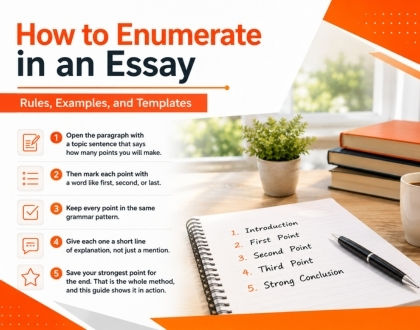
Keep every point in the same grammar pattern. Give each one a short line of explanation, not just a mention. Save your strongest point for the end. That is the whole method, and this guide shows it in action.
What Is Enumeration in an Essay?
Enumeration means naming and explaining a set of related items in order. Those items are usually reasons, causes, types, or steps. You give each one its own space instead of crowding them together.
There is a key difference hidden in this topic. Enumerating in an essay means listing points inside your normal paragraphs. An enumerative essay is a whole paper built around a stated number of parts.
Enumeration vs. the Enumerative Essay
When you enumerate inside an essay, the list supports a bigger argument. It fills a paragraph or two, while your thesis and structure still run the show.
An enumerative essay works the other way. The list becomes the frame of the whole paper, and each part turns into its own body paragraph. We disambiguate that format near the end and link to a dedicated guide.
Enumeration vs. Sequence
Enumeration and sequence both list items, but sequence locks the order. Step two cannot come before step one in a recipe or an experiment. In enumeration, logic does not fix the order, so you may arrange points for effect. Climactic order, where the strongest point comes last, is one such deliberate choice.
Quick Answer: The Four Ways to Enumerate
There are four ways to enumerate in academic writing. You can use an in-sentence list, a prose paragraph, a numbered list, or a bulleted list. Your purpose decides which one fits.
Why Enumeration Matters in Academic Writing
Enumeration turns a block of text into a clear path for the reader. It guides them from one point to the next without confusion. That makes your ideas easier to follow and to grade.
It also shows that you can organize your thinking, which rubrics reward under structure and coherence. If you want the bigger picture, see our essay structure guide for how lists fit into a full essay.
Types of Enumeration (With Examples)
Each type suits a different context. Using the wrong one makes an essay feel cluttered or too casual. Here is how each works and when to use it.
1. In-Sentence (Run-In) Enumeration
This is the most common and most academic option. The items sit inside a normal sentence, split by commas. Your prose keeps flowing while each point stays clear.
Example: The study measured three variables: motivation, study habits, and grades over two terms.
2. Prose Paragraph Enumeration
Here the list spreads across several sentences. You open with a topic sentence that names the number of points. Each point then gets a signpost and a line or two of detail.
Example: Students procrastinate for three reasons. First, big tasks feel overwhelming. Second, distractions are always close. Last, perfectionism makes starting feel risky.
3. Numbered (Vertical) Lists
A numbered list suits steps or rankings where order matters. Many teachers dislike vertical lists in formal essays. Use one only when the assignment allows it.
4. Bulleted (Vertical) Lists
Bullets fit unordered items of equal weight. They are the least accepted format in academic essays and can read as casual. When unsure, turn bullets back into a prose paragraph.
How to Enumerate in an Essay: Step by Step
This is the workflow for enumerating inside your prose. It is the version most students need. Follow these five steps and your lists will look planned.
Step 1. Check that your items are distinct. Each point should be separate and roughly equal in weight. For example, "cost, safety, and speed" are distinct, while "cost, price, and expense" overlap.
Step 2. Open with a quantifier topic sentence. Name the count up front so the reader knows what is coming. For example, "There are three benefits to cycling to work."
Step 3. Signpost each item. Introduce every point with a marker so the reader stays on track. For example, "First, it saves money. Second, it builds fitness. Last, it cuts pollution."
Step 4. Keep every item parallel. Match the grammar of each point to the first one. For example, write "reading, writing, and speaking," not "reading, to write, and speech."
Step 5. Explain, then close. Give each item real comment, then wrap the list before your conclusion. For example, add "which lowers monthly costs" to a point, then move on.
First vs. Firstly: Which Is Correct?
Both forms are fine in grammar terms. Most guides prefer first, second, third, and last. Reserve firstly for rare cases, and never mix the two systems.
Enumerators and Transition Words
Enumerators are a small family of transition words. They mark position in a list, such as first, next, and last. Vary them a little so a long list never sounds robotic.
Punctuation Rules for Enumerating in an Essay
Punctuation is where most lists go wrong. Fixing it makes your writing look sharper at once. Three rules solve most problems.
When to Use a Colon
Use a colon only when the words before it form a full sentence. For example, "The essay covers three areas:" is complete, so the colon is correct before the items. The Purdue OWL gives the same rule for introducing lists in academic prose.
When Not to Use a Colon
Skip the colon when the list is the object of the verb. Write "The novel explores love, loss, and memory," with no colon. The verb needs its objects right away.
When to Use Semicolons
Use semicolons when the list items already contain commas. Commas alone would blur where one item ends and the next begins. Semicolons keep each item separate and easy to read.
Example: The panel had three experts: Dr. Lee, a psychologist; Dr. Ortiz, a statistician; and Dr. Bello, an educator.
How APA, MLA, and Chicago Handle Enumeration
Each style guide treats lists a little differently. Knowing the basics keeps your formatting correct for the course.
APA Style
APA allows lettered items inside a sentence, marked (a), (b), and (c). It uses numbered vertical lists for steps in order and bullets for unordered items. APA also spells out numbers below 10 and uses numerals for 10 and above. These rules come from the Publication Manual of the APA, 7th edition, summarized clearly on the Purdue OWL.
MLA Style
MLA prefers run-in lists woven into your prose. Vertical lists are rare in MLA essays, so keep items in the sentence when you can. Use a colon before a list only when a full sentence introduces it, per the MLA Handbook.
Chicago Style
Chicago accepts vertical lists, numbered when order matters and bulleted when it does not. For lists inside a sentence, it often marks items (1), (2), and (3). The Chicago Manual of Style also spells out whole numbers up to one hundred in general prose.
Enumeration Examples by Essay Type
Real examples make the technique easy to copy. Here are three short models across common assignments.
Argumentative Essay
Example: Social media harms teenagers in three ways. First, it splits attention and lowers grades. Second, it feeds comparison and anxiety. Most of all, it steals the sleep teens need.
The strongest point lands last, a choice called climactic order. Enumeration also organizes balanced arguments, which suits many discursive essay topics that weigh points on both sides.
Cause-and-Effect Essay
Example: Tuition rises from several linked causes. One is lower public funding. Another is administrative growth. A third is the cost of new campus technology.
Classification Essay
Example: College writers fall into three types. The planner outlines everything first. The drafter finds ideas by writing. The reviser improves through steady editing.
Before vs. After: Fixing a Weak List
A rewrite often teaches more than a rule. Compare these two versions of the same idea. The first crowds everything together. The second enumerates with clear signposts.
Before: There are many reasons remote work is popular like flexibility and no commute and people save money and feel productive.
After: Remote work is popular for three reasons. First, it offers flexible hours. Second, it removes the commute. Last, it helps workers save money while staying productive.
Copy-Paste Enumeration Templates
These fill-in templates give you exact wording to adapt. No competing article offers this. Swap in your own content and adjust the signpost words.
In-sentence list: "[Subject] involves three parts: [item one], [item two], and [item three]."
Three-reason paragraph: "There are three reasons [claim]. First, [reason and detail]. Second, [reason and detail]. Most of all, [strongest reason and detail]."
Common Enumeration Mistakes to Avoid (and Fixes)
These errors quietly cost marks. Each has a quick fix. Scan them before you submit.
Non-parallel items. Make every point start with the same part of speech. The list then reads smoothly instead of jolting.
Colon misuse. Check that the words before the colon form a full sentence. Remove the colon if the list is the verb's object.
Over-listing. Cap most lists at three to five points. Longer lists tire the reader and bury your best ideas.
Listing without analysis. Add real comment to each item. A list should explain your thinking, not just count it.
Bullets in a formal essay. Turn vertical bullets into a prose paragraph. Keep bullets only when the assignment allows them.
Advanced Tips for Stronger Enumeration
Use climactic order. Put your best point last. Readers remember final items most, and the paragraph builds to a strong close.
Name the count only when it helps. A number adds clarity for reasons and steps. Drop it when the list is short and obvious.
Vary your signposts. Move between first, another, a further point, and last. A long list then never feels like a countdown.
Enumeration vs. Listing vs. Outlining
These three terms overlap, which confuses many students. This table clears it up.
| Enumeration | Listing | Outlining | |
|---|---|---|---|
| Purpose | Explain points in prose | Name items quickly | Plan before writing |
| Where it lives | Inside your essay | Inside or outside prose | In your notes |
| Order matters? | Sometimes | Usually no | Yes |
| Reader sees it? | Yes | Yes | No |
What Is an Enumerative Essay? (Quick Note)
An enumerative essay is not the same as enumerating inside an essay. It is a whole paper built as a list, where you name a number of parts in the thesis and give each part its own paragraph.
That format has its own rules and its own search intent, so we cover it separately. Read our full guide on how to write an enumerative essay for outlines and examples. Some prompts are built as lists too, such as the Columbia supplemental essays and certain Boston College supplemental essays.
Frequently Asked Questions
What does it mean to enumerate in an essay?
It means listing related points, such as reasons or causes, one by one in a clear and marked order.
Should I use numbers or words when enumerating?
Words like first and second suit most essays. Numerals fit steps. Pick one system and stay consistent.
Is "firstly, secondly, thirdly" correct?
It is fine, but first, second, and last read cleaner. Most teachers prefer the shorter forms.
Can I use bullet points in an academic essay?
Some teachers allow them. Most prefer lists written into prose. Check your assignment first.
How many points should I enumerate at once?
Three to five works best. Longer lists overwhelm readers and weaken your key points.
Do I need a colon before a list?
Only when the words before it form a full sentence. Skip it when the list is the verb's object.
Need a Hand With Your Essay?
Enumeration is easier to master with feedback from a strong writer. Students who work with mypremiumessay say the same thing: clear communication, fast delivery, and quality that earns top grades. Here is what a few verified Google reviewers shared.
"I ordered my essay last week and scored an A. I was amazed at the professional essay writers they had to offer and was blown away with the quality of work they provided. I will definitely use them again." — Roderick Gors, Google review (5 stars)
"One of the best essay writing services I've ever used. My writer kept in touch through the entire process and finished fast. He even sent the essays early, which was very helpful. A fantastic service that I would recommend to everyone." — Medo_SY, Google review (5 stars)
"I tracked down mypremiumessay online and the process was clear and direct. I received my paper on time, and it was exactly what I asked for, with great content and strong language." — Jagriti Bilwal, Google review (5 stars)
Ready for help with your next paper? Hire a writer and get clear, well-structured work on time.
Final Thoughts
Enumeration is a small skill with a big effect. It makes your essays feel clear and controlled. Use signposts, keep items parallel, and add real comment, and every list will support your argument.

 MyPremiumEssay