
A well written descriptive essay transforms ordinary observations into immersive experiences. The reader can see the setting, hear the sounds, smell the scents, feel the textures, and even connect emotionally with the subject. Descriptive writing requires careful observation, strong vocabulary, and attention to detail.
This guide will walk you through everything you need to know about writing a descriptive essay, including structure, planning, sensory language, writing techniques, common mistakes, and practical tips for creating memorable descriptions.
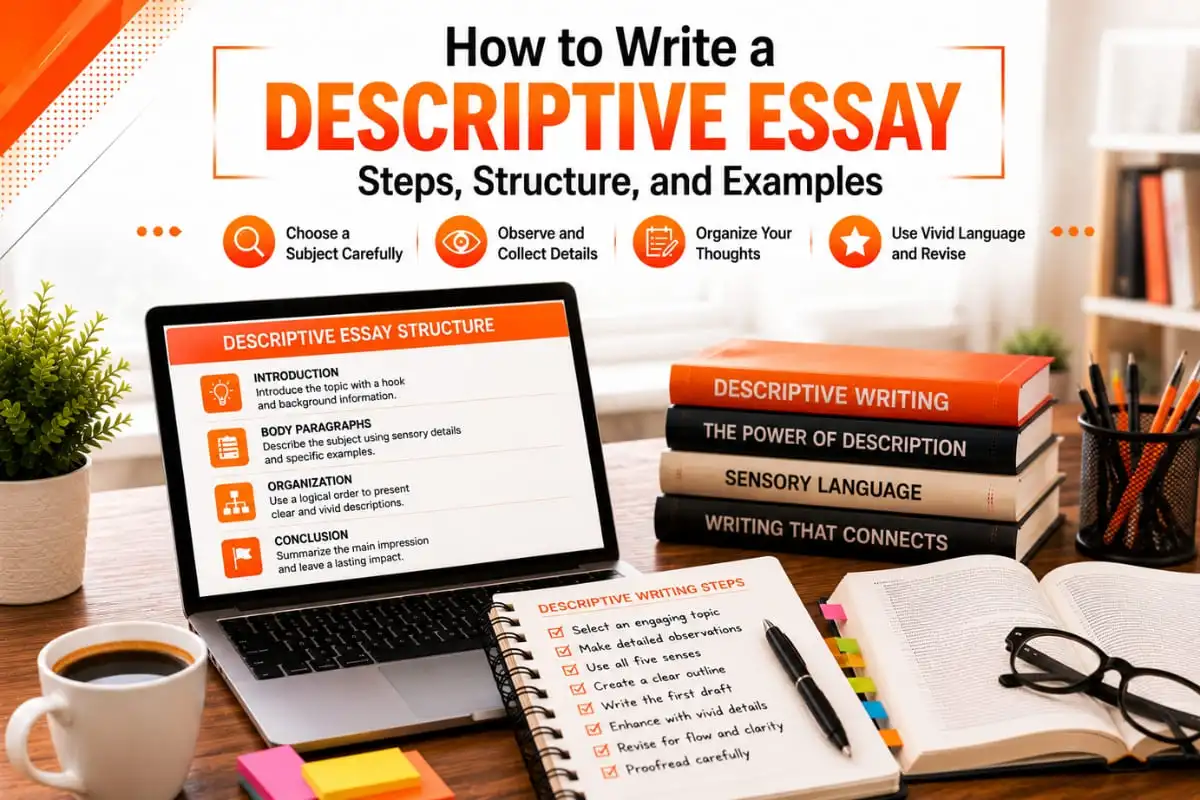
What Is a Descriptive Essay?
A descriptive essay is a type of essay that creates a detailed picture of a person, place, object, experience, or event through vivid language and sensory details. Its primary purpose is to help readers visualize and emotionally connect with the subject being described.
Rather than simply presenting facts, descriptive essays focus on observation and experience. They answer questions such as:
- What does it look like?
- What does it sound like?
- What does it smell like?
- What does it feel like?
- What emotions does it evoke?
The best descriptive essays allow readers to experience the subject through the writer's perspective.
Example
Telling:
"The beach was beautiful."
Describing:
"The golden sand stretched endlessly beneath the afternoon sun, while gentle waves rolled toward the shore with a soothing rhythm. The salty breeze carried the scent of the ocean, and distant laughter blended with the cries of seagulls overhead."
The second example helps readers imagine and experience the scene rather than simply being told about it.
The Five Senses Framework
The most reliable tool in the descriptive writer's kit is the five senses. Most inexperienced writers rely almost exclusively on sight. They describe what things look like and stop there. Strong descriptive writers engage all five senses to create a fully immersive experience.
Sight
- Color and shade
- Shape and size
- Movement and stillness
- Light and shadow
Smell
- Sharp and pungent
- Sweet and floral
- Earthy and damp
- Stale or fresh
Sound
- Volume and pitch
- Rhythm and pattern
- Silence as contrast
- Texture of sound
Taste
- Sweet, sour, bitter
- Texture on the tongue
- Aftertaste and memory
- Metaphorical taste
Touch
- Temperature
- Texture and surface
- Weight and pressure
- Pain or comfort
You don't need to force all five senses into every paragraph. The key is to reach for sensory details beyond the purely visual whenever they serve your description. A thunderstorm is not only dark clouds and lightning. It is the electric smell in the air, the vibration you feel in your chest when thunder breaks, and the cold sting of the first fat raindrop on your forearm.
Example: Sight Only vs. Multi-Sensory
Weak (Sight Only):
"The bakery had a display case full of pastries and warm lighting."
Strong (Multi-Sensory):
"The moment she pushed open the bakery door, a wave of warm, yeast-scented air washed over her. Behind the glass display case, croissants lay golden and flaking, their buttery sheen catching the amber glow of overhead lights. The gentle thud of the oven door closing somewhere in the back sent a faint vibration through the worn wooden floor beneath her feet."
The Structure of a Descriptive Essay
A descriptive essay generally follows the traditional essay structure:
1. Introduction (Approximately 10%)
The introduction serves as the gateway to your essay. It captures the reader's attention and prepares them for the description that follows.
A strong introduction generally includes:
- Hook: An interesting opening sentence designed to engage the reader. This may be a surprising fact, a thought-provoking question, a vivid image, or a brief anecdote.
- Background Information: A few sentences that provide context about the subject being described. This helps readers understand its significance and relevance.
- Thesis Statement: The main idea or overall impression that the essay will convey. Rather than presenting an argument, the thesis in a descriptive essay communicates the dominant feeling, mood, or image associated with the subject.
Example:
"The scent of freshly baked bread drifted through the air as the morning sun illuminated the small village bakery. For generations, this bakery has been a gathering place for locals seeking warmth and comfort. More than just a shop, it represents the heart and spirit of the community."
2. Body Paragraphs (Approximately 80%)
The body is the largest and most important section of a descriptive essay. Here, the writer develops a detailed and organized description of the subject using sensory details and figurative language.
The body paragraphs should be arranged in a logical order, such as:
- Spatial Order: Describing from left to right, top to bottom, near to far, or outside to inside.
- Chronological Order: Describing events in the order they occur.
- Order of Importance: Moving from the least significant detail to the most significant, or vice versa.
Each body paragraph should focus on a specific aspect of the subject. Writers should use the five senses whenever possible:
- Sight: Colors, shapes, sizes, and appearances.
- Sound: Noises, voices, music, or silence.
- Smell: Fragrances, odors, and scents.
- Taste: Flavors and textures.
- Touch: Temperature, texture, and physical sensations.
Additionally, descriptive essays often employ literary devices such as:
- Similes
- Metaphors
- Personification
- Imagery
These techniques help make descriptions more engaging and memorable.
Example:
"The lake's surface shimmered like a sheet of polished glass beneath the afternoon sun. Gentle waves lapped against the shore, producing a soothing rhythm that echoed through the quiet landscape. The cool breeze carried the scent of pine trees, creating an atmosphere of peace and serenity."
3. Conclusion (Approximately 10%)
The conclusion brings the essay to a satisfying close. Instead of introducing new information, it reinforces the overall impression created throughout the essay.
A strong conclusion usually includes:
- Reflection: A brief statement about the significance or meaning of the subject.
- Restatement of the Main Impression: Reminding readers of the dominant image, feeling, or experience.
- Final Thought: A memorable closing sentence that leaves a lasting impression on the audience.
Example:
"Although many visitors see the lake as merely a beautiful destination, it represents much more to those who know it well. Its tranquil waters and breathtaking scenery offer a rare escape from the pressures of modern life. Long after leaving its shores, the sense of peace it provides remains unforgettable."
Example Descriptive Essay Outline
Topic
My Childhood Garden
Introduction
- Hook
- Background
- Thesis about the garden's significance
Body Paragraph 1
- Visual appearance of the garden
- Flowers, trees, and pathways
Body Paragraph 2
- Sounds and smells
- Birds, insects, fresh soil, blooming flowers
Body Paragraph 3
- Personal memories and emotional connection
- Family gatherings and childhood adventures
Conclusion
- Reflection on the garden's lasting impact
- Final emotional impression
Descriptive Essay Writing Process
A well-written descriptive essay begins with a structured approach to planning and writing.
Step 1: Choose Your Subject
The first step is selecting a suitable topic. Choose a person, place, object, event, memory, or experience that you know well and can describe in detail. A familiar subject allows you to provide authentic observations and richer descriptions.
When choosing a topic, consider:
- Whether you have enough details to describe it effectively.
- Whether it evokes strong emotions or memories.
- Whether it can engage your audience.
Examples: A childhood home, a favorite vacation spot, a family member, a school event, or a beautiful natural landscape.
Step 2: Observe Carefully
Before writing, spend time observing your subject closely. Pay attention to details that others might overlook. The more carefully you observe, the more vivid and realistic your description will be.
Focus on the five senses:
- What does it look like?
- What sounds are present?
- Are there any noticeable smells?
- What textures can be felt?
- Are there any tastes associated with it?
Taking notes during observation helps capture details that can later enrich your essay.
Step 3: Brainstorm
Once you have observed your subject, write down everything that comes to mind. Do not worry about organization at this stage. Simply generate as many ideas and details as possible.
You might brainstorm:
- Physical characteristics
- Sensory details
- Emotions and feelings
- Personal memories
- Interesting facts or observations
Creating a mind map or list can help organize your thoughts and uncover unique details that make your essay stand out.
Step 4: Identify the Main Impression
Every successful descriptive essay communicates a central impression or feeling. Decide what you want readers to think, feel, or understand after reading your essay.
Ask yourself:
- What makes this subject special?
- What emotion does it evoke?
- What overall message do I want to convey?
For example, a beach may be described as peaceful and relaxing, while a busy marketplace may be portrayed as energetic and vibrant. This main impression will guide your choice of details and language throughout the essay.
Step 5: Create an Outline
An outline helps organize your ideas before you begin writing. It ensures that your descriptions flow logically and remain focused on the main impression.
A basic outline may include:
Introduction
- Hook
- Background information
- Thesis statement
Body Paragraphs
- First aspect of the description
- Second aspect of the description
- Third aspect of the description
Conclusion
- Reflection on the subject
- Final impression
A clear outline makes the writing process smoother and helps maintain coherence.
Step 6: Write the First Draft
Using your outline, begin writing the essay. Focus on expressing your ideas and creating vivid descriptions rather than worrying about perfection.
While drafting:
- Use specific details instead of general statements.
- Incorporate sensory language.
- Include figurative language such as similes and metaphors when appropriate.
- Maintain a logical flow between paragraphs.
Remember that the first draft is meant to capture your ideas. Revisions can improve it later.
Step 7: Revise
Revision involves improving the content, structure, and effectiveness of your essay. Read your draft carefully and evaluate whether your descriptions create a clear image in the reader's mind.
During revision:
- Add stronger sensory details.
- Remove unnecessary or repetitive information.
- Improve paragraph organization.
- Strengthen transitions between ideas.
- Ensure every detail supports the main impression.
Many writers find that revision significantly enhances the quality of their work.
Step 8: Proofread
The final step is proofreading. Carefully review your essay to eliminate grammatical, spelling, punctuation, and formatting errors.
When proofreading:
- Check sentence structure and word choice.
- Correct spelling mistakes.
- Ensure punctuation is used properly.
- Read the essay aloud to identify awkward wording or unclear sentences.
A polished essay appears more professional and allows readers to focus on the description rather than distractions caused by errors.
Since the thesis statement serves as the foundation of any essay, you may also find our article How To Write A Thesis Statement helpful for strengthening your academic writing.
What Can You Write About in a Descriptive Essay?
Almost anything can become the subject of a descriptive essay if it offers meaningful details and sensory experiences.
People
- A family member
- A mentor
- A friend
- A historical figure
Places
- Your hometown
- A favorite vacation destination
- A classroom
- A park
Objects
- A treasured possession
- A family heirloom
- A piece of artwork
- A meaningful gift
Events
- A wedding
- A sporting event
- A graduation ceremony
- A childhood memory
Experiences
- Your first day at school
- Learning to ride a bicycle
- Traveling abroad
- Overcoming a challenge
The most effective topics are those you know well and can describe in rich detail.
Key Writing Techniques
The following techniques can help you create more vivid, engaging, and memorable descriptive essays.
Show, Don't Tell
The most important principle in descriptive writing is the instruction to show rather than tell. "Telling" gives readers a label or conclusion. "Showing" gives readers the evidence and lets them arrive at the conclusion themselves. "She was nervous" tells. "Her hands moved constantly, adjusting her collar, smoothing the crease of her trousers, tucking a strand of hair behind her ear only to pull it loose again" shows. Showing is almost always more powerful.
Figurative Language
Similes, metaphors, and personification are your closest allies. They allow you to connect the unfamiliar to the familiar, making abstract or complex impressions suddenly tangible. Use figurative language with precision. The best comparisons are surprising but immediately feel correct. Avoid clichés like "white as snow" or "eyes like stars." Instead, push for comparisons that feel specific to your subject and your voice.
Precise Word Choice (Diction)
Every word in a descriptive essay should earn its place. Replace general nouns with specific ones (not "bird" but "sparrow," not "vehicle" but "dented pickup truck"). Replace weak verbs with strong ones (not "walked slowly" but "shuffled," "trudged," or "inched"). Replace vague adjectives with concrete ones (not "loud" but "ear-splitting," not "old" but "warped and grey-green with moisture").
Vary Your Sentence Rhythm
Long, flowing sentences can create a dreamy, immersive atmosphere. Short, punchy sentences create impact and urgency. The best writers alternate between the two. A long sentence that builds and builds can be followed by a single short sentence that lands like a stone dropped into still water. That contrast creates emphasis.
Common Mistakes in Descriptive Essays
Even strong writers can make mistakes that reduce the impact of their descriptions. Being aware of these common pitfalls can help you create clearer and more engaging essays.
Overloading the Essay with Adjectives
Using too many descriptive words can overwhelm readers and make writing feel forced. Instead, choose specific and meaningful details that create a strong image.
Listing Details Without Purpose
A descriptive essay should not be a random collection of observations. Every detail should support the main impression, mood, or message of the essay.
Ignoring Structure
Descriptive writing still needs clear organization. Arrange details logically, such as by location, time, or importance, to help readers follow the description easily.
Using Clichés
Overused expressions can make writing sound unoriginal. Avoid phrases such as:
- Busy as a bee
- Cold as ice
- Quiet as a mouse
Instead, create fresh and specific descriptions that reflect your own perspective.
Neglecting the Emotional Element
Great descriptions do more than paint a picture; they also evoke feelings. Include details that help readers connect emotionally with the subject and understand its significance.
Expert Tips for Better Descriptive Essays
Strong descriptive essays do more than provide details. They immerse readers in an experience. The following tips can help you create descriptions that are vivid, engaging, and memorable.
Use Specific Details
Specific details make descriptions more realistic and believable. Rather than using general statements, include precise observations that help readers clearly visualize the subject.
Engage Multiple Senses
Effective descriptions appeal to more than just sight. Incorporating sounds, smells, textures, and even tastes can create a richer and more immersive experience for readers.
Create Emotional Depth
The best descriptive essays connect physical descriptions to emotions, memories, or personal experiences. This helps readers understand not only what something is like but also why it is meaningful.
Read Aloud
Reading your essay aloud can help identify awkward wording, repetitive phrases, and sentences that do not flow smoothly. It is an effective way to improve clarity and readability.
Avoid Repetition
Using the same words and sentence patterns repeatedly can make writing feel monotonous. Vary your vocabulary and sentence structure to keep readers engaged.
Focus on Significance
A descriptive essay should explain why the subject matters. Highlighting its importance helps readers connect with the description on a deeper level.
Balance Description and Reflection
While detailed descriptions are essential, they should also support a larger idea or impression. Reflection adds meaning and helps readers understand the subject's significance.
Revise Carefully
Excellent descriptions are often developed during the revision process. Review your essay carefully, strengthen weak details, and remove anything that does not contribute to the overall impression.
Students often wonder, Can I Buy Essays Online safely and responsibly? Explore our detailed guide to learn what to look for when choosing an essay writing service.
Elevate Your Descriptive Writing Skills With MyPremiumEssay
Descriptive essays allow writers to transform ordinary subjects into vivid experiences through careful observation and powerful language. By engaging the senses, using precise vocabulary, incorporating figurative language, and maintaining a clear structure, you can create descriptions that resonate with readers long after they finish reading.
Whether you are working on an academic assignment or looking to improve your writing skills, mastering descriptive essays can strengthen your ability to communicate ideas effectively and creatively. If you need expert guidance with essay writing, editing, or proofreading, or want to buy essays online, MyPremiumEssay is here to help you achieve your academic goals with confidence.

 MyPremiumEssay