For example, instead of writing, "Social media is popular," a stronger thesis statement would be: "Although social media improves communication, excessive use can negatively affect mental health, productivity, and personal relationships."
A clear, specific, and focused thesis statement serves as the foundation of a well-organised essay and guides both the writer and the reader throughout the paper.
In this guide, you'll learn what a thesis statement is, why it matters, how to write one step by step, common mistakes to avoid, and examples for different types of essays.
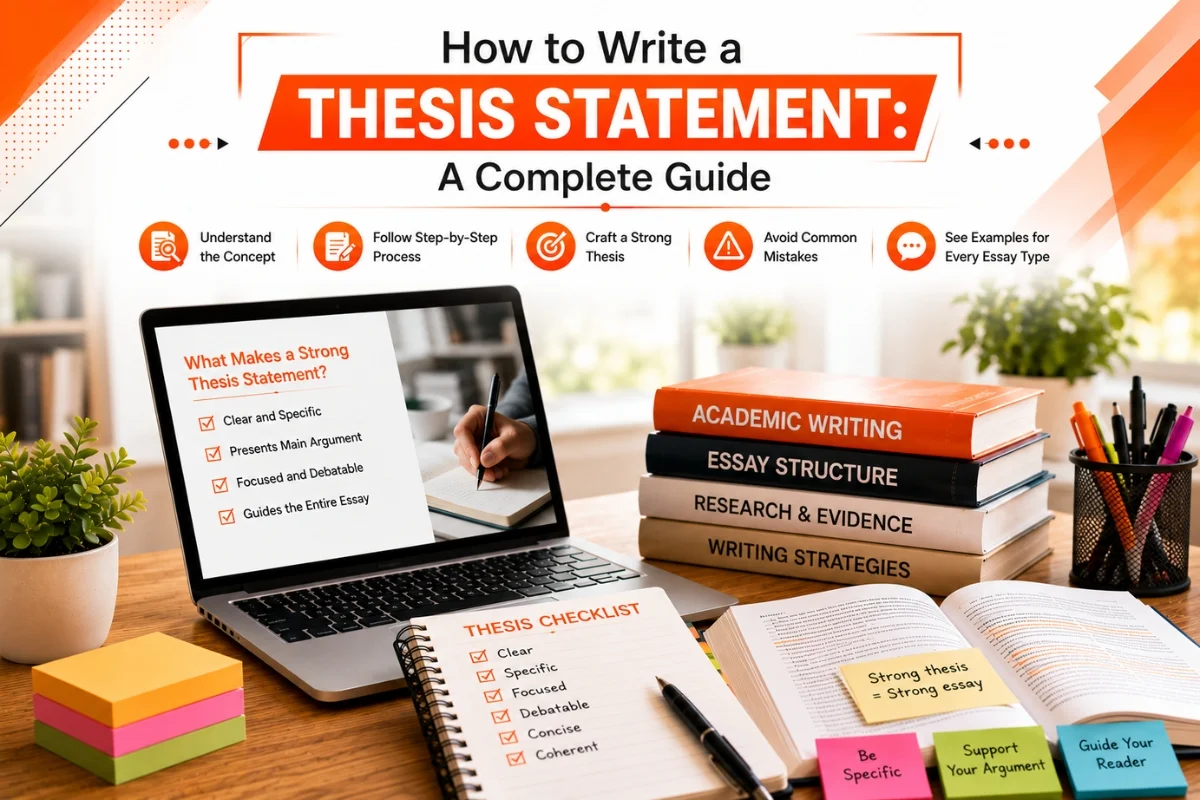
What Is a Thesis Statement?
A thesis statement is a single sentence (sometimes two) that sits near the end of your introduction and tells the reader:
- What your essay is about
- What position or claim are you making
- Why it matters (implied or explicit)
Think of it as a compass. Every sentence in your body paragraphs should point back to it. If a paragraph doesn't support your thesis, it doesn't belong in your essay.
It is not a statement of fact. It is not a question. And it is not a vague announcement like "In this essay, I will discuss climate change."
Where Does It Go?
The thesis statement belongs at the end of your introduction, not the first sentence. Your opening lines should hook the reader and provide context. The thesis lands after that setup, acting as the pivot into your argument.
Structure of a solid introduction:
- Hook: an interesting fact, question, or anecdote
- Background / Context : 2–3 sentences orienting the reader
- Thesis Statement: your central claim
The 4 Non-Negotiable Qualities of a Strong Thesis Statement
A strong thesis statement doesn't happen by accident. Before writing a single word, memorize these four qualities.
1. Specific
Vague language kills thesis statements. Words like "interesting," "important," or "many factors" are red flags.
| Weak | Strong |
|---|---|
| "Social media affects teenagers." | "Excessive social media use among teenagers is linked to higher rates of anxiety and depression, making school-based digital literacy programs essential." |
2. Arguable
Your thesis must be a claim or something a reasonable person could disagree with. If it's a plain fact, it's not a thesis.
| Not arguable | Arguable |
|---|---|
| "Shakespeare wrote Hamlet." | "Hamlet's paralysis is not a character flaw but a rational response to moral corruption in a society where justice is impossible." |
3. Focused
One central idea. Not three. One. If your essay is 5–8 pages, your thesis can have two or three supporting points. If it's shorter, keep it leaner.
| Unfocused | Focused |
|---|---|
| "Fast food is bad for your health, the environment, and the economy." | "Fast food industry marketing aimed at children is a primary driver of childhood obesity in the United States." |
4. Supportable
Everything you claim in your thesis must be backed up in the body of your paper. If you can't support it with evidence, revise the thesis.
| Unsupportable | Supportable |
|---|---|
| "Social media is the sole cause of political polarization." | "Social media algorithms that prioritize outrage-driven content are a significant contributing factor to political polarization among adults under 40." |
Thesis Statement Formula
If you're struggling to write a thesis statement, use this simple formula:
Topic + Position + Main Supporting Points
Example:
- Topic: Online learning
- Position: Benefits students
- Supporting Points: Flexibility, accessibility, affordability
Thesis Statement:
Online learning provides students with greater flexibility, improved accessibility, and lower educational costs than traditional classroom instruction.
For argumentative essays, try this formula:
Because [Reason 1] and [Reason 2], [Subject] should [Action].
Example:
Because renewable energy reduces carbon emissions and improves long-term energy security, governments should increase investment in solar and wind power.
How to Write a Thesis Statement from Scratch
Writing a thesis statement is a learnable skill, not a talent. Here's the actual process that works even when you're stuck.
Step 1: Start with Your Topic
Pick (or receive) a topic. Don't write a thesis yet. Just name the subject.
Example topic: Remote work and productivity
Step 2: Ask a Pointed Question
Turn your topic into a question you're genuinely trying to answer. This is the engine of your thesis.
Question: Does remote work make employees more or less productive?
Step 3: Write a Rough Answer
Don't worry about phrasing. Just answer the question in plain language.
Rough answer: Remote work can increase productivity when employees have strong self-management skills and a good home environment.
Step 4: Add Nuance and "So What?"
Push past the obvious. Why does this matter? Who should care? What should be done about it?
Refined: Because remote work outcomes depend heavily on individual work habits and home conditions, companies need to provide personalized support, not blanket policies, to maximize distributed team performance.
Step 5: Test It Against the 4 Qualities
- Specific? Yes — it names why outcomes vary and what the solution is.
- Arguable? Yes — many companies use blanket policies and would dispute this.
- Focused? Yes — one central claim.
- Supportable? Yes — research and case studies exist.
Final thesis:
"Because remote work productivity depends on individual work habits and home environments rather than hours logged, companies should replace uniform policies with personalized support structures for distributed teams."
The "Working Thesis" Trick for Students
Here's something most guides don't tell beginners: you don't need a perfect thesis before you start writing.
A working thesis is a rough draft of your argument. It is a placeholder that gives your writing direction without locking you in. Many writers finalize their thesis after drafting the body of the essay, once the argument becomes clearer.
Use this starter template to get unstuck:
"In this essay, I argue that _____ because _____ and _____."
It might feel clunky. That's fine. You'll polish it later. The point is to start moving.
Useful Thesis Statement Starters
Sometimes getting started is the hardest part. These sentence starters can help you develop a stronger thesis.
For Argumentative Essays
- Although...
- While...
- Because...
- Despite...
- Given that...
- In order to...
Example:
Although remote work offers greater flexibility, companies should adopt hybrid models to maintain collaboration and employee engagement.
For Analytical Essays
- By examining...
- Through the use of...
- The author demonstrates...
- The text reveals...
Example:
By examining symbolism and imagery, the novel reveals the destructive consequences of unchecked ambition.
For Compare-and-Contrast Essays
- While both...
- Although...and...share...
- Compared with...
- Unlike...
Example:
While both online and traditional learning offer educational opportunities, online learning provides greater flexibility for working adults.
Thesis Statement Examples for Every Essay Type (With Templates)
Different essays demand different thesis structures. Here's a breakdown of the four most common types, each with a real example and a fill-in-the-blank formula.
1. Argumentative Thesis
Purpose: Take a debatable stance and defend it with evidence.
Template:
"Because [reason 1] and [reason 2], [subject] should/must/should not [action]."
Example:
"Because standardized testing fails to capture creative thinking and penalizes students from under-resourced schools, colleges should adopt holistic admissions processes that weigh portfolio work alongside GPA."
2. Expository / Explanatory Thesis
Purpose: Explain a topic, process, or concept without arguing a position.
Template:
"[Topic] involves [component A], [component B], and [component C], each of which [brief explanation of significance]."
Example:
"The process of photosynthesis, involving light absorption, water splitting, and carbon fixation, allows plants to convert sunlight into chemical energy that sustains nearly all life on Earth."
3. Analytical Thesis
Purpose: Break down a text, event, or idea and explain how its parts work together to create meaning.
Template:
"By examining [element A], [element B], and [element C], [the work/subject] reveals [interpretation or insight]."
Example:
"By examining Fitzgerald's use of color symbolism, fragmented timelines, and unreliable narration, The Great Gatsby reveals how the American Dream functions as both a motivating myth and a moral trap."
4. Compare and Contrast Thesis
Purpose: Highlight meaningful similarities and/or differences between two subjects to make a larger point.
Template (Evaluative):
"While both [Subject A] and [Subject B] [shared quality], [Subject A] is superior/more effective/more [X] because [specific reason]."
Template (Explanatory — no judgment):
"Although [Subject A] and [Subject B] share [similarity], they differ significantly in [dimension 1] and [dimension 2], reflecting [broader insight]."
Example:
"While both immunotherapy and chemotherapy aim to eliminate cancer cells, immunotherapy produces fewer long-term side effects and shows greater efficacy in certain cancers, making it the more promising direction for oncological research."
What to Do When Your Thesis Changes Mid-Essay
This happens to every writer, including professionals. You start with one argument, and by the time you've written three body paragraphs, your actual position has evolved.
Don't ignore it. Update your thesis.
Here's the fix:
- Finish writing the body of your essay.
- Read your body paragraphs and ask: "What is the one claim all of these paragraphs are actually supporting?"
- Write that claim down. That's your real thesis.
- Go back and revise your introduction to match.
This is normal. It's called recursive writing, and it produces better essays than forcing yourself to stick with your original thesis when your thinking has grown.
7 Thesis Statement Mistakes That Weaken Strong Essays
These are the patterns that consistently prevent writers from crafting a strong thesis statement.
1. The Fact Statement
✗ Climate change is a global problem.
✓ Without legally binding international emissions targets, climate change will disproportionately devastate developing nations least responsible for the crisis.
A fact needs no argument. A thesis does.
2. The Announcement
✗ In this paper, I will discuss the effects of social media on mental health.
✓ Algorithmic social media feeds, designed to maximize engagement rather than wellbeing, are a leading driver of anxiety disorders among users under 25.
State your claim, not your writing plan.
3. The Vague Generalizer
✗ There are many positive and negative aspects of online learning.
✓ Online learning improves accessibility for working adults but widens achievement gaps for K–12 students without stable home environments, demanding a two-tiered policy response.
Vague theses produce vague essays.
4. The Question
✗ Is social media harmful to democracy?
✓ Social media platforms, by amplifying emotionally charged misinformation over factual content, pose a direct structural threat to democratic discourse.
A thesis doesn't ask a question; it answers.
5. The Scope Mismatch
✗ The entire history of racism in America must be dismantled.
✓ Mandatory anti-bias training in K–8 schools can reduce racial prejudice by shaping attitudes before they become deeply ingrained.
Match your thesis to the length and scope of your assignment.
6. The Buried Thesis
Don't hide your thesis in the middle of a body paragraph. It belongs at the end of your introduction.
7. The Misaligned Thesis
If your body paragraphs argue something different from your thesis, you have a mismatch. This often happens when you revise your argument mid-draft but forget to update the opening. Always re-read your thesis after finishing your draft.
Thesis Statements Beyond the Classroom
Here's the part most academic blogs skip entirely: thesis statements aren't just for essays.
The skill of building a clear, defensible central claim transfers directly into real life:
- Professional reports: "Our Q3 decline in customer retention stems primarily from onboarding friction, not pricing and can be reversed with targeted UX improvements in the first 14 days."
- Job interviews: "I'm the right fit for this role because I combine deep technical expertise with cross-functional communication skills, something your team currently lacks."
- Arguments and debates: Knowing your thesis prevents you from rambling. It keeps you anchored to your actual point.
- Pitches and presentations: Every compelling pitch has a thesis, a central claim the rest of the presentation exists to prove.
The moment you start thinking in thesis statements, your communication gets sharper across every context.
After crafting your thesis, learn how to develop supporting paragraphs and strong conclusions in our guide on how to write a compare-and-contrast essay.
Quick Thesis Statement Checklist
Before submitting any essay, run your thesis through this checklist:
- Is it one or two sentences?
- Does it appear at the end of the introduction?
- Does it make a claim, not state a fact?
- Is it specific, with no vague words like "interesting" or "important"?
- Could a reasonable person disagree with it?
- Do all my body paragraphs support it?
- Does it match the scope of my assignment?
If you can check every box, your thesis is solid.
Get Expert Help with Thesis Statements and Essays
A strong thesis statement doesn't write itself. It takes a clear question, a specific answer, and the willingness to revise until your claim is sharp enough to cut through.
Knowing how to write a thesis statement is one thing; turning it into a strong essay under a tight deadline is another. If you're short on time or need help organizing your ideas, My Premium Essay can help. At my premium essay, we connect students with experienced essay writers who create original, well-structured essays built around clear, effective thesis statements.
Whether you need an argumentative essay, research paper, or urgent assignment, our experts can help you submit high-quality work on time.
Frequently Asked Questions
What is a thesis statement in simple terms?
A thesis statement is one or two sentences, placed at the end of your introduction, that tells the reader exactly what your essay argues, explains, or analyzes. Everything else in your paper exists to support it.
How long should a thesis statement be?
One to two sentences. A thesis is not a paragraph. If yours runs longer, you likely have multiple claims tangled together; split them out and pick the strongest one as your central argument.
What is the difference between a thesis statement and a topic sentence?
A thesis statement presents the main argument of the entire essay, while a topic sentence introduces the main idea of a single paragraph and supports the thesis.
Can a thesis statement be more than one sentence?
Yes. Most thesis statements are one sentence, but complex topics may require two sentences to clearly communicate the central argument and supporting points.
Do different essay types require different thesis statements?
Yes. Argumentative essays present a debatable claim, analytical essays interpret evidence or texts, expository essays explain a topic, and compare-and-contrast essays highlight similarities and differences between subjects.
Can a thesis statement be a question?
No. A thesis must answer a question, not ask one. If you find yourself writing a question as your thesis, that question is your research question, your thesis is the answer to it.
How do you write a thesis statement for a research paper?
Start by identifying your research question, then answer it with a specific claim supported by your findings. A strong research thesis names the relationship between variables or ideas, takes a clear position, and signals the scope of your paper. Use a working thesis early and refine it as your research develops.
What is a working thesis?
A working thesis is a rough, preliminary version of your argument that you write before finishing your research or drafting. It gives your writing direction without locking you in. Most writers revise their working thesis at least once after drafting the body of their essay.

 MyPremiumEssay