
Keep it 150 to 250 words (check your specific limit; some run up to 300), and write it only after the full paper is finished, so every claim matches what the paper actually delivers.
This abstract writing guide breaks down exactly how to write each section, how length and structure change by discipline and format, and includes complete research paper abstract examples you can model your own writing on.
What Is an Abstract?
An abstract is a concise, self-contained summary placed at the start of a research paper, thesis, or journal article. It allows a reader to understand the scope, purpose, and findings of a paper without reading the full document.
Researchers scan abstracts to decide whether a paper is relevant to their work, which makes the abstract one of the most-read sections of any academic paper, often more read than the paper itself.
An abstract is not an introduction. The introduction draws the reader in and sets up the argument gradually. The abstract delivers the complete picture immediately: what the paper investigated, how, and what it found.
Where the Abstract Appears
The abstract sits on its own page directly after the title page and before the introduction. It is the first full piece of content a reader encounters, which is why it must function as a complete, accurate summary on its own.
Abstract Format Requirements by Citation Style
Whether your paper requires an abstract depends on the citation format and discipline.
| Format | Abstract Required? | Typical Length |
|---|---|---|
| APA 7th edition | Yes, for most academic papers | 150 to 250 words |
| MLA 9th edition | No, not standard | N/A |
| Chicago/Turabian | Sometimes, more common in sciences | 150 to 250 words |
| IMRaD (scientific papers) | Yes, always | 150 to 300 words |
If your assignment does not specify, ask your instructor before submission. A missing abstract on a paper that required one is an easy and entirely avoidable point deduction.
A note on structured and graphical abstracts:
Some STEM and medical journals require a structured abstract, which breaks the same five elements into labeled subheadings (Background, Methods, Results, Conclusion) instead of one flowing paragraph.
A small but growing number of journals also request a graphical abstract, a single image summarizing the methodology and findings visually.
If your target journal or course requires either format, follow its specific template exactly. The five-element content described in this guide still applies; only the presentation changes.
Abstract Structure: The 5 Key Elements
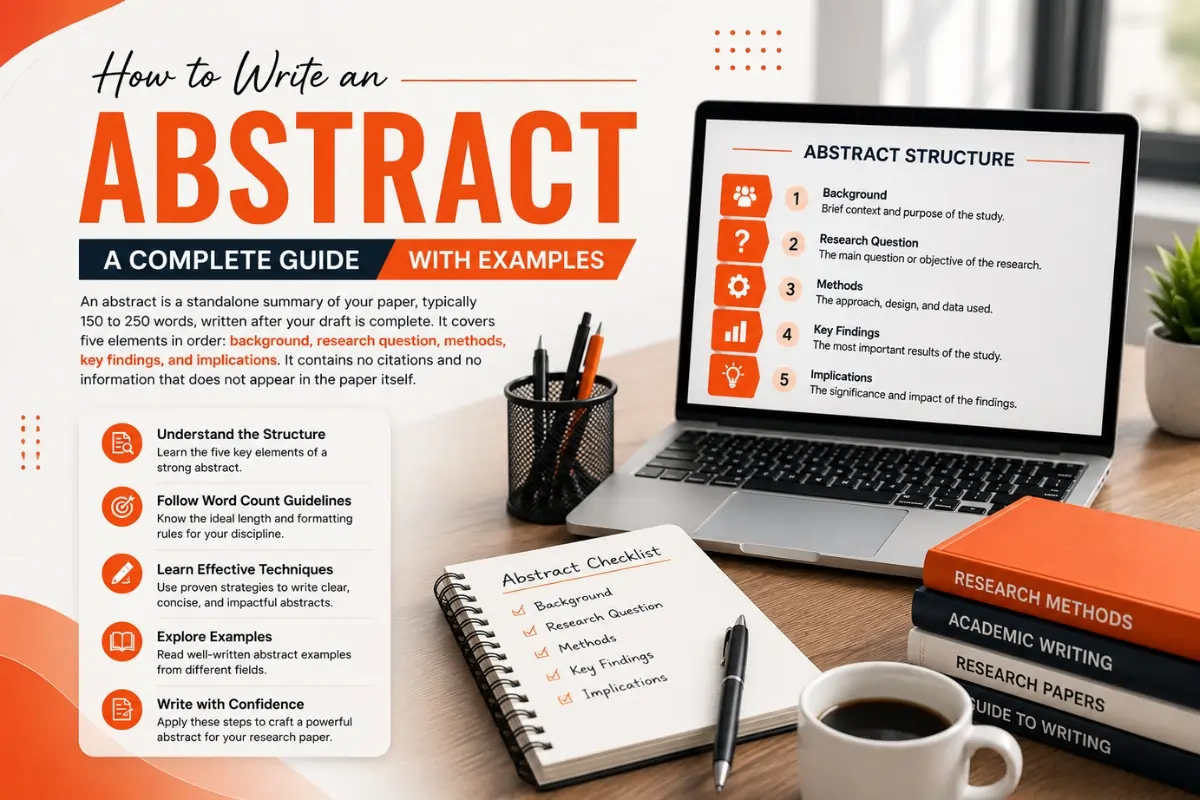
Every strong abstract, regardless of discipline, covers five elements in this order.
1. Background or Context (1 to 2 sentences)
State the topic and why it matters. This orients the reader before you narrow to your specific focus.
2. Research Question or Purpose (1 sentence)
State precisely what your paper investigates. This is the narrowest, most specific sentence in your abstract.
3. Methods or Approach (1 to 2 sentences)
Explain how you investigated the question. For empirical papers, this includes your sample, data source, or experimental method. For argumentative or analytical papers, this describes your approach: which sources, frameworks, or case studies you used.
4. Key Findings or Argument (2 to 3 sentences)
State what you found or concluded. This is the core of your abstract and should be the most detailed section. Be specific. Vague claims like "the results were significant" tell the reader nothing.
5. Implications (1 sentence)
Explain why the findings matter, what they contribute to the field, or what they suggest for future research or practice.
How to Write an Abstract Step by Step
Step 1: Write the Abstract Last
Never write your abstract before your paper is complete. It is a summary of what you actually wrote, not a preview of what you plan to write. Drafting it early forces you to either guess at conclusions you have not reached yet or rewrite the abstract entirely once your argument evolves, which it almost always does during the writing process.
Step 2: Extract Your Thesis and Key Findings
Reread your introduction and conclusion. Pull out your thesis statement and your three to four most important findings or arguments. These become the raw material for elements two and four above.
Step 3: Draft One Sentence per Element
Write a single, complete sentence for each of the five elements before worrying about transitions or flow. This keeps the abstract tight and prevents it from ballooning past the word limit.
Step 4: Combine and Tighten
Connect your five sentences into a coherent paragraph. Cut any sentence that does not directly serve one of the five elements. Abstracts have no room for throat-clearing, scene-setting, or transitional filler.
Step 5: Check Against the Rules
Verify your draft against the core rules below before finalizing.
Key Rules for Every Abstract
Follow these rules without exception:
- No citations appear in the abstract, even if you cite the same sources extensively in your paper.
- No information appears in the abstract that does not also appear in the body of the paper.
- Use past tense to describe what you did and present tense for conclusions and implications. The abstract is one paragraph, no headings or bullet points, unless your specific format or instructor requires otherwise.
- Stay within the word count: 150 to 250 words for most formats.
- Do not define basic terms or include background that a reader in your field already knows.
Research Paper Abstract Examples
Below are three complete, worked abstract examples across different disciplines and paper types. Each follows the five-element structure described above.
Example 1: Psychology (Empirical Paper, APA Format)
Sleep deprivation is widely associated with cognitive impairment, yet its specific effects on working memory in young adults remain underexamined. This study investigates whether acute sleep deprivation (24 hours without sleep) impairs working memory performance in adults aged 18 to 25, using a randomized controlled design with 60 participants split between a sleep-deprived condition and a rested control condition. Participants in the sleep-deprived group showed a 23% decrease in working memory accuracy on the N-back task compared to controls, with the largest deficits observed in tasks requiring sustained attention beyond five minutes. Reaction time also slowed significantly in the sleep-deprived group, though no significant differences emerged in simple recall tasks. These findings suggest that working memory tasks requiring sustained attention are more vulnerable to acute sleep deprivation than basic recall tasks, with implications for shift workers and students during exam periods.
Example 2: History (Argumentative Paper, Chicago Format)
Wartime propaganda has long been studied for its persuasive techniques, but its role in shaping legal and policy outcomes has received less scholarly attention. This paper examines how Office of War Information campaigns between 1942 and 1945 contributed to public support for Japanese American internment, drawing on archival press releases, newspaper coverage, and contemporary public opinion polling. Analysis of over 200 wartime publications reveals a consistent pattern of selective omission, particularly the exclusion of Japanese American military service records from domestic coverage, which constructed loyalty as something absent rather than demonstrated. This omission directly correlates with rising support for internment in opinion polling between 1942 and 1943. The paper argues that propaganda's influence on policy operated not primarily through explicit persuasion but through selective absence, a mechanism with continued relevance to contemporary information campaigns during periods of perceived national crisis.
Example 3: Literature (Analytical Paper, MLA-Adjacent Format)
Critical readings of Shakespeare's cross-dressing comedies have traditionally treated disguise as a temporary device resolved through marriage and the restoration of social order. This paper examines the function of disguise as a mechanism for female agency in As You Like It and Twelfth Night, analyzing the language and stage directions associated with Rosalind and Viola against early modern conventions of female speech and movement. Close reading reveals that both characters retain rhetorical and social privileges gained through disguise even after their identities are revealed, complicating readings that treat the comedic resolution as a full return to gendered norms. The paper argues that Shakespeare's comedies stage disguise not as a contained exception but as a durable expansion of female agency that survives the plot's formal restoration of order. This reading contributes to the ongoing scholarly debate about the conservatism or subversiveness of Shakespearean comic structure.
For thesis statement examples (literature) is a clear opportunity to link to our guide on Writing a Literary Analysis Thesis Statement: A Step-by-Step Guide.
Not sure your abstract is hitting the mark? Our academic writers review and rewrite abstracts daily across every discipline and citation format. If you want a second opinion or a fully written abstract built around your actual findings, MyPremiumEssay is available 24/7.
Common Abstract Mistakes to Avoid
1. Writing it first. An abstract written before the paper is finished is a prediction, not a summary. It will not match your actual conclusions.
2. Including citations. Citations belong in the body of the paper. An abstract is a standalone summary and never references outside sources directly.
3. Vague findings. "The results showed an interesting pattern" tells the reader nothing. State the actual finding, with a number or specific outcome where possible.
4. Exceeding the word limit. Most journals and instructors enforce strict word counts. Going over signals a lack of attention to formatting requirements and often gets penalized directly.
5. Including new information. Anything in the abstract must also appear in the paper. Do not introduce a finding or argument in the abstract that the body of the paper does not actually develop.
6. Confusing the abstract with the introduction. The introduction builds context gradually and ends with a thesis. The abstract delivers the complete picture, including the conclusion, immediately.
7. Using first person inconsistently. Match the person and tense conventions of your discipline and format. If your paper avoids first person throughout, the abstract should too.
For help structuring the paper's body, see our guide on how to write body paragraphs.
Abstract Quick-Reference Checklist
- Written after the full paper draft is complete
- Covers all five elements: background, question, methods, findings, implications
- Stays within required word count (typically 150 to 250 words)
- Contains zero citations
- Contains zero information not found in the paper itself
- Uses past tense for what was done, present tense for conclusions
- Written as a single paragraph with no headings or bullet points
- Findings are specific, not vague
- Matches the person and tense conventions used in the rest of the paper
- Proofread separately from the rest of the paper, since it is often the most-read section
Frequently Asked Questions
How long should an abstract be?
Most academic abstracts run 150 to 250 words. Scientific journals sometimes allow up to 300 words. Always check your specific format or journal guidelines, since exact limits vary.
Do I need an abstract for an MLA paper?
No. MLA format does not require an abstract. If your instructor requests one anyway, follow their specific instructions rather than standard MLA convention.
Can I use first person in an abstract?
It depends on your discipline and format. APA permits first person in many contexts. Scientific and Chicago-style papers often avoid it. Match whatever convention the rest of your paper follows.
What is the difference between an abstract and an executive summary?
An abstract summarizes an academic paper for an academic audience and follows strict formatting and length rules. An executive summary is used in business and policy documents, is often longer, and may include recommendations or action items that an academic abstract would not contain.
Should I write the abstract before or after the paper?
Always after. The abstract summarizes your actual conclusions, methods, and findings, which only exist once the paper is complete.
What makes a strong research paper abstract?
A strong abstract is specific rather than vague, follows the five-element structure in order, stays within the word limit, and gives the reader a complete and accurate picture of the paper without needing to read further. See the worked examples above for models across disciplines.
Do I need to include keywords below my abstract?
Many journals and some instructors require 4 to 6 keywords listed directly beneath the abstract, separated by commas. These keywords help the paper appear in academic database searches. Choose terms that reflect your topic, methodology, and field, and avoid repeating words already prominent in your title. Check your specific format or journal guidelines, since this requirement is not universal.
Need Help Writing Your Research Paper or Abstract?
If you are working on a complete research paper and need expert support on the abstract, methodology, or any other section, MyPremiumEssay's professional research paper writing service is built for exactly that.
MyPremiumEssay has delivered over 10,000 research papers across every major discipline and citation format, including APA, MLA, Chicago, Harvard, and more. Every paper, including the abstract, is written to your exact instructions, properly formatted, plagiarism-checked, and delivered on time.
Whether you need a complete paper, a properly structured abstract, or help with one specific section, get expert help now. Available 24/7.
Order Now
 MyPremiumEssay