




Those four moves cover most dialogue you will ever write. The sections below show each rule with a clear example. Where students slip up, you will see the mistake fixed and the reason why.
Punctuation is one part of the wider skill. Our full guide on how to write dialogue in an essay covers building the scenes themselves.
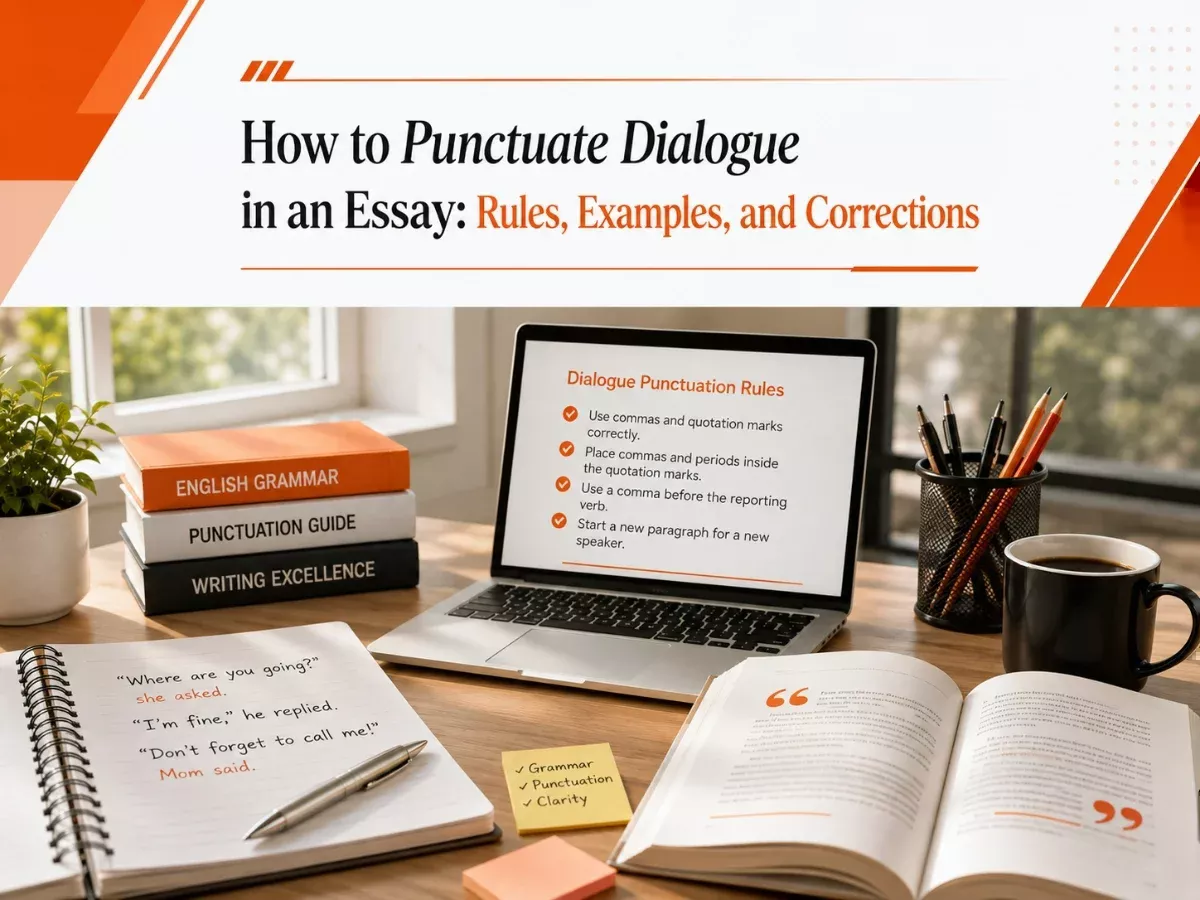
What Dialogue Looks Like Inside an Essay
Dialogue is direct speech, the exact words a person says. Quotation marks set it apart from the rest of your writing. A dialogue tag, like she said, tells the reader who is speaking.
Here is a correctly punctuated line in an essay:
As I stepped off the bus, my grandmother said, "You've grown taller than the doorframe."
The quotation marks wrap the spoken words. A comma follows the tag. The period sits inside the closing quotation mark.
Direct Speech vs. Reported Speech
Dialogue quotes a speaker word for word. Reported speech paraphrases it and needs no quotation marks.
- Direct: "I'm not going," she said.
- Reported: She said that she wasn't going.
Only direct speech gets punctuated as dialogue. If you paraphrase what someone said, drop the quotation marks.
Can You Use Dialogue in an Essay? Read This First
Before you punctuate anything, check that dialogue belongs in your essay. Most guides skip this step. It is the reason some students lose marks even with perfect punctuation.
Essays Where Dialogue Belongs
Dialogue works well in essays that tell a story or recreate a scene:
- Narrative essays, where dialogue moves the events forward.
- Personal statements, where a short exchange reveals character.
- Descriptive essays, where a line of speech adds life.
If you write one of these, dialogue is a real tool. Used well, it moves the story without overloading it.
Essays Where You Should Avoid It
Argumentative, research, and expository essays rarely suit invented dialogue. These essays are built on evidence and analysis, not scene-setting. Use quoted sources instead of spoken lines.
Longer academic projects, like research papers and dissertations, almost never use narrative dialogue. The simple rule is this. If the essay tells a story, dialogue fits. If it makes an argument, use evidence.
Dialogue vs. a Quoted Source: Don't Confuse Them
This is the most common point of confusion, and few guides address it. Dialogue and quoted evidence both use quotation marks. They are not the same thing.
Dialogue is a person speaking inside your own narrative. You wrote or recalled it, so it needs no citation.
"We'll be late," Dad muttered, checking his watch.
A quotation is borrowed wording from a source. It must be cited in MLA, APA, or Chicago style, depending on your assignment.
Orwell warned that political language is "designed to make lies sound truthful" (Orwell 116).
The Quick "Dialogue or Quotation?" Test
Ask one question. Did these words come from an outside source I need to credit?
- Yes. It is a quotation, so cite it. Purdue OWL keeps clear guides for MLA, APA, and Chicago.
- No. It is dialogue, so punctuate it with the rules below. No citation needed.
The Core Rules for Punctuating Dialogue
Four rules cover almost every line of dialogue you will write.
1. Put spoken words inside double quotation marks. In US English, dialogue uses double marks. UK writers often use single marks, so pick one and stay consistent.
2. Keep end punctuation inside the closing quotation mark. In American style, periods and commas always sit inside the quotes.
3. Use a comma to connect dialogue and its tag. When a tag follows speech, the period becomes a comma, as in "I'm leaving," she said.
4. Capitalize the first spoken word, even when the dialogue starts mid-sentence, as in He whispered, "Wait for me."
When the Tag Comes First
If the dialogue tag opens the sentence, put a comma after it. Then capitalize the first spoken word.
She turned and said, "You didn't have to come."
The period still lands inside the closing quotation mark.
Where Each Punctuation Mark Goes
Choosing between a comma, period, question mark, or exclamation mark trips up many students. One question settles it. What is the spoken line doing?
| The dialogue is a… | Use this mark | Example |
|---|---|---|
| Statement, followed by a tag | Comma, inside quotes | "I finished the essay," he said. |
| Statement, standing alone | Period, inside quotes | He nodded. "I finished the essay." |
| Question | Question mark, inside quotes | "Did you finish the essay?" she asked. |
| Exclamation | Exclamation mark, inside quotes | "I finished the essay!" he shouted. |
The Rule Most Students Get Wrong
When speech ends in a question mark or exclamation mark, do not add a comma before the tag. The stronger mark already does the job.
- Incorrect: "Are you serious?," she asked.
- Correct: "Are you serious?" she asked.
- Why: A question mark and a comma cannot share the same spot. The question mark replaces the comma, and the tag stays lowercase.
Starting a New Paragraph When the Speaker Changes
Every time a new person speaks, start a new paragraph. Do this even if they say one word. The break tells the reader that the speaker has changed.
- Incorrect: "Are you ready?" Mara asked. "Almost," I replied, tightening my laces.
Correct:
"Are you ready?" Mara asked.
"Almost," I replied, tightening my laces.
- Why: Running two speakers together forces the reader to work out who spoke. A paragraph break removes that doubt.
Dialogue Tags vs. Action Beats
A dialogue tag reports speech, using verbs like said or asked. An action beat describes what a speaker does, like she smiled. They are punctuated differently, and mixing them up is a frequent error.
Dialogue Tag: Use a Comma
A tag attaches to the speech with a comma. The verb stays lowercase.
"This is the one," she said.
Action Beat: Use a Period
An action is not speech, so it cannot join with a comma. It becomes its own sentence.
- Incorrect: "This is the one," she smiled.
- Correct: "This is the one." She smiled.
- Why: You cannot smile words, so she smiled is an action. It needs a period and a capital letter.
Mid-Sentence Tags
When a tag interrupts one continuous sentence, wrap it in commas. Keep the continuation lowercase.
"If we leave now," he said, "we'll still make the train."
If the tag divides two separate sentences, close the first one with a period.
"We're not going to make it," he said. "The train already left."
Single vs. Double Quotation Marks
In American English, dialogue takes double quotation marks. In British English, single marks are common. Neither is more correct, but you must stay consistent within one essay.
A Quotation Inside Dialogue
When a speaker quotes someone else, switch to single quotation marks for the inner quote.
"She looked at me and said, 'Don't wait up,'" Jenna recalled.
The single mark and the double mark stack at the end, with the period tucked inside both.
Tricky Cases Students Get Wrong
These situations sit scattered across other guides. Here they are in one place.
Interrupted Dialogue
When a speaker is cut off by another person or event, use an em dash inside the quotation marks.
"But I never said that I—" The phone cut out.
Trailing Off
When speech fades rather than stops sharply, use an ellipsis.
"I'm not sure this is a good idea…"
Dialogue Followed by Action
Keep the spoken line and the action as separate sentences.
"Leave it." She turned back to the window.
Multi-Paragraph Speech
When one person speaks for more than a paragraph, start each paragraph with an opening quotation mark. Add a closing mark only at the end of the final paragraph. This shows the same speaker is still talking.
Correct vs. Incorrect: Dialogue Examples Fixed
Here are four common mistakes from real student essays, each corrected.
1. Period instead of a comma before a tag
- "I'll think about it." she said.
- "I'll think about it," she said.
- Why: A tag continues the sentence, so the speech ends in a comma.
2. Capitalized tag after a comma
- "We should go," She whispered.
- "We should go," she whispered.
- Why: The tag is part of the same sentence, so she stays lowercase.
3. Punctuation outside the quotation marks
- "That's the plan".
- "That's the plan."
- Why: In US style, the period belongs inside the closing quotation mark.
4. No new paragraph for a new speaker
- "Ready?" he asked. "Not yet," I said.
- Two separate paragraphs, one per speaker.
- Why: A new speaker always starts a new paragraph.
Common Dialogue Punctuation Mistakes to Avoid
- Placing periods or commas outside the closing quotation mark in US style.
- Adding a comma after a question mark or exclamation mark before a tag.
- Capitalizing a dialogue tag that follows a comma.
- Joining an action beat to speech with a comma instead of a period.
- Failing to start a new paragraph when the speaker changes.
- Mixing single and double quotation marks in the same essay.
- Treating invented dialogue like a source quotation, or the reverse.
Dialogue Punctuation Editing Checklist
Run this over any essay before you submit.
- Are all spoken words inside quotation marks?
- Are periods and commas inside the closing quotation mark?
- Does each tag connect with a comma, with the verb lowercase?
- Is the first spoken word capitalized?
- Did you avoid a comma after a question or exclamation mark?
- Does each new speaker start a new paragraph?
- Are action beats written as separate sentences?
- Are single and double marks used consistently?
- Is any borrowed wording cited as a quotation, not dialogue?
Frequently Asked Questions
Do you use quotation marks for dialogue in an essay?
Yes. Direct speech always sits inside quotation marks. Use double marks in US English and single marks in UK English. Only paraphrased speech skips them.
Can you use dialogue in an argumentative essay?
Usually not. Argumentative and research essays rely on evidence and analysis. Quote and cite sources instead, and save dialogue for narrative essays.
What is the difference between dialogue and a quotation in an essay?
Dialogue is a person speaking within your own narrative, so it needs no citation. A quotation is borrowed wording from a source and must be cited.
Do you start a new paragraph every time the speaker changes?
Yes, even for a single word. A new paragraph for each speaker keeps the exchange easy to follow.
Does dialogue in an essay need a citation?
No. Dialogue is your own narrative writing, so it is not cited. Only words from an outside source need a citation.
Can you start an essay with dialogue?
Yes, in a narrative or personal essay. A short line of speech makes a strong hook. Avoid it in argumentative and research essays, where a clear claim works better.
How do you punctuate a quote within dialogue?
Use single quotation marks for the inner quote. For example, "She said, 'Wait for me,'" he recalled. The marks and the period stack at the end.
Should you italicize dialogue in an essay?
No. Spoken dialogue uses quotation marks, not italics. Writers sometimes italicize a character's silent thoughts, but standard speech stays in quotation marks.
Where does the comma go when the dialogue tag comes first?
Place the comma right after the tag, before the opening quotation mark. Then capitalize the first spoken word, as in She said, "Come in."
How much dialogue should an essay include?
Only as much as the story needs. Use short, purposeful lines that reveal character or move the events. Long stretches of speech can crowd out your own analysis.
How do you show two people talking in an essay?
Give each speaker their own paragraph. Start a new line whenever the speaker changes, even for a one-word reply. This keeps the exchange clear.
How do you punctuate interrupted dialogue?
Use an em dash inside the quotation marks when a speaker is cut off. For example, "But I never said that I—" The mark shows the sudden break.
Do you capitalize the first word after a dialogue tag?
Not if the sentence continues. In "Wait," she said, "for me," the word for stays lowercase because the sentence is still going.
Need a narrative or personal essay with dialogue handled correctly from the first draft? Our writing team can help you get both the punctuation and the story right.

 MyPremiumEssay