In this guide, you'll learn how to write a critical response essay step by step, including its structure, essential elements, examples, and common mistakes to avoid.

What Is a Critical Response Essay?
A critical response essay is an academic paper that analyzes and evaluates a text, such as a book, article, film, speech, or research study. Rather than simply summarizing the content, you examine the author's ideas, arguments, evidence, and overall effectiveness.
Here is what a critical response essay involves:
Reading a source text carefully and understanding its main argument
Briefly summarizing what the author claims
Analyzing the strengths and weaknesses of that argument
Presenting your own informed position, backed by evidence from the text
Notice that "critical" here does not mean you have to disagree or be negative. It means you are thinking carefully and analytically, which is a very different thing.
Types of Critical Response Essays
While all critical response essays involve analysis and evaluation, they can focus on different aspects of a source depending on the assignment.
Analytical Response
Examines how the author develops ideas, structures arguments, or uses evidence. The focus is on understanding and assessing the author's approach.
Evaluative Response
Judges the effectiveness of the work by analyzing its strengths, weaknesses, credibility, and overall impact.
Interpretive Response
Explores the deeper meaning of a text, theme, symbol, or message and explains how the author communicates it.
Comparative Response
Compares two or more texts, authors, or viewpoints to identify similarities, differences, and relative effectiveness.
Personal Response
Connects the source to your own experiences, beliefs, or observations while still supporting your analysis with evidence from the text.
Regardless of the type, a strong critical response should move beyond summary and provide thoughtful analysis supported by specific examples.
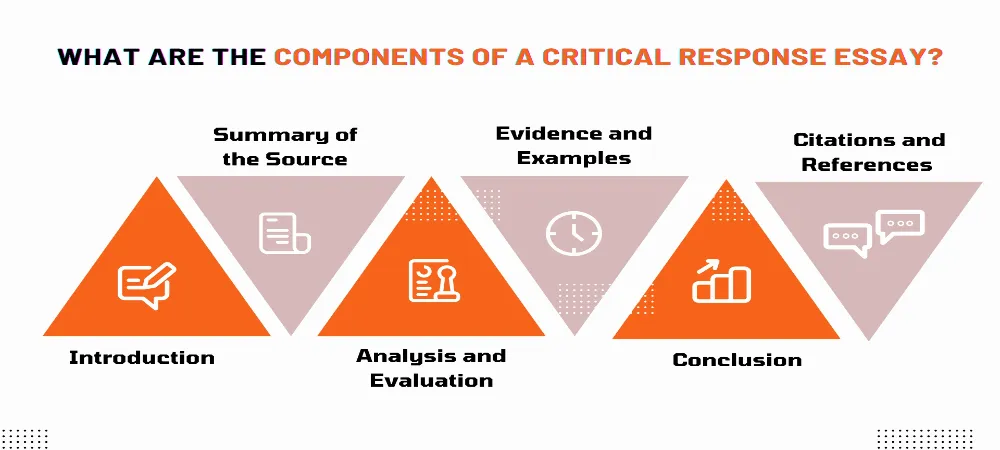
Structure of Critical Response Essay
Here is a simple breakdown of how a typical critical response essay is structured:
Introduction (around 10% of the essay):
Identify the text, summarize the main argument, and state your thesis
Summary (around 10 to 15% of the essay):
Briefly cover the key points relevant to your critique
Body paragraphs (around 60 to 70% of the essay):
One evaluative point per paragraph using the PIE structure
Conclusion (around 10% of the essay):
Restate thesis, recap key points, broader reflection
How to Write a Critical Response Essay: Step by Step
Whether you are writing one for the first time or trying to improve on previous attempts, following these steps in order will make the whole experience a lot less stressful.
Step 1: Read the Text More Than Once
This sounds obvious, but most writing problems start with rushing through the reading. You cannot evaluate something you do not fully understand.
Here is how to approach the reading:
Read through the text once just to understand the overall argument and get familiar with the content
Read it a second time with a pen or highlighter in hand, marking the key claims, supporting evidence, and any logical jumps that catch your attention
Ask yourself as you read: What is this person trying to convince me of? What reasons do they give? Do those reasons actually support the claim?
Pay attention to the tone the author uses, the type of evidence they rely on (statistics, personal stories, expert quotes), and whether there are any points in the argument that feel weak or unsupported.
Taking notes at this stage saves you a lot of time when you sit down to write.
Step 2: Develop Your Thesis
Your thesis is the most important sentence in your essay. It is your position on the text, stated clearly and specifically.
Many students write a vague thesis because they are nervous about committing to a strong opinion. But a vague thesis produces a vague essay. You need to take a real stance.
Here is the difference between a weak and a strong thesis:
Weak thesis: "This article makes some interesting points but also has a few problems."
Strong thesis: "While Johnson's argument about social media and anxiety is emotionally compelling, it ultimately fails to convince because the evidence she cites is correlational rather than causal, and she ignores a significant body of research that points in the opposite direction."
The strong version tells the reader exactly what you think and why. That specificity gives your entire essay direction.
Your thesis should:
State whether you find the argument convincing, unconvincing, or somewhere in between
Briefly indicate the main reason or reasons for your position
Be specific enough that someone could write a focused essay from it
Step 3: Write the Introduction
Your introduction has three jobs, and they need to happen in a logical order.
Here is what to include:
Identify the text. Name the author, the title, and ideally the year or publication context. This gives your reader the basic information they need.
Summarize the main argument. In one or two sentences, explain what the author is arguing. Keep this neutral, you are not evaluating yet, just reporting.
State your thesis. End the introduction with your evaluative position. This is where you tell the reader what to expect from the rest of the essay.
The introduction does not need to be long. Three to five sentences is usually enough. Your goal is to orient the reader and signal your argument, not to impress them with your opening paragraph.
Step 4: Briefly Summarize the Text
Before you analyse, you need to provide readers with enough context to follow your critique. But this section should be noticeably short, usually no more than a paragraph or two.
Cover the key points of the text that are relevant to your argument. You do not need to mention everything the author said. Focus on the claims and evidence that you are going to analyze.
A few things to keep in mind:
Use your own words rather than quoting long passages
Stay objective here, save your opinions for the analysis section
Do not spend so much time summarizing that you run out of space to analyze
This is one of the most common mistakes students make. They spend sixty or seventy percent of the essay summarizing and only a small amount analyzing. Summary is scaffolding. The analysis is the actual building.
Step 5: Write the Body Paragraphs (This Is the Main Event)
This is where most of your essay lives and where your critical thinking is on full display. Each body paragraph should focus on one evaluative point.
A reliable structure for each paragraph is the PIE method:
Point: Start with a clear evaluative claim. For example, "One of the weakest aspects of the argument is its reliance on anecdotal evidence."
Illustration: Back up your point with a specific quote or paraphrase from the text.
Explanation: Explain why this supports your point and what it means for the overall argument.
Here are some questions you can use to generate analysis:
Is the logic of the argument sound, or does it contain gaps and leaps?
What type of evidence does the author use, and is it appropriate and reliable?
What assumptions is the author making that they never directly address?
Is there bias in the way the argument is framed?
What perspectives or evidence has the author left out?
Does the conclusion actually follow from the evidence provided?
You do not need to cover all of these in every essay. Choose the angles that are most relevant to your thesis and develop them with specific references to the text.
A strong critical response essay also acknowledges what the author does well. If the evidence is strong in some areas but weak in others, say so. That kind of nuanced thinking is exactly what markers are looking for.
Step 6: Write the Conclusion
The conclusion is not just a place to repeat yourself. It is your final opportunity to leave the reader with a clear sense of your overall evaluation.
Here is what a good conclusion does:
Restates your thesis in fresh language, not word for word
Briefly recaps the main evaluative points you made in the body
Ends with a broader reflection, such as the significance of the argument, what it gets right despite its flaws, or what would be needed to make the argument stronger
What a good conclusion does not do:
Introduce brand new arguments or evidence
End abruptly without a sense of closure
Simply list everything you already said without adding any final insight
Keep the conclusion focused. Two to four sentences restating your position plus one sentence of broader reflection is usually enough.
Step 7: Revise and Edit Before You Submit
Writing a first draft is not the same as finishing your essay. The revision stage is where good essays become great ones.
After you finish your draft, come back to it with fresh eyes if you can; even a few hours later makes a difference. Ask yourself these questions:
Does every paragraph connect back to the thesis?
Is my summary section noticeably shorter than my analysis?
Have I supported every evaluative claim with evidence from the text?
Does my tone stay analytical throughout, or does it slip into purely personal reactions?
Are all quotes properly attributed and cited?
Does the conclusion restate my thesis without copying it word for word?
Also check for clarity. If a sentence took you more than one read to understand, it probably needs to be rewritten. Academic writing should be precise and readable, not deliberately complicated.
Critical Response Essay Outline and Template
Use this outline as a fill-in-the-blank starting point every time you sit down to write. Simply replace the bracketed sections with your own content.
Title
[Optional, if required by your instructor]
Introduction
[Name of author] in [title of text], published in [year/source], argues that [one to two sentence neutral summary of the author's main claim]. While [acknowledge something the author does well], this essay argues that [your thesis: your evaluative position and the main reason or reasons behind it].
Brief Summary
[Author's last name] begins by [key point one]. The author then [key point two], drawing on [type of evidence used]. The piece concludes by [key point three or overall conclusion the author reaches].
Body Paragraph 1
[Evaluative claim about the text, for example: one of the strongest aspects of the argument is...]. [Author] supports this by [quote or paraphrase from the text]. This is effective because [explanation of why the evidence supports your claim and what it means for the overall argument].
Body Paragraph 2
[Evaluative claim, for example: however, the argument is weakened by...]. For instance, [quote or paraphrase from the text]. This undermines the argument because [explanation of the weakness and its impact on the overall persuasiveness of the text].
Body Paragraph 3 (optional)
[A third evaluative point, either another strength, another weakness, or a comparison with another perspective]. [Evidence from the text]. [Explanation connecting evidence back to your thesis].
Conclusion
In summary, while [acknowledge what the text does well], [restate your thesis in fresh words]. The argument [brief recap of your main evaluative points]. Ultimately, [broader reflection: what does this tell us about the topic, the debate, or what would be needed to strengthen the argument?
If you're looking to strengthen your academic writing skills beyond critical responses, read our complete guide on how to write an essay.
Common Mistakes to Avoid
Even students who understand the format sometimes fall into these traps when they write a critical response essay:
Summarizing instead of analyzing.
If your essay is mostly about what the author said rather than how well they said it, you need to shift the balance.
Being vague in the thesis.
A thesis like "I partially agree with this argument" tells the reader almost nothing. Specify what you agree with and why.
Learn how to create one with our guide on how to write a thesis statement.
Using emotional language instead of analytical language.
"This argument is ridiculous" is not analysis. "This argument fails because it conflates correlation with causation" is.
Ignoring the strengths of the text.
A critical response that only attacks and never acknowledges what works often feels one-sided and unconvincing.
Quoting too much.
Your analysis should drive the essay. Quotes are evidence, not argument. Always follow a quote with your own explanation of what it shows.
Get Expert Critical Response Essay Help From Premium Essay
Understanding how to write a critical response essay is one thing, but completing it under a tight deadline is another. If you need expert assistance, Premium Essay's professional essay writers are here to help.
Our critical response essay writing service provides:
Subject-specific academic experts
100% original, custom-written essays
Fast, on-time delivery
Unlimited revisions
Confidential and plagiarism-free work
Whether you need someone to write a critical response essay from scratch, review an existing draft, or strengthen your thesis, the team at Premium Essay can help.
Get your critical response essay written by an expert today. Place your order in minutes.
Frequently Asked Questions
How long should a critical response essay be?
Most critical response essays range from 500–1,500 words, depending on the assignment:
High school: 500–700 words
Undergraduate: 750–1,200 words
Advanced coursework: 1,500+ words
Focus on developing a clear thesis and strong analysis rather than meeting a specific word count.
Can I use first person in a critical response essay?
Often, yes. Many instructors allow first person because you're presenting your evaluation.
Acceptable: "I argue..." or "In my view..."
Avoid unsupported personal reactions such as "I hated this article."
When unsure, use an objective, analytical tone.
What is the difference between a summary and a critical response essay?
A summary explains what the author says. A critical response evaluates how effective or convincing the author's argument is.
Summary provides context; analysis should make up most of the essay.
How many body paragraphs should a critical response essay have?
Most essays include 2–4 body paragraphs:
500–700 words: 2 paragraphs
750–1,000 words: 2–3 paragraphs
1,000–1,500 words: 3–4 paragraphs
Each paragraph should focus on one key evaluative point.
What if I mostly agree with the text?
That's perfectly acceptable. A critical response doesn't have to be negative.
You can:
Explain why the argument is effective
Point out areas for improvement
Highlight insights the author provides
A balanced, nuanced evaluation is often stronger than complete agreement or disagreement.

 MyPremiumEssay