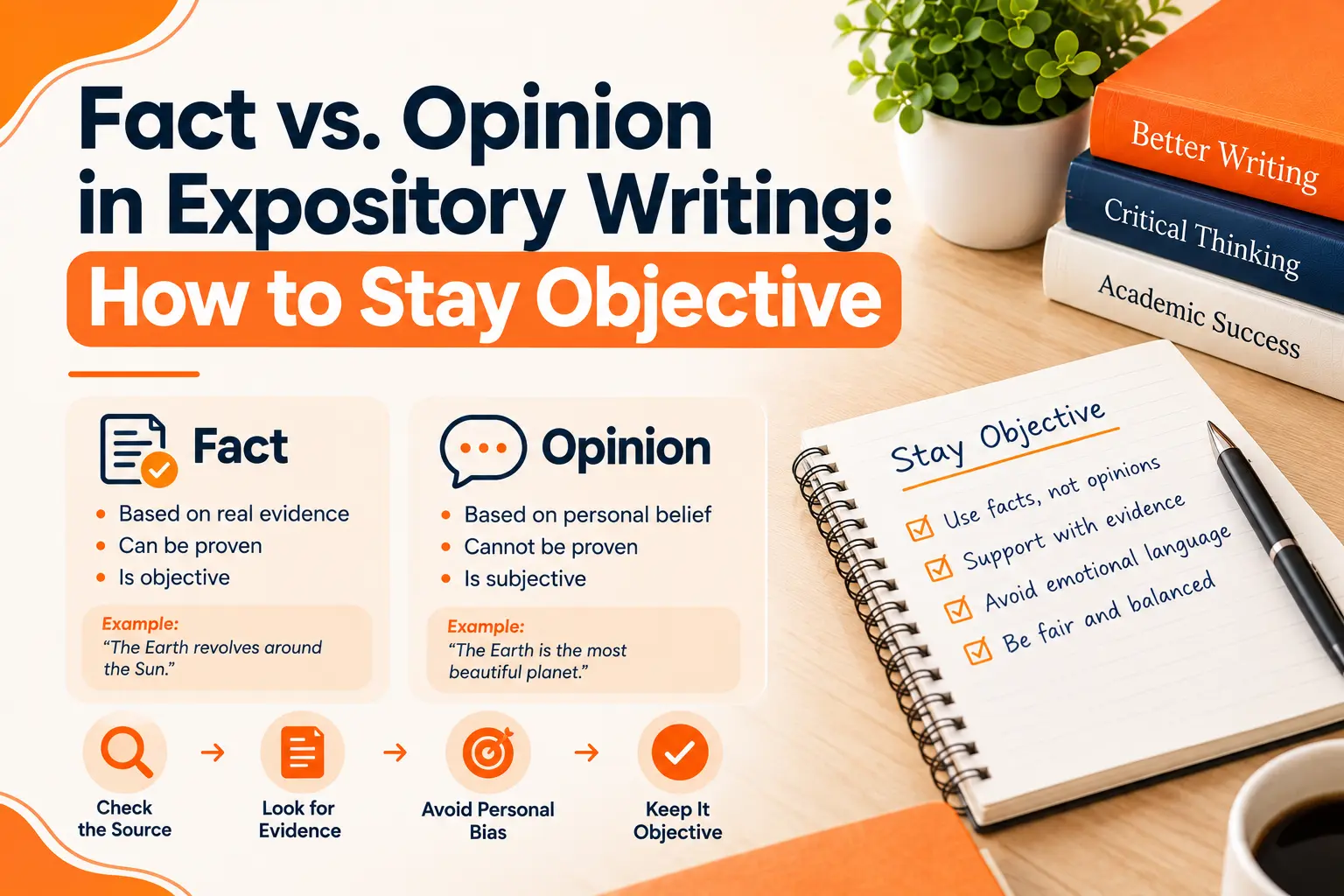
A topic that passes all four filters will explain rather than argue. It will also give you enough material to sustain the essay without padding or crowding. This guide walks you through the full framework, step by step.
- Why Topic Selection Decides the Grade Before You Start Writing
- What Makes a Topic Suitable for an Expository Essay?
- Step 1: Decode the Prompt Before You Brainstorm
- Step 2: Apply the Four Factor Selection Framework
- Step 3: Calibrate Your Topic's Scope
- Step 4: Run the 10 Minute Topic Viability Test
- Topics to Avoid: Common Traps That Look Expository but Aren't
- Calibrating Topic Difficulty to Your Academic Level
- Worked Examples: From Blank Page to Chosen Topic
- What to Do When Nothing Feels Right
- Turning Your Chosen Topic Into a Working Thesis
- Frequently Asked Questions
- Still Stuck? Get a Second Set of Eyes on Your Topic
.webp)
Why Topic Selection Decides the Grade Before You Start Writing
Topic choice is not a warm up. It sets four things in motion before you draft a single paragraph.
It decides how easily the essay can be researched. A topic with plentiful, credible sources lets you spend your time analysing and explaining. A topic with sparse sources forces you to hunt, cut, and hedge.
It decides whether the essay fits the assignment. An expository essay explains. If your topic pushes you into arguing or storytelling, you are writing the wrong kind of essay.
It decides whether you can cover the topic in the word count. A topic like "climate change" cannot be explained in 1,000 words. A hyper narrow topic may leave you with nothing to say by paragraph two.
It decides how strong your evidence and structure can be. A well scoped topic suggests its own outline. A poorly chosen topic resists structure and forces you to pad.
Get the topic right, and drafting becomes a matter of execution. Get it wrong, and every later step becomes harder than it needs to be.
What Makes a Topic Suitable for an Expository Essay?
A topic is rarely expository or argumentative on its own. What matters is the question you ask about it. Suitability depends on whether your framing invites explanation rather than persuasion or personal storytelling.
The Explain, Don't Argue Test
State your topic as a question, then check what kind of answer it needs.
If the answer is "here is how this works," it is expository.
If the answer is "here is why my position is right," it is argumentative.
If the answer is "here is what happened to me," it is narrative.
If the answer is "here is what this looks like," it is descriptive.
The same subject can produce all four essay types, depending on the question you ask.
| Subject | Argumentative question | Expository question |
|---|---|---|
| Remote work | Should companies force staff back to the office? | How has remote work changed team communication? |
| Vaccines | Should childhood vaccines be mandatory? | How do mRNA vaccines trigger an immune response? |
| Fast fashion | Is fast fashion morally indefensible? | How does a fast fashion garment reach stores in three weeks? |
The expository version does not ask you to take a side. It asks you to explain a mechanism, a process, or a change.
How Expository Topics Differ From Argumentative, Narrative, and Descriptive Topics
The differences appear in the shape of the question you ask.
Expository: asks what, how, or why with a factual answer.
Argumentative: asks should or which is better and defends a position.
Narrative: organises the topic around events, characters, and time.
Descriptive: organises the topic around sensory detail and impression.
If your topic idea fits another type better, either reframe the question or pick a different topic. A weak expository framing produces a weak essay.
Match Your Topic to an Expository Essay Type
Most expository essays follow one of six recognisable structures. Matching your topic early makes drafting easier because the structure tells you what your body paragraphs must do.
Definition Topics
Best when a term is widely used but poorly understood, or when the specialist definition differs from the everyday one.
Example: What does "food insecurity" mean in public health, and how does it differ from hunger?
Process Topics
Best when your subject involves a sequence of steps or stages that produce a specific outcome.
Example: How does a bill become law in the United States Congress?
Compare and Contrast Topics
Best when two subjects share enough common ground for the comparison to reveal something meaningful.
Example: How do the parliamentary systems of the United Kingdom and Canada differ in choosing a head of government?
Cause and Effect Topics
Best when your subject involves a chain of influence that can be traced with clear evidence.
Example: What effects has the Seattle minimum wage increase had on small business hiring since 2015?
Classification Topics
Best when your subject is a large or messy category that becomes clearer once broken into types.
Example: What are the main types of renewable energy used in homes, and how do they differ?
Problem Solution Topics
Best when a specific problem has several documented responses whose trade offs you can explain.
Example: How are U.S. cities trying to reduce urban heat island effects, and what trade offs do they involve?
If your topic idea does not fit any of these six shapes, it usually needs reframing or narrowing.
Step 1: Decode the Prompt Before You Brainstorm
The most common cause of a mismatched essay is brainstorming before reading the prompt carefully. Every prompt contains constraints, even open ones. Extract them first.
Open Prompts Versus Constrained Prompts
Open prompts sound like: "Write a 1,500 word expository essay on any topic."
Constrained prompts sound like: "Write a 1,500 word expository essay explaining a policy debate from the past decade, using four peer reviewed sources."
For open prompts, brainstorming is genuinely wide. Your job is to invent your own constraints by picking a subject area and then narrowing it down.
For constrained prompts, brainstorming becomes a filtering exercise. The prompt has already narrowed the field, so you need a topic that satisfies each constraint.
A common mistake is treating a constrained prompt as if it were open. That mismatch alone can sink an otherwise strong essay.
Five Signals Hidden in Every Assignment Brief
Read the prompt once for meaning, then again for these five signals.
Subject or Topic Boundaries
Check which subject areas are in or out. A prompt asking for a scientific process rules out historical or literary topics. Highlight every boundary word before brainstorming.
The Task Verb
Expository prompts use verbs like explain, describe, analyse, examine, or trace. Argumentative prompts use argue, defend, or evaluate. The task verb tells you what the essay must do.
Required Approach or Perspective
Some prompts specify a lens, such as "from a public health perspective" or "using two frameworks from class." Your topic must genuinely support that lens without forcing the fit.
Evidence and Source Requirements
Look for source type requirements: peer reviewed articles, primary sources, government data, or course readings. If your topic has almost no coverage in the required source type, drop it.
Word Count and Format Constraints
Word count is not just a length limit. It is a scope indicator. A 750 word essay cannot cover the same ground as a 2,500 word one, so evaluate scope against length early.
When to Ask Your Instructor for Clarification
Ask when a specific decision affects your topic choice and the prompt does not resolve it. Useful questions include:
"Does the source requirement include textbook chapters or only outside sources?"
"Would a comparative topic satisfy the 'explain a single process' requirement?"
"Is a historical case acceptable, or should the topic be from the past decade?"
Do not ask "Is this topic okay?" without proposing an angle, source plan, and rough scope first. Instructors want to see you have already thought it through.
Step 2: Apply the Four Factor Selection Framework
Once the prompt is decoded, run each candidate topic through four filters. These are decision criteria, not writing tips, and each one can save you hours.
The four factors:
Personal interest: do you have enough curiosity to sustain the work?
Research availability: is the evidence you need actually accessible?
Prompt fit: does the topic genuinely answer what the assignment asks?
Scope calibration: is the topic sized correctly for the word count?
Take each in turn.
Factor 1: Personal Interest, and Why "Passion" Is Overrated
You do not need passion for your topic. You need enough curiosity to keep reading sources without dreading it. That is a lower and more useful bar.
Four things get confused here:
Genuine curiosity: you want to know how or why something works. This is what you actually need.
Existing knowledge: you already know some things. Useful, but sometimes it makes the topic feel too obvious.
Emotional attachment: the topic matters to you personally. This can pull the essay toward argument or narrative.
Blind enthusiasm: you feel excited but cannot name a question. This usually fades once you start reading.
Curiosity is the most reliable because it survives contact with dry academic material. Passion often does not.
Factor 2: Research Availability
Before committing to a topic, verify that the evidence exists. What you should look for:
Credible sources appropriate to your discipline and academic level.
Enough recent or relevant material to answer your specific question.
Multiple perspectives so your explanation is not built on one source.
Sources that fit your academic level rather than sitting above or below it.
Information that answers your specific question, not just the general subject.
If a reasonable search turns up little of what you need, that is a warning. Change the topic or the angle rather than working harder against a shortage.
Factor 3: Prompt Fit, Aligning Your Topic to the Rubric
There is a difference between an interesting topic, a suitable topic, and one that directly satisfies the assignment. Prompt fit is the strictest test.
Take a prompt: "Explain a scientific process relevant to everyday life in 1,500 words."
Interesting topic: The ethics of gene editing.
Suitable topic: How CRISPR gene editing works.
Direct fit: How CRISPR is used to develop drought resistant crops.
The first is off brief. The second is on brief but abstract. The third satisfies every element of the prompt.
Before committing, ask if your topic answers the assignment as written. Do not hope the instructor will accept a close enough version.
Factor 4: Scope Calibration
At this stage, you are only checking whether the topic is roughly the right size. Detailed narrowing comes next.
Three quick questions:
Too broad? Could this topic support a whole book?
Appropriately focused? Can you sketch three to five distinct sub sections?
Too narrow? Could the whole answer fit in one paragraph?
If a topic passes all four factors, take it to Step 3 for detailed calibration.
Step 3: Calibrate Your Topic's Scope
Scope calibration is where most topics succeed or fail. This is the practical work of matching the topic to the length your assignment can hold.
Scope Examples at 500, 1,000, and 2,500 Words
There is no universally correct scope for any subject. Only a scope that fits the specific assignment in front of you.
| Broad subject | 500 words | 1,000 words | 2,500 words |
|---|---|---|---|
| Sleep | How afternoon caffeine delays REM sleep onset. | How caffeine, screens, and irregular schedules disrupt sleep stages. | How caffeine, light, and schedule interact to disrupt sleep in college students. |
| Social media | How Instagram ranks posts in a user's feed. | How Instagram and TikTok differ in the signals they weight. | How short video platforms have changed their recommendation logic since 2020. |
| Artificial intelligence | How a language model chooses the next word. | How transformer models are trained, from pretraining to fine tuning. | How training pipelines for large language models have changed since 2017. |
The subject stays the same. The question narrows or widens to match the space you have.
The Ladder Technique for Narrowing a Broad Topic
Move from a broad field down through progressively more specific levels. Stop at the rung where the question becomes answerable.
Broad field: Public health.
Specific area: Nutrition policy.
Population or context: School lunches in U.S. public schools.
Dimension: Nutritional standards for those lunches.
Focused question: How have U.S. school lunch nutrition standards changed since 2010?
If the final rung feels too narrow, step back up. If it feels too broad, step down. Do not skip rungs.
Signs Your Topic Is Too Narrow to Sustain
Narrowing can go too far. Watch for these warning signs:
Very few credible sources exist, and not because the topic is genuinely obscure.
Evidence is repetitive and every source says essentially the same thing.
The answer fits in one paragraph and stretching it will require padding.
You cannot generate three distinct body sections without forcing them.
"Too narrow" is not the same as "appropriately focused." A focused topic still has internal structure. A narrow one is a single fact stretched thin.
Step 4: Run the 10 Minute Topic Viability Test
Before you commit, run one last check. Five yes or no questions. If you cannot answer yes to all of them, the topic needs more work.
Does it fit the assignment? Would a fair reading of the prompt include this topic?
Can I explain rather than argue? Does the question invite explanation rather than a verdict?
Can I find enough credible evidence? In ten minutes of searching, can I locate several usable sources?
Is the scope right for the word count? Can I sketch three to five sections that fit the length?
Can I explain it to my audience? Given their background, can I explain without oversimplifying or losing them?
If the answer is no:
No to 1 or 2: Reframe the question or change the topic entirely.
No to 3: Search once more with different terms, then narrow or switch topics.
No to 4: Use the ladder technique to widen or narrow, then re test.
No to 5: Adjust the scope or framing so the topic reaches the reader you have.
Once all five come back yes, commit. Further second guessing at this stage costs more than it saves.
Topics to Avoid: Common Traps That Look Expository but Aren't
Some subjects consistently produce weak expository essays. They resist the explanatory mode, resist objective handling, or have been so overworked that a fresh angle is hard to find.
Opinion Driven Topics in Disguise
These topics force you into argument even when you meant to explain. Common examples:
"Why the death penalty should be abolished."
"Whether social media is bad for teenagers."
"The best programming language for beginners."
Sometimes a reframe rescues them. "Whether social media is bad for teenagers" becomes "How current research measures the psychological effects of social media on teenagers." You are now explaining research, not taking a side.
If a reframe strips out what interested you, pick a different topic.
Topics With No Factual Consensus
Some subjects lack a stable evidence base because research is early, sources conflict, or the underlying facts are contested. Explaining them honestly becomes very hard.
This does not mean controversial subjects are off limits. A controversial subject with strong factual grounding can work well. What fails is a subject where the disputed claims are themselves the material you need to explain.
Overly Personal or Anecdotal Topics
Personal experience can support an expository essay in small ways. When it becomes the whole topic, the essay drifts into narrative.
"My experience with anxiety" is a narrative topic. "How cognitive behavioural therapy treats generalised anxiety disorder" is expository and can still include a brief personal example.
Topics That Require Specialist Prior Knowledge
Highly technical topics create two problems. You may lack the background to explain them accurately, and your audience may lack it to follow.
Specialist topics can work when both the assignment and audience support them. They rarely work in general education courses where you need to build too much prerequisite context. In cases where the technical demand is beyond your current background, some students choose to buy expository essay from a subject specialist rather than misrepresent material they do not fully understand.
Topics That Have Been Written to Death
Common topics are not automatically weak. They fail when the student has no specific angle, no manageable scope, and no evidence beyond what any casual reader already knows.
A common topic done well starts with a specific question the reader has not heard answered. It uses recent or specific evidence and stays within a narrow scope. If you cannot meet these conditions, pick something less crowded.
Calibrating Topic Difficulty to Your Academic Level
The same subject can be appropriate at several levels. What shifts is the scope, evidence, and complexity expected at each stage.
High School Expectations
At high school level, expository topics can be broader and rely on more accessible sources. Reputable news outlets, textbooks, and established reference works usually work well.
Scope is typically one main concept explained clearly. Evidence should be accurate and properly attributed rather than drawn from advanced academic literature.
Workable high school topic: How the water cycle moves water between oceans, atmosphere, and land.
Undergraduate Expectations
Undergraduate topics need more specificity. General subjects should be narrowed to a particular process, case, or context.
Source expectations rise, with peer reviewed articles, academic books, and primary documents replacing popular sources as the main evidence base. Disciplinary context matters more, and the framing shifts with the course.
Workable undergraduate topic: How U.S. municipal water systems respond to lead contamination, using the Flint crisis as a case study.
Graduate Level Expectations
Graduate topics require narrower research questions and deeper engagement with existing literature. Disciplinary terminology should be used correctly and analytically.
The topic should sit within an ongoing scholarly conversation and address a specific gap or reframing within it. Evidence expectations shift toward primary literature and methodological transparency.
Workable graduate topic: How recent revisions to lead in water regulatory thresholds have shaped municipal testing protocols.
Worked Examples: From Blank Page to Chosen Topic
The framework is easier to see in action than to describe. Three examples, all different in prompt type and discipline.
Example 1: Open Prompt, First Year Composition
Prompt: "Write a 1,200 word expository essay on any topic."
Initial idea: "Social media." The student picks it because it feels current.
Problems: Far too broad for 1,200 words. Their opinions push them toward argument. No specific question in mind.
Applying the four factors:
Interest: Real curiosity, but specifically about why some posts go viral.
Research: Plenty of accessible material on recommendation algorithms exists.
Prompt fit: Open prompt, so any expository framing satisfies it.
Scope: One platform at 1,200 words is realistic. Multiple platforms are not.
Narrowing: Social media, then recommendation algorithms, then TikTok, then the For You page for new users.
Final topic: "How TikTok's For You algorithm decides which videos to show a new user in the first week."
The topic is expository, scoped correctly, researchable, and genuinely interesting to the student.
Example 2: Constrained Prompt, Science Course
Prompt: "Explain a biological process in 2,000 words, using five peer reviewed sources from the last decade."
Initial idea: "Photosynthesis." The student remembers it from high school.
Problems: General photosynthesis has been explained thousands of times. Recent peer reviewed research on the general mechanism is limited. Scope is enormous.
Applying the four factors:
Interest: Curiosity is real but generic. A specific angle is needed.
Research: Recent peer reviewed work requires a specific sub question.
Prompt fit: Photosynthesis qualifies as a biological process.
Scope: 2,000 words fits one specific sub process well.
Narrowing: Photosynthesis, then light dependent reactions, then C4 plants, then how they differ from C3.
Final topic: "How C4 photosynthesis differs from C3 at the biochemical level, and why the adaptation is common in tropical grasses."
Peer reviewed research on C4 photosynthesis is active, the topic fits 2,000 words, and the structure is clear.
Example 3: Compare and Contrast, Humanities
Prompt: "Write a 1,800 word compare and contrast essay on how two works from different periods treat a shared theme."
Initial idea: "Compare Shakespeare and modern authors on love." Common and vague.
Problems: "Modern authors" is a category, not a work. "Love" is too broad. No clear basis for comparison.
Applying the four factors:
Interest: Present but needs sharpening.
Research: Criticism on Shakespeare is abundant, but the modern work needs to be specific.
Prompt fit: Two works, different periods, shared theme.
Scope: 1,800 words fits two works and one specific dimension.
Narrowing: Love, then marriage as social contract, then Much Ado About Nothing and Normal People, then the tension between romantic feeling and social expectation.
Final topic: "How Much Ado About Nothing and Normal People each portray the tension between romantic feeling and social expectation."
Two specific works, one dimension of comparison, and a theme both works genuinely engage with.
What to Do When Nothing Feels Right
Sometimes you have run the framework and nothing survives. Every topic feels wrong. Three recovery tactics.
The Topic Ladder
If a topic feels too broad, step down the ladder one rung and re evaluate. If it feels too narrow, step back up.
The problem is often that you have landed at the wrong rung, not that the field is wrong for you. Move one rung at a time and re test after each step.
The Adjacent Field Browse
If your subject area feels exhausted, look at adjacent fields. If health feels stale, browse public policy that touches health.
Adjacent browsing works because you keep the terrain you already know. Skim a course reading list from a related discipline or a journal table of contents.
Reverse Engineering a Topic From a Source You Like
Start with a source that interests you and let it suggest a topic. Read it carefully and ask what question the source implicitly answers.
Example: You read a magazine article on how cities are redesigning intersections to reduce pedestrian deaths. Your reverse engineered topic: "How the redesign of intersections in Hoboken, New Jersey has reduced pedestrian injuries since 2019."
Turning Your Chosen Topic Into a Working Thesis
Choosing a topic is not the same as having a thesis. A topic tells you what the essay is about. A thesis tells the reader what your essay will explain about it.
The transition usually looks like this:
Topic: How TikTok's For You algorithm decides what to show a new user.
Focused question: What signals does the algorithm weight most in the first week?
Working thesis: In the first week, TikTok's algorithm weights watch time, early rewatches, and completion rate more heavily than follows or likes.
For a full walk through of moving from topic to thesis, see How to Write a Thesis Statement.
Frequently Asked Questions
Can an Expository Essay Be About a Controversial Topic?
Yes, as long as your framing invites explanation rather than argument. Controversy does not disqualify a topic. Taking a side does.
"Whether mandatory vaccination is ethical" is argumentative. "How courts have interpreted mandatory vaccination laws over twenty years" is expository. Same subject, different framing.
How Do I Know if My Topic Is Too Broad?
Ask three quick questions. Could the topic support a whole book? Would each body paragraph itself need to be its own essay?
Can you state the topic as a specific question with a specific answer? If it collapses into "it depends," narrow further using the ladder technique.
Is It Okay to Change My Topic Mid Draft?
Sometimes. Change when the evidence contradicts your angle, when scope is very off, or when drafting reveals a stronger angle within the same subject.
Narrow or reframe rather than switching entirely when the problem is scope, not subject. A full topic change is expensive, so try reframing first.
Can I Pick a Topic Outside My Major?
Usually yes, with three caveats. Check that the assignment does not require an in course topic, and confirm you can access credible sources in the outside field.
Be honest about your background knowledge. Outside topics work when they rely on accessible sources. They go badly when specialist prerequisites are underestimated.
How Many Sources Should I Be Able to Find Before Committing?
There is no universal number. Source requirements depend on the assignment length, academic level, instructor expectations, and topic depth.
A practical rule of thumb: verify enough credible sources to cover each major sub section, with some redundancy so no point relies on a single source.
Still Stuck? Get a Second Set of Eyes on Your Topic
The framework works for most students most of the time. When it does not, a second reader can spot what you cannot see from inside the assignment.
If you have run the four factors and the viability test without landing on a topic, our academic writers can review your prompt and suggest angles. They can also help you calibrate scope to the assignment.
Explore our Expository Essay Writing Service for topic development and full drafting support. If you are ready to buy an essay written to your specific prompt, our subject specialists can take it from topic selection through to a finished draft.
The process is the same either way. Prompt, suitable subject, four factor evaluation, calibrated scope, viability test, workable topic.
Order Now
 MyPremiumEssay