In this guide, you'll learn how to choose a topic, structure your essay, write a strong thesis, and avoid common mistakes in a compare-and-contrast essay.
What Is a Compare and Contrast Essay?
A compare-and-contrast essay examines two subjects and analyses how they are similar and how they differ.
Those subjects can be people, places, ideas, texts, events, or objects. The goal is not to list facts about each subject side by side. The goal is to reveal something meaningful through the comparison.
That might be a deeper truth, a surprising insight, or a well-supported argument about which subject is stronger, more effective, or more relevant.
Compare and contrast essays appear across almost every academic discipline:
- In English class, you might compare two novels or two literary characters
- In history, two political leaders or two revolutions
- In science, two theories or two organisms
- In business, two market strategies or two companies
The structure is the same regardless of subject matter. That is what makes mastering this essay type one of the most transferable academic skills you can develop.
How to Choose a Strong Compare and Contrast Essay Topic
Good compare-and-contrast essay writing begins with choosing subjects that are genuinely worth comparing.
A strong topic meets three criteria:
The subjects share a meaningful connection. They should belong to the same general category, such as two cities, two authors, or two economic systems, so the comparison is logical rather than arbitrary.
They have real similarities and real differences. If two subjects are identical, there is nothing to analyze. If they share no common ground at all, the comparison falls apart. The sweet spot is subjects that overlap in some ways but diverge in important ways.
The comparison reveals something. The best topics produce an insight the reader would not have without reading your essay.
"Remote work and office work differ in location" tells us nothing new.
"Remote work and office work differ in measurable effects on collaboration, creativity, and employee wellbeing" gives readers a reason to read on.
10 Ready-to-Use Topic Ideas
- High school education vs. college education
- Leadership styles of two historical figures (e.g., Lincoln vs. Churchill)
- Two renewable energy sources (solar vs. wind power)
- Online learning vs. traditional classroom learning
- Two social media platforms and their effects on mental health
- Democracy vs. authoritarianism as systems of government
- Shakespeare's Hamlet vs. Sophocles' Oedipus Rex
- Western medicine vs. traditional medicine
- Keynesian vs. supply-side economic policy
- Living in a large city vs. living in a small town
The Two Main Compare and Contrast Essay Structures
This is where most students make their first big mistake: not choosing a structure before writing.
Every solid compare-and-contrast essay guide will tell you the same thing: structure determines everything. There are two standard approaches, and choosing the wrong one for your topic can make an otherwise good essay feel disorganized.
The Block Method
In the block method, you discuss everything about Subject A first, then everything about Subject B. Each subject gets its own block of paragraphs.
Outline:
- Introduction and thesis
- Body block 1: All points about Subject A
- Body block 2: All points about Subject B, mirroring the same points in the same order
- Conclusion
Best for shorter essays (under 800 words), subjects that need sustained individual focus, or when your reader may be unfamiliar with one of the subjects.
Watch out for: Without strong transitions between the two blocks, the essay can read like two separate papers. Your transition paragraph must explicitly connect what you said about A to what you are about to say about B.
The Point-by-Point Method
In the point-by-point method, you alternate between the two subjects for each comparison criterion. Each body paragraph addresses one point and discusses both subjects within it.
Outline:
- Introduction and thesis
- Body paragraph 1: Point of comparison 1, Subject A vs. Subject B
- Body paragraph 2: Point of comparison 2, Subject A vs. Subject B
- Body paragraph 3: Point of comparison 3, Subject A vs. Subject B
- Conclusion
Best for longer essays, topics with four or more comparison points, and academic essays where the comparison itself is the argument.
Watch out for: Repetitive sentence structure. Vary how you introduce each subject within paragraphs, or the writing becomes mechanical.
Block vs. Point-by-Point: Quick Comparison
| Feature | Block Method | Point-by-Point Method |
|---|---|---|
| Best for | Short essays, 2 to 3 comparison points | Longer essays, 4 or more comparison points |
| Structure | All of Subject A, then all of Subject B | Alternate between A and B for each point |
| Main risk | Reads like two separate essays | Can feel repetitive without varied transitions |
| Transitions needed | Between the two major blocks | Between every paragraph |
| Reader experience | Deep focus on each subject | Direct, side-by-side clarity |
How to Write a Compare and Contrast Essay: 7 Steps
If you are looking for a clear, repeatable process, these seven steps cover everything. Follow them in order, and you will have a structured, well-argued essay every time.
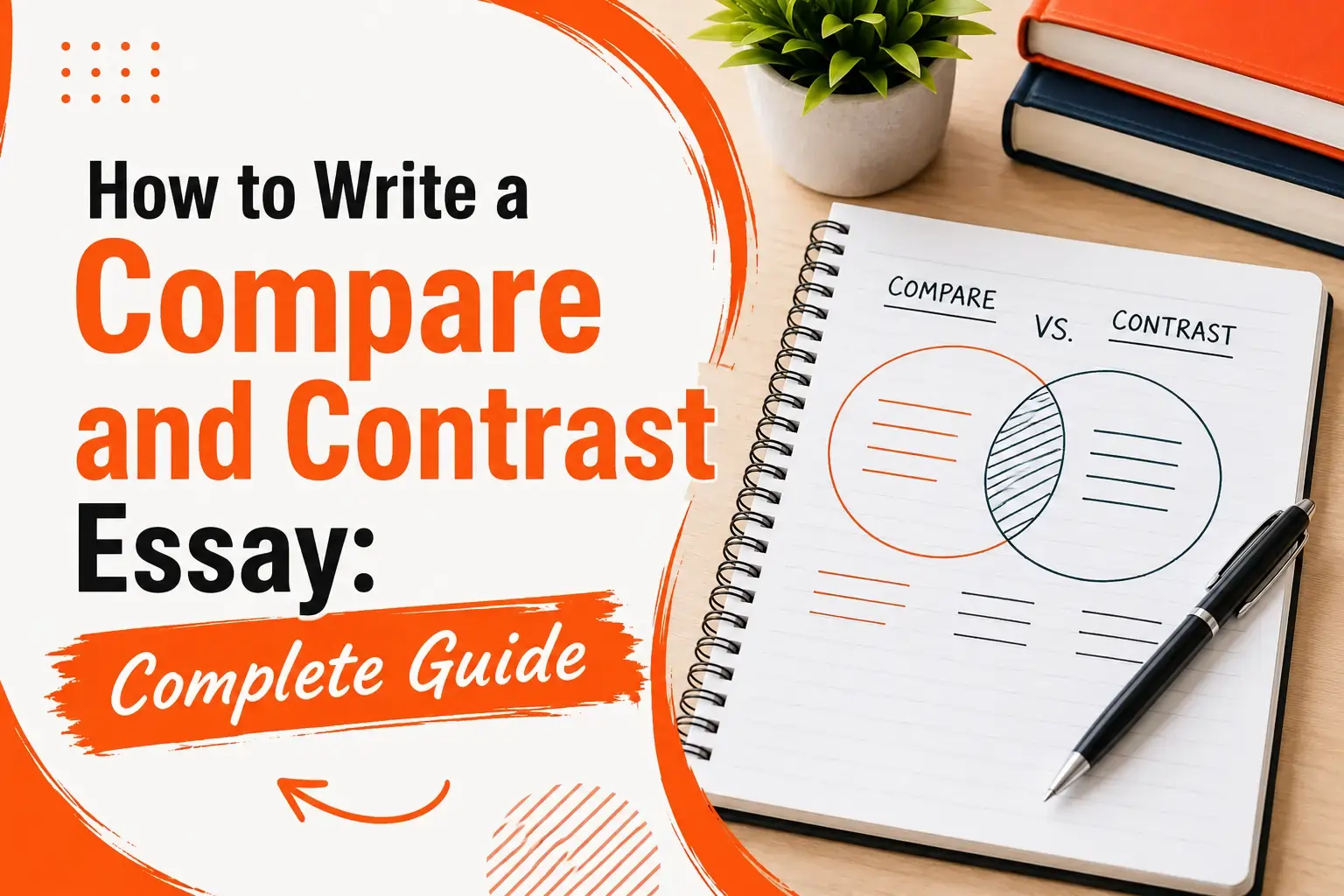
Step 1: Brainstorm with a Venn Diagram
Draw two overlapping circles. Label each circle with one subject.
In the outer sections, write traits unique to each subject. In the overlapping center, write traits they share.
Aim for at least four to five points in each section. This is your raw material.
Step 2: Narrow to Your Strongest Comparison Points
Not every point from your Venn diagram belongs in the essay.
Select three to five comparison criteria that are most relevant, most interesting, and most arguable.
Weak criteria, such as "both have names," should be cut. Strong criteria, such as "both use conflict to drive character development but in structurally opposite ways," should stay.
Step 3: Write a Specific Thesis Statement
Your thesis is the single most important sentence in the essay.
It must name both subjects, signal the focus of the comparison, and make a claim, not just a statement of topic.
Weak thesis: "This essay will compare online learning and traditional classroom learning."
Strong thesis: "Although online learning and traditional classroom learning both aim to develop knowledge and skills, they differ significantly in student engagement, instructor accountability, and long-term retention."
Step 4: Build a Detailed Outline
Outline every paragraph before you write a word of prose.
For each body paragraph, note:
- The comparison point
- The evidence for Subject A
- The evidence for Subject B
- The analytical link back to your thesis
Skipping the outline is the single most common cause of unbalanced compare-and-contrast essays.
Step 5: Write Body Paragraphs Using the PEEL Structure
Each body paragraph should follow this pattern:
- Point: State the comparison criterion in a clear topic sentence
- Evidence: Provide specific evidence for Subject A (a quote, statistic, example, or detail)
- Evidence + Explanation: Do the same for Subject B, then explain what the comparison reveals
- Link: Connect back to your thesis and explain why this comparison point matters
Use transition words consistently.
For similarity: similarly, likewise, in the same way, equally, just as.
For difference: however, in contrast, whereas, on the other hand, conversely, while.
Step 6: Write the Introduction
Start with a hook: a surprising statistic, a provocative question, or a brief anecdote that frames why the comparison matters.
Introduce both subjects with two to three sentences of context.
End the introduction with your thesis statement.
Step 7: Write the Conclusion
Do not simply restate your thesis and summarize your points.
A strong conclusion answers the "so what?" question:
- Why does this comparison matter?
- What does the reader now understand that they did not before?
- What broader implication, recommendation, or open question can you leave them with?
Compare and Contrast Essay Example
Reading the theory is one thing. Seeing it in action makes it click.
Below is a short sample compare-and-contrast essay using the point-by-point method. The topic is online learning vs. traditional classroom learning. Annotations in brackets show what each part is doing structurally.
Title
Online Learning vs. Traditional Classroom Learning: A Comparison
Introduction
Education has never offered more choices. Students today can earn a degree from their bedroom or walk into a lecture hall on campus — and both paths promise the same credential. But the experience, the outcomes, and the challenges are very different. Although online learning and traditional classroom learning both aim to develop knowledge and skills, they differ significantly in flexibility, student engagement, and long-term knowledge retention.
[Hook → context → thesis]
Body Paragraph 1: Flexibility
One of the clearest differences between the two formats is scheduling flexibility. Online learning allows students to access lectures, readings, and assignments at any time, making it well suited to working adults, caregivers, and students in different time zones. Traditional classroom learning, by contrast, operates on a fixed schedule. Students must attend classes at set times and locations, which limits flexibility but also creates a consistent routine and structure. For students who struggle with self-discipline, that structure can be an advantage rather than a constraint.
[Point → Subject A evidence → Subject B evidence → analytical link]
Body Paragraph 2: Student Engagement
Engagement looks different in each format. In a traditional classroom, face-to-face interaction encourages spontaneous discussion, immediate feedback from instructors, and a sense of shared academic community. Online learners, similarly, can participate in discussion forums and video calls, but the asynchronous nature of most online courses means that responses are delayed and the social energy of a live classroom is absent. A 2023 report by the Educause Center for Analysis and Research found that 63% of students said they felt more engaged in face-to-face courses than in fully online ones, pointing to a consistent pattern across institutions.
[Point → Subject A evidence → Subject B evidence with transition word "similarly" → analytical link with evidence]
Body Paragraph 3: Knowledge Retention
The format of a course also affects how well students retain what they learn. Traditional classroom learners benefit from repeated in-person reinforcement: live explanations, peer discussion, and the social accountability of attending class. Online learners, on the other hand, must take greater responsibility for reviewing material independently. While this builds self-directed learning habits, online course completion rates average around 40 to 60 percent compared to over 80 percent for in-person programs — a gap that reflects the challenge of sustaining motivation without built-in structure.
[Point → Subject A evidence → "on the other hand" transition → Subject B evidence with data → evaluative analysis]
Conclusion
Both online learning and traditional classroom learning offer genuine value. The best choice depends on a student's personal circumstances, learning style, and goals. What the comparison reveals, however, is that flexibility and engagement pull in opposite directions: the format that offers the most freedom demands the most self-discipline. As hybrid models become more common, understanding these trade-offs is not just academic — it shapes how students invest their time and money.
[Synthesis → "so what?" → broader implication]
Notice how each body paragraph stays focused on one comparison point, addresses both subjects, uses a transition word to signal the shift, and links back to a broader argument. That is the compare-and-contrast essay structure working at its best.
Common Mistakes to Avoid
Treating the essay as two separate descriptions.
Every paragraph must include an active comparison, not just a description of a single subject.
Unbalanced coverage.
If you spend 400 words on Subject A and 150 on Subject B, your essay loses credibility. Mirror your coverage as closely as possible.
A thesis that just states the topic.
"This essay compares cats and dogs" is a topic statement, not a thesis. Make a claim.
Learn how to create a clear, arguable thesis with our complete guide on How to Write A Thesis Statement.
Forgetting transitions.
Without clear transition words and sentences, the reader cannot follow your comparisons. Transitions are not decorative; they are structural.
Summarizing instead of analyzing.
Summary tells readers what happened. Analysis tells readers what it means. Every paragraph should push toward analysis.
Need an expert to compare and Contrast Essay Writing? MyPremiumEssay Has You Covered
You have the guide. Now let the experts handle the rest.
Since 2020, MyPremiumEssay has delivered professional essay writing to thousands of students across the US — handled by native, university-qualified essay writers who know your subject inside out.
When you buy a compare-and-contrast essay from MyPremiumEssay, you get:
- 100% original content with a free Turnitin report
- Native US writers — PhDs and subject-matter experts
- On-time delivery, even on 24-hour deadlines
- Unlimited free revisions, no extra charge
- 40% off your first order
Do not let one essay drag your grade down. Get your compare-and-contrast essay help from MyPremiumEssay today.
Order Your Essay at MyPremiumEssay.com
Frequently Asked Questions
How long should a compare and contrast essay be?
High school essays are typically 500 to 800 words; college essays range from 1,000 to 1,500 words; graduate-level assignments may require 2,000 or more.
Can I use first person in a compare and contrast essay?
Most academic compare and contrast essays are written in third person. Check your assignment brief, as some instructors allow first person for reflective tasks.
How many body paragraphs should a compare and contrast essay have?
Three body paragraphs is the standard for a five-paragraph essay. Aim for four to six for college-level work, with each paragraph covering one clear comparison point.
What is the best structure, block or point-by-point?
Point-by-point is preferred for most college essays because it keeps the comparison direct and sustained. Block method works well for shorter essays or less familiar subjects.
What makes a strong compare and contrast thesis?
A strong thesis names both subjects and makes a specific claim about their relationship — not just a statement that you are comparing them. It should tell the reader what the comparison reveals.
Ready to get started? Pick your two subjects, build your Venn diagram, and follow the seven steps above. The essay practically writes itself from there.
 MyPremiumEssay