
Following these steps in the right order makes the writing process more organized, improves the quality of your argument, and helps you avoid common mistakes.
This research writing guide breaks down every step in detail, with examples across multiple disciplines, a realistic timeline, common mistakes to avoid, and a checklist you can use from start to submission.
What Is a Research Paper?
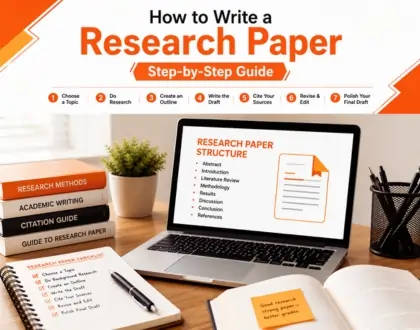
A research paper is a formal academic document in which a writer investigates a specific topic, evaluates evidence from peer-reviewed sources, and presents an original, well-supported argument or analysis. It is more rigorous than a standard essay because it requires engagement with existing scholarship, proper citation, and strict adherence to a defined research paper format.
Research papers appear across every academic discipline, from psychology and history to biology, engineering, and literature. While subject matter changes by field, the process for how to write a research paper step by step remains consistent enough that mastering it once benefits every paper you write.
Types of Research Papers
The type of paper you are assigned shapes every decision you make, from thesis framing to section organization.
Argumentative Research Paper: You take a debatable position and defend it with scholarly evidence. Most common in humanities and social sciences.
Example: arguing that mandatory minimum sentencing disproportionately impacts low-income communities.
Analytical Research Paper: You examine a topic from multiple angles and present balanced findings without advocating for one side.
Example: comparing competing theories of language acquisition in early childhood.
Experimental/Empirical Research Paper: You report on original data collected through experiments or surveys, typically using IMRaD structure (Introduction, Methods, Results, Discussion).
Example: a biology lab report on the effect of pH on enzyme activity.
Review Paper/Literature Review: You synthesize existing research on a topic, identifying themes, patterns, and gaps rather than generating new data.
Example: a systematic review of CBT trials for generalized anxiety disorder.
Confirm your paper type before writing anything. It determines your thesis, structure, and source requirements.
How Long Does a Research Paper Take? A Realistic Timeline
A standard undergraduate research paper (8 to 12 pages) needs three to four weeks to do properly. Each phase requires dedicated time and cannot be meaningfully compressed.
| Phase | Task | Time Needed |
|---|---|---|
| Week 1 | Read assignment, narrow topic, preliminary research | 3 to 5 days |
| Week 1 to 2 | Deep research, note-taking, research question, working thesis | 4 to 6 days |
| Week 2 | Build detailed outline | 1 to 2 days |
| Week 2 to 3 | Write first draft | 3 to 5 days |
| Week 3 | Write abstract; build References page continuously | 1 day |
| Week 3 | Revise for argument, structure, and evidence | 1 to 2 days |
| Week 3 | Peer review: classmate, writing center, or instructor | 1 to 2 days |
| Week 3 to 4 | Revise based on feedback; proofread and edit | 1 to 2 days |
| Week 4 | Final format check and submission | Half a day |
For shorter papers (5 to 8 pages), compress to a minimum of two weeks. For longer papers or thesis chapters (20 or more pages), extend to six to eight weeks and add a dedicated annotation week before outlining.
The most important rule: start the day you receive the assignment. Even 30 minutes of preliminary research on Day 1 prevents the paralysis that sets in when a deadline appears suddenly.
The Complete Research Paper Format
Most academic institutions require one of three major formatting and citation styles. The table below gives you the essentials at a glance.
| Format | Used Most Often In | In-Text Citation | Reference Page |
|---|---|---|---|
| APA 7th ed. | Social sciences, psychology, education, nursing, business | Author-date: (Smith, 2021, p. 47) | References |
| MLA 9th ed. | Humanities, literature, cultural studies, language arts | Author-page: (Smith 47) | Works Cited |
| Chicago/Turabian | History, philosophy, theology, fine arts | Footnotes or author-date | Bibliography |
Standard structural components (all formats):
| Section | Purpose | Required By |
|---|---|---|
| Title Page | Paper title, author, course, instructor, date | APA, Chicago; MLA uses a header |
| Abstract | 150 to 250 word standalone summary | APA (most disciplines); sciences |
| Introduction | Background, research question, thesis | All formats |
| Literature Review | Synthesis of existing scholarship | Longer papers; integrated in shorter ones |
| Body/Methodology | Argument development or research methods | All formats |
| Results/Discussion | Interpretation of findings | Empirical papers |
| Conclusion | Synthesis and implications | All formats |
| References/Works Cited | Complete list of all cited sources | All formats |
| Appendices | Supplementary data, figures, raw results | When required |
Always confirm the required format with your instructor before you begin and again before you submit.
How to Write a Research Paper Step by Step
Follow these steps in order. Each one builds on the last.
Step 1: Understand the Assignment Completely
Read the assignment prompt carefully twice before choosing a topic or opening a search engine. Extract and record:
- Type of paper (argumentative, analytical, empirical, review)
- Required length (word count or page range)
- Required format (APA, MLA, Chicago)
- Source requirements (minimum number, peer-reviewed only, primary vs. secondary)
- All deadlines, including intermediate ones (outline due, draft due, peer review session)
- Grading rubric: if provided, it is a blueprint for full marks
Clarify anything unclear with your instructor before investing time. An assumption here costs far more to fix than a quick email. Convert requirements into a checklist and check items off as you complete each stage.
Step 2: Choose and Narrow Your Topic
Start broadly and narrow deliberately. A subject area is not a topic. Here is the difference across three disciplines:
History: "World War II" becomes "The role of the Office of War Information in shaping domestic public opinion about Japanese Americans, 1942 to 1945"
Biology: "Cancer research" becomes "The efficacy of CRISPR-Cas9 gene editing in targeting HER2-positive breast cancer cells in vitro"
Literature: "Shakespeare" becomes "The function of disguise as a mechanism for female agency in As You Like It and Twelfth Night"
Each narrowed topic is specific, bounded, and researchable. Use this four-step process to get there:
- Start with a subject area you find genuinely interesting because motivation matters over weeks of work.
- Browse recent peer-reviewed journals in that field to see what questions scholars are debating.
- Identify a specific angle: a time period, population group, policy, causal mechanism, or gap in existing research.
- Ask whether the topic can be meaningfully explored within your page limit and time frame.
Four topic traps to avoid: too broad (cannot do it justice in the space), too narrow (insufficient scholarly sources), too settled (no argument to make), too recent (peer-reviewed scholarship not yet available).
Step 3: Conduct Preliminary Research
Before committing to a thesis, confirm that sufficient credible scholarly evidence exists on your topic.
Reliable places to search for academic sources:
- Google Scholar: Free, broad, links to full texts, shows citing papers
- JSTOR: Peer-reviewed journals across humanities and social sciences
- PubMed: Biomedical and life sciences literature
- EBSCOhost/ProQuest/Scopus/Web of Science: Your institution's library portal; gold standard for academic databases
- Government databases (.gov): Public policy data, legal records, official statistics
- Google Scholar "Cited by" feature: Reveals papers that cited a key source, rapidly expanding your literature map
Five questions to evaluate every source:
- Is it recent enough for your topic?
- Does it directly address your research question?
- Who wrote it, and are their credentials verifiable?
- Are claims supported by data?
- Is there a commercial or ideological motive?
Do not search only for sources that confirm what you already think. Actively seek counterarguments, competing frameworks, and contradicting data. Engaging with opposition separates sophisticated research from a one-sided summary, and it is what instructors and peer reviewers reward.
Step 4: Develop Your Research Question and Working Thesis
A research question is the specific question your paper will answer. A working thesis is your preliminary answer, called "working" because it sharpens as your research deepens.
Examples across disciplines:
Social science Research question: What is the relationship between passive social media use and depression rates among adolescents aged 13 to 17? Working thesis: While social media offers some social benefits, longitudinal studies consistently link high-frequency passive use (scrolling without posting) to elevated depression and anxiety rates among teenagers, particularly girls.
History Research question: How did wartime propaganda shape public attitudes toward Japanese American internment during World War II? Working thesis: Through selective framing and appeals to national security, Office of War Information campaigns constructed Japanese Americans as a collective threat rather than individual citizens, normalizing internment in the domestic press.
Biology (empirical) Research question: Does CRISPR-Cas9 targeting of the HER2 gene reduce proliferation in breast cancer cell lines compared to controls? Working hypothesis: CRISPR-Cas9 editing of the HER2 oncogene will significantly reduce cell proliferation rates in HER2-positive MCF-7 cells relative to unedited controls, based on prior gene-silencing literature.
Four hallmarks of a strong thesis: makes a specific arguable claim (not a statement of fact), defines the scope clearly, is falsifiable using evidence, and suggests the paper's organizational logic.
For a full guide on thesis construction, see How to Write a Thesis Statement.
Step 5: Build Your Research Paper Outline
An outline prevents the most common failure in research writing: a draft that collects information without developing a coherent argument. Keep it tight. Its job is to map the argument's skeleton.
I.   Introduction
     A. Hook
     B. Background and significance
     C. Framing of the scholarly conversation
     D. Thesis statement

II.  Literature Review (standalone in longer papers; integrated in shorter ones)
     A. Key findings and frameworks in existing research
     B. Major debates or contradictions in the field
     C. Gap this paper addresses

III. Body Section 1 — First major point
     A. Topic sentence / claim
     B. Evidence (data, analysis, case)
     C. Analysis: what it means and why it matters
     D. Counterargument and rebuttal
     E. Transition

IV.  Body Section 2 — Second major point [same structure]

V.   Body Section 3 — Third point or supporting evidence [same structure]

VI.  Discussion (empirical papers only)
     A. Interpretation of results
     B. Limitations
     C. Implications

VII. Conclusion
     A. Thesis restated in new language
     B. Synthesis of key arguments
     C. Broader implications or future research

VIII. References
Adapt this structure to your paper type. Scientific papers use IMRaD. Humanities papers often integrate the literature review into the body. Review papers organize sections thematically.
Step 6: Read, Annotate, and Take Organized Notes
Return to your sources with a specific purpose: extract evidence for each section of your outline. This is targeted reading, not passive browsing.
Key note-taking practices:
Organize notes by outline section, not by source. When you sit down to draft Section III, everything you need is already in one place. Record complete citation information immediately for every source (author, year, title, journal, volume, issue, page numbers, DOI or URL). Distinguish clearly between direct quotations (with page numbers), paraphrases, and your own analytical observations; conflating these causes accidental plagiarism. Write brief synthesis notes as you read, for example: "This source contradicts Y on methodology, useful for the Section IV counterargument."
Tools that help: Zotero (free, integrates with Word and Google Docs) and Mendeley (free, strong PDF annotation) generate formatted citations automatically and keep your library organized across every paper you write.
Step 7: Write the First Draft
The goal of the first draft is completion, not perfection. Write forward and revise later.
Writing a strong introduction
Move from broad to specific, like a funnel narrowing toward your thesis.
Weak hook: "Throughout history, propaganda has been used by governments in many ways."
Strong hook: "In the six months following Executive Order 9066, over 120,000 Japanese Americans were relocated to inland detention camps, a policy that public opinion polls showed most Americans supported. That support did not form spontaneously. It was built."
The strong version opens with a specific fact, creates immediate tension, and signals an argument. Follow your hook with two to four sentences of background, a brief acknowledgement of the scholarly conversation, then close with your thesis.
Writing body paragraphs — the TEA structure
Every body paragraph delivers three things in order: Topic sentence, Evidence, Analysis.
The topic sentence states the paragraph's claim and connects it to the thesis. The evidence is a quotation, statistic, or paraphrase from a credible source with an in-text citation. The analysis is your interpretation of what the evidence means and why it supports your argument. The analysis is the most important part. Evidence supports the argument; analysis is the argument.
Avoid the "quote dump" of stacking quotations with no analysis between them.
Learn more in our guide on how to write body paragraphs.
Writing the literature review
The literature review synthesizes the scholarly conversation, not a list of summaries. Group sources by theme or methodology, not chronologically. Identify where scholars agree, where they diverge, and what remains unresolved. End by explaining how your paper contributes to or advances that conversation.
Stuck on your first draft? Our expert academic writers have helped over 10,000 students produce research papers across every major discipline and citation format. From a complete paper to a structured outline you can build from, MyPremiumEssay is available 24/7.
Step 8: Write the Abstract
The abstract is a standalone summary of your entire paper, typically 150 to 250 words for APA format. Write it after the full draft is complete, because it summarizes what you actually argued and found.
Five elements every abstract covers:
- Background/context: What is the topic and why does it matter? (1 to 2 sentences)
- Research question or purpose: What specific question does this paper address? (1 sentence)
- Methods/approach: How did you investigate it? (1 to 2 sentences)
- Key findings or argument: What did you conclude? (2 to 3 sentences)
- Implications: Why do the findings matter for the field? (1 sentence)
Social science example (APA format):
Social media has become a defining feature of adolescent life, yet its effects on mental health remain debated. This paper examines the relationship between passive social media use and depression rates among adolescents aged 13 to 17, drawing on longitudinal data from five peer-reviewed studies published between 2016 and 2023. Analysis indicates that high-frequency passive use is significantly associated with elevated depression and anxiety scores, particularly among girls. Active social media behaviors show weaker associations. These findings suggest intervention strategies should target passive use patterns rather than total screen time.
Biology/STEM example (empirical paper):
HER2-positive breast cancer accounts for 15 to 20 percent of all breast cancer diagnoses and is associated with aggressive tumor behavior. This study investigates whether CRISPR-Cas9 targeting of the HER2 oncogene reduces proliferation in MCF-7 breast cancer cell lines in vitro. Edited cell lines showed a 64 percent reduction in proliferation rate over 72 hours compared to unedited controls, with minimal off-target effects detected via whole-genome sequencing. These results support CRISPR-mediated HER2 disruption as a viable preclinical strategy warranting investigation in animal models.
Key rules: Write it last. Do not cite sources in the abstract. Include only information that appears in the paper. Use past tense for what you did; present tense for conclusions. Keep it to one paragraph unless your field specifies otherwise.
APA requires an abstract for most papers. MLA does not. Chicago requires one in some disciplines. When uncertain, include one and confirm with your instructor.
Step 9: Cite All Sources Correctly
Proper citation credits the scholars whose work you built on, protects you from academic misconduct, and allows any reader to verify your evidence.
Core rule across all formats: every in-text citation must have a matching full entry in your References page, and every References entry must appear somewhere in the body text.
Build your References page as you write, not after. Formatting citations the night before submission produces the most errors.
Step 10: Revise for Argument and Structure
Revision is where good papers become excellent ones. It is not the same as proofreading and must happen first.
What revision examines:
Logic: Does each section support the thesis?
Is the reasoning consistent?
Evidence: Is every major claim backed by credible, current evidence?
Structure: Does the paper move logically from section to section?
Thesis accuracy: Does the conclusion match what the paper actually proved?
If the argument evolved during drafting (and it usually does), revise either the thesis or the conclusion until they align.
The topic sentence test: Read only your topic sentences in sequence, skipping all supporting content. They should collectively tell a coherent story that maps onto your thesis. If any sentence seems out of place or redundant, that paragraph belongs elsewhere or does not belong at all.
Weak vs. strong topic sentences:
Weak: "There are many different factors that affect the way propaganda works in wartime situations." This sentence is vague, avoids making a claim, and could belong to almost any paper. It does not advance the argument.
Strong: "The Office of War Information's strategic omission of Japanese American military service records from domestic press releases ensured that civilian readers encountered loyalty as absence rather than demonstrated fact." This sentence makes a specific, arguable claim, names a mechanism, and advances a clear thesis. The reader immediately knows what the paragraph will prove.
Every topic sentence in your paper should pass this comparison. If it cannot, rewrite it before considering the paragraph done.
Four revision questions: Can a reader understand your central argument from the introduction and conclusion alone? Does every body paragraph contribute something distinct? Are there sections where you summarize rather than analyze? Have you engaged honestly with the strongest counterargument?
Step 11: Get Peer Feedback
Before proofreading, get outside eyes on the paper. After weeks inside the same argument, you will miss gaps and unclear passages that a fresh reader catches immediately.
Three realistic feedback options:
A classmate or study partner: Ask them to read for clarity of argument, not grammar. Give them three questions: Does the thesis come through clearly? Is there any section where you lost the thread? Does the conclusion feel earned?
Your institution's writing center: Most universities offer free appointments with trained writing consultants. They read for argument structure, paragraph organization, and use of evidence without grading you.
Your instructor during office hours: Bringing a draft before the deadline is one of the most underused academic strategies. Instructors give more useful guidance on a draft than on graded feedback after submission.
What to do with feedback: Address structural comments (argument logic, paragraph order, missing evidence) before stylistic ones. If two reviewers flag the same confusion independently, the problem is in the paper, not the reader. You do not have to accept every suggestion, but genuinely consider each one. Give the paper at least one night after incorporating feedback before the final proofread.
Step 12: Proofread and Edit for Clarity
Once the argument is solid and feedback is incorporated, turn attention to the prose. Editing at the sentence level before the argument is sound wastes time.
Common language errors to fix:
- Vague nouns ("things," "aspects," "factors") should be replaced with specific language.
- Passive voice overuse: active constructions are clearer in most contexts.
- Run-on sentences and comma splices: split or restructure.
- Inconsistent verb tense: most disciplines use past tense for prior studies.
- Unnecessary hedging ("it could be argued that it seems possible that"): state what the evidence shows.
- Citation formatting inconsistencies: verify every entry against the style guide.
Read your paper aloud. Your ear catches rhythm breaks, missing words, and unclear phrasing that your eye overlooks after repeated readings.
Use Grammarly, Hemingway Editor, and spell-check as a first pass, but understand their limits. They do not flag incorrect citations, logical errors, weak analysis, or arguments that fail to support the thesis.
Step 13: Format and Submit
Run a final formatting check before submission:
- The title page matches the required format
- Margins, font, and line spacing are correct (typically 1-inch margins, 12pt Times New Roman, double-spaced)
- Abstract present and correctly formatted (if required)
- Running head on every page (APA)
- All headings formatted consistently
- In-text citation present for every borrowed idea, quotation, or paraphrase
- References/Works Cited page complete, correctly formatted, alphabetically ordered
- Page numbers correctly placed
- File named per instructor specifications
- Plagiarism check run (Turnitin, Grammarly, or your institution's tool)
Common Research Paper Mistakes to Avoid
1. Starting too late.
For a standard 8 to 12-page paper, start three weeks before the deadline. For thesis chapters, four to six weeks minimum. Use the timeline table above.
2. Relying on non-scholarly sources.
Wikipedia and news articles are useful for orientation only. Follow their citations to the peer-reviewed sources they reference.
3. Summarizing instead of arguing.
If your paper could be described as "a summary of what researchers found about X," it needs a thesis. Evidence without analysis is a literature report, not a research paper.
4. Burying the thesis.
Your reader should know your central argument by the end of the introduction. Do not make them search through three pages to find it.
5. Skipping peer review.
Students who get at least one round of outside feedback consistently produce stronger papers than those who submit a first draft. Writing centers are free. Use them.
6. Ignoring counterarguments.
Engaging with the strongest objection to your position makes your argument more credible. A paper that pretends no counterevidence exists reads as intellectually thin.
7. Mosaic plagiarism.
Copying phrases without quotation marks is plagiarism even when you cite the source. Every borrowed phrase needs quotation marks. Every paraphrase needs genuine rewording, not synonym substitution.
8. Building the References page at the last minute.
Record complete citation information the moment you use each source. Formatting citations under deadline pressure produces errors that cost marks.
Quick-Reference Checklist
Before writing
- Assignment requirements confirmed (type, format, length, source count, rubric reviewed)
- Topic narrowed to a specific, researchable question
- Preliminary research confirms that sufficient peer-reviewed sources exist
- Working thesis drafted: specific, arguable, and scoped
- Detailed outline completed before drafting begins
During writing
- Full citation information recorded immediately for every source
- Notes organized by outline section, not by source
- Introduction opens with a specific, concrete hook
- Introduction closes with a clear thesis statement
- Every body paragraph delivers a topic sentence, evidence, analysis
- Strongest counterargument acknowledged and rebutted
- Abstract written after the full draft is complete
- References page built continuously throughout writing
- Conclusion synthesizes and extends, does not simply summarize
Before submission
- Argument revision complete (logic, structure, evidence quality)
- Peer feedback received and incorporated
- Prose editing complete (clarity, tense, voice, vague language removed)
- Formatting verified against the style guide
- Every in-text citation has a matching References entry and vice versa
- Plagiarism check completed
- File named correctly and submitted to the correct portal
Need Professional Research Paper Writing Help?
If your paper is too complex, too time-pressured, or outside your area of expertise, our professional research paper writing service is built for exactly that.
MyPremiumEssay has delivered over 10,000 research papers across every major discipline and citation format, including APA, MLA, Chicago, Harvard, and more. Every paper is written to your exact instructions, properly formatted, plagiarism-checked, and delivered on time.
Whether you need a full paper, a structured outline, or help with one section (literature review, methodology, abstract, or discussion), get expert help now. Available 24/7.
.
Frequently Asked Questions
How long does it take to write a research paper?
Plan for three to four weeks for a standard 8 to 12-page undergraduate paper. The research phase alone takes one to two weeks when done properly. Rushing revision and peer review consistently produces lower-quality work. See the timeline table above.
How long should a research paper be?
Length depends on the assignment. Undergraduate papers typically run 5 to 15 pages. Graduate seminar papers run 20 to 30 pages. Thesis chapters often run 30 to 50 pages. If the prompt does not specify, ask your instructor.
How many sources does a research paper need?
A common guideline is one to two scholarly sources per page of body text. A literary analysis may use five to ten effectively; a social science literature review may draw on forty or more. Confirm the minimum with your instructor.
How do I write an abstract for a research paper?
Write it after your full draft is complete. In 150 to 250 words, cover: background of the topic, your research question, your methods, your key findings or argument, and the broader implications. Do not cite sources in the abstract. See the worked examples in Step 8 above.
Can I use first person in a research paper?
It depends on the discipline and style guide. First-person is generally discouraged in APA and scientific writing. It is sometimes appropriate in humanities papers. When uncertain, write in third person and confirm with your instructor.
What is a literature review in a research paper?
A literature review synthesizes existing scholarly research on your topic, identifies the major arguments and debates in the field, and explains how your paper fits into or advances that conversation. In shorter papers, it is integrated into the introduction. In longer papers and thesis work, it is a standalone section.
How do I avoid plagiarism in a research paper?
Cite every idea, statistic, or phrase that is not your own original thought. When paraphrasing, rewrite the idea in your own language and sentence structure entirely. When quoting directly, use quotation marks and include a page number. When uncertain, cite.
What is the IMRaD structure?
IMRaD stands for Introduction, Methods, Results, and Discussion. It is the standard structure for empirical research papers in natural and social sciences. Introduction explains why the research was done; Methods describes how; Results presents what was found; Discussion interprets findings and limitations.
Written by Kenaz F., University Professor and Academic Writing Instructor, specializes in research paper writing, academic research methodology, and analytical writing | Last Updated: June 2026

 MyPremiumEssay