
That single habit, previewing before reading, is the core skill behind every source-evaluation method. It also happens to be the correct answer to the study-skills question most students search for when they land on this page.
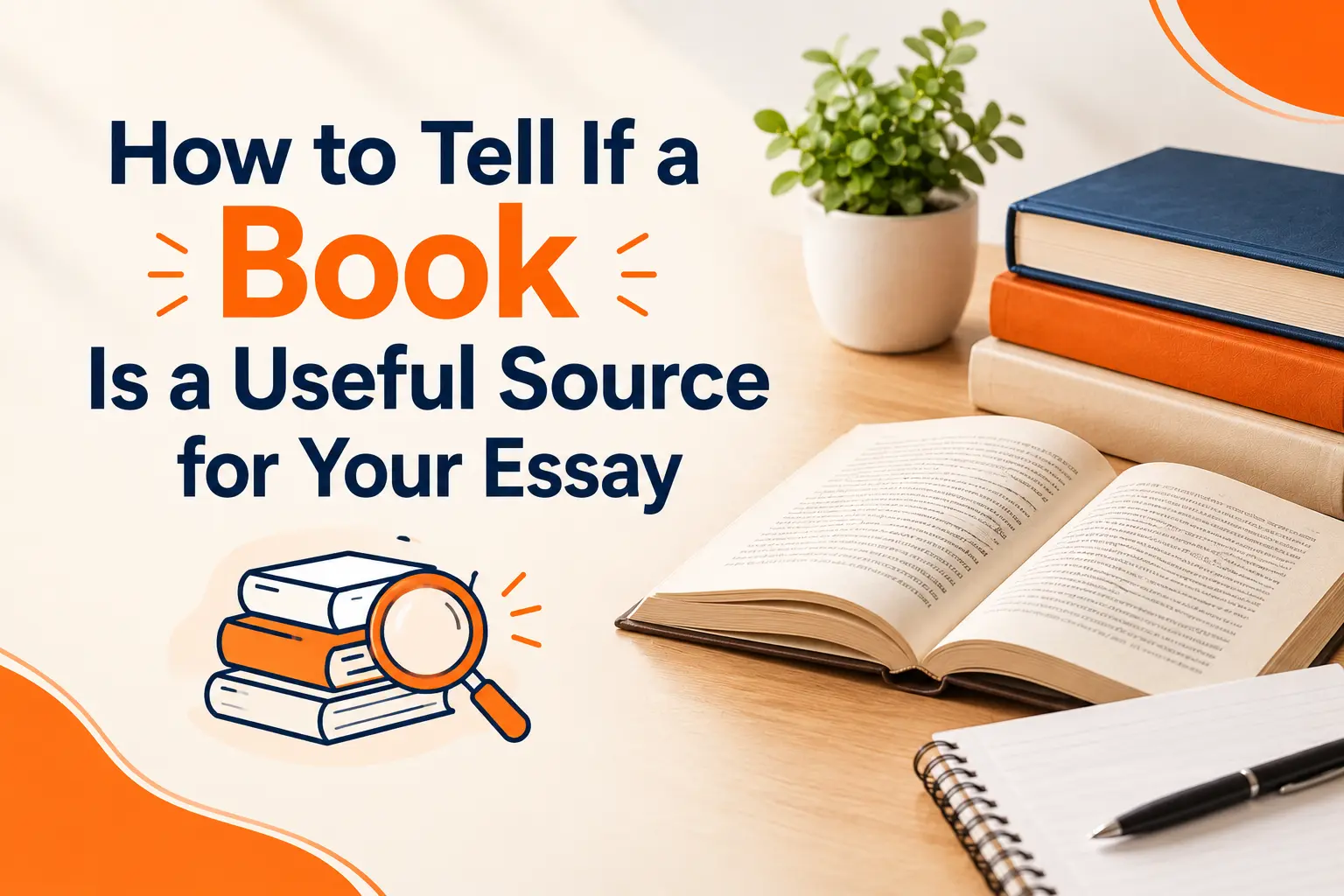
Quick Answer: What to Do the Moment You Find a Book
When you find a book that might work, do not open it and start reading. Preview it first, in this order.
Open the table of contents. Check the index for two or three of your key terms. Then skim the preface.
Five minutes tells you whether the book actually addresses your topic and thesis. That saves you an hour of reading a chapter that does not help.
The 5-Minute Book Evaluation Checklist
Work through these six steps in order. Stop as soon as a book clearly fails one of them.
A book that fails step one almost never recovers by step six. Triage first, read later.
Scan the Table of Contents
The table of contents is the book's blueprint. Look for chapters whose titles include your topic or your thesis terms.
If nothing in the contents speaks to your essay, the book probably will not either. Move on to the next candidate.
Search the Index for Your Key Terms
Flip to the back and look up two or three specific terms from your essay question. A useful book will list your terms with multiple page references.
A single passing mention on one page is a warning sign. Your topic is a footnote in this book, not its subject.
Read the Preface and Introduction
The preface tells you why the author wrote the book and who they wrote it for. The introduction states the main argument.
Together they take about five minutes to skim. They reveal the book's scope, its assumptions, and whether the angle fits your essay.
Note the Publication Date and Edition
Check the copyright page for the publication year. Ask whether the book is current enough for your topic.
A 2005 book on Renaissance poetry can still be canonical. A 2005 book on artificial intelligence is a historical document.
Check the Author's Credentials and Publisher
Search the author's name. Look for a university affiliation, published research, or recognized expertise in the field.
Then look at the publisher. University presses like Oxford, Cambridge, Chicago, and Harvard signal peer review and editorial rigor.
Skim the Bibliography
The bibliography is a hidden research shortcut. A rich, current bibliography shows the author engaged seriously with the field.
It also hands you a curated list of further sources you can follow up on. A thin bibliography suggests thin engagement.
Match the Book to Your Thesis
A book can be credible, current, and well written and still be wrong for your essay. What matters is whether it supports your specific argument.
Hold each candidate book up against your thesis statement and ask three questions. Does this book provide evidence for my argument? Does it offer a counter-argument I should address? Does it give useful background my reader needs?
If the answer to all three is no, the book is off-topic. If the answer to any is yes, keep it.
A book that challenges your thesis intelligently is often more valuable than one that agrees. Addressing counter-arguments is what separates strong essays from surface-level ones.
Types of Books and When Each Fits Your Essay
Not all books do the same job. Matching book type to essay type saves time and strengthens your argument.
| Book type | What it is | Best used for | Watch out for |
|---|---|---|---|
| Monograph | A single-author, in-depth book on one focused subject | Analytical, argumentative, and research essays that need sustained expert reasoning | Author's angle can be strong; balance with other sources |
| Edited volume | A collection of chapters by different authors, curated by an editor | Essays covering a topic from multiple angles or debates | Chapter quality varies; evaluate each chapter separately |
| Textbook | An organized overview of a discipline, written for students | Background context, definitions, foundational concepts | Rarely works as a primary source for a college essay's core argument |
| Reference work | Encyclopedias, handbooks, companions | Quick facts, definitions, orientation to a new topic | Cite the specific entry, not the whole reference; use sparingly |
| Primary source book | Historical documents, letters, memoirs, original data | History, literature, and empirical essays that analyze original material | Requires interpretation; do not confuse the source with the analysis |
For an argumentative essay on climate policy, a monograph by a policy scholar will serve you better than a textbook overview. Add an edited volume with opposing viewpoints and you have a stronger foundation.
Apply the CRAAP Test to a Book
The CRAAP test was developed by librarians at the Meriam Library at California State University, Chico. It is a five-point framework for evaluating any source.
Applied to a book, the five points are:
- Currency. When was the book published? Is that recent enough for your topic?
- Relevance. Does the book address your essay question at the depth you need?
- Authority. Who wrote it, who published it, and what qualifies them?
- Accuracy. Does the author cite sources? Do other scholars cite this book?
- Purpose. Why does the book exist, to inform, argue, persuade, or entertain?
CRAAP takes about the same five minutes as the checklist above. Used together, they form a triage system rather than a research method.
Need a professionally researched paper?
Let our skilled writers build your argument on credible research.
Elevate your grades today!
How Many Book Sources Should Your Essay Have?
There is no universal number, but there is a reasonable range by academic level. Treat these as starting points, not rules.
- High school essays (1,000 to 1,500 words): one to three sources total, with at least one book.
- First-year undergraduate essays (1,500 to 2,500 words): three to six sources, with at least one book unless articles fit better.
- Upper-level undergraduate essays (2,500 to 4,000 words): six to ten sources, with two to four books typical in humanities and social sciences.
- Graduate essays and seminar papers: ten or more sources, with books doing serious argumentative work.
The right number is whatever your argument actually needs. Padding your bibliography with unread books is a habit graders recognize on sight.
When Books Are the Wrong Tool
Books are not always the best source. Pretending they are can weaken an essay rather than strengthen it.
Consider whether you actually need a book for these topics:
- Current events or recent legislation. Books lag reality by one to three years. Use news outlets and official documents instead.
- Fast-moving fields. Machine learning, biotechnology, and cybersecurity change faster than books can keep up. Prefer peer-reviewed articles.
- Statistics and data. Books cite older datasets. Go to the primary source, such as government agencies or the original studies.
- Legal or medical specifics. Use official sources like statutes, court opinions, and clinical guidelines from bodies such as the CDC or WHO.
When articles or primary sources fit better, use them without apology. Fit matters more than source format.
How to Preview a Book Before You Own or Borrow It
You do not need to physically check out a book to evaluate it. Several free tools show you enough to decide.
- Google Books preview shows the table of contents, front matter, and sample pages for most published books.
- Amazon "Look Inside" offers the same for books sold on the platform.
- Publisher websites, especially university presses, usually post sample chapters and full tables of contents.
- Your library's discovery layer often shows the table of contents, chapter abstracts, and reader reviews.
- WorldCat at worldcat.org helps you locate a book in any library and often links to fuller records.
Ten minutes of online previewing can save an hour at the library. It can also save a wasted interlibrary loan request.
Mining a Book's Bibliography for More Sources
Once you have identified one strong book, its bibliography is often the fastest route to the rest of your research. Scholarly authors have already found, read, and vetted the most relevant sources in their field.
To mine a bibliography effectively, follow these steps:
- Look for repeated citations. If three books cite the same article, that article is likely foundational.
- Note the most recent works. They show you where the field is now.
- Search each promising title in Google Scholar to see how often it has been cited.
- Watch for clusters of citations from a five-year window. They point you to a key debate.
This is standard research practice and saves hours of database searching. For a broader look at where these sources fit, see our research paper writing guide.
Common Mistakes Students Make with Book Sources
A few patterns show up repeatedly in weak essays. Avoid them.
- Reading before previewing. You lose an hour on a chapter you could have ruled out in five minutes.
- Citing the whole book when you only used one chapter. In MLA, APA, and Chicago, you cite the specific chapter or pages.
- Using the introduction as evidence. The introduction summarizes the argument. Cite from the chapters where evidence appears.
- Ignoring the publication date. A book that was cutting-edge in 1998 may have been superseded by a decade of research.
- Confusing scholarly with popular. A trade book by a journalist is not the same as a peer-reviewed monograph.
- Padding the bibliography. Listing books you did not read is easy for graders to spot. It weakens trust in the sources you did use.
Answering the "Three Books" Study-Skills Question
A common study-skills exam question reads as follows. You've located three books on a topic you're researching for an essay. The first thing you should do in determining if any of these books will be useful is...
The correct answer is to preview each book by scanning the table of contents and the index. You are checking whether the book actually addresses your topic.
You are not reading a chapter, checking every citation, or evaluating the author yet. All of those steps come later. The first step is triage.
The reason preview-first is correct is simple. Reading is expensive and previewing is cheap.
Scanning the table of contents and index of three books takes about fifteen minutes total. It tells you which one deserves a full chapter read, which is a maybe, and which goes back on the shelf.
Every evaluation method you learn later starts from the same principle. Eliminate the obvious no-fits before you invest real reading time.
This is also the habit that survives after the exam. Every experienced researcher previews before reading, from undergraduates to senior professors.
Frequently Asked Questions
- Are books good sources for a college essay?
- Yes, for most humanities and social science essays. Books provide sustained argument, detailed evidence, and context that shorter sources rarely offer.
- How do you know if a book is credible?
- Check the author's credentials, the publisher's reputation, the publication date, and whether other scholars cite the book. University press titles carry the strongest automatic credibility.
- Can you use old books in an essay?
- Yes, when the age of the book fits your topic. Older books work well as primary sources, foundational theory, or historical evidence.
- How many book sources should an essay have?
- It depends on length and level. A first-year essay might need one or two books, while an upper-level essay often uses three to five.
- Is Google Books enough to evaluate a book?
- For evaluation, usually yes. Google Books almost always shows the table of contents, preface, and sample pages, which is enough to decide.
- How do I know if a book is scholarly?
- Look for a university or academic press, a credentialed author, footnotes or endnotes, and a substantial bibliography. The focus should be argument and evidence rather than opinion.
Key Takeaway
A book earns its place in your essay by passing two tests. It addresses your topic and it supports your argument.
Preview first, evaluate second, read third. Ten minutes of triage will save you hours of misdirected reading.
Build the habit once and you will never open a research book blind again. Your essays will be tighter, better sourced, and easier to defend.
 MyPremiumEssay