
The catch is that an essay about yourself is really three different essays. A scholarship essay, an application statement, and a class assignment each reward different choices. This guide helps you spot which one you are writing, then decide what belongs in it.
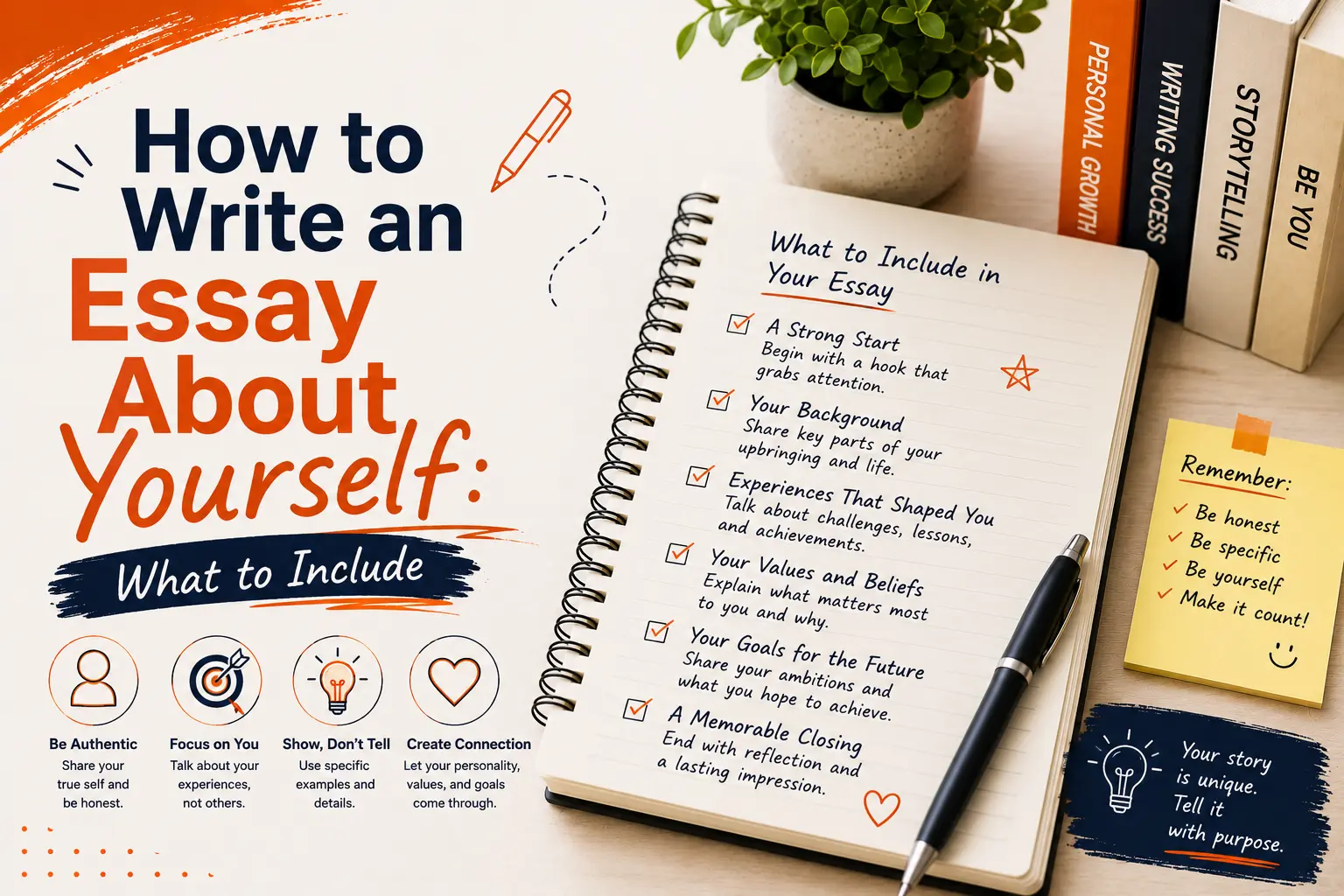
First, Figure Out Which Essay You Are Writing
The most common reason these essays fail is a mismatch of context. Students pour out a hardship when the task wanted evidence. Or they list awards when the reader wanted a person. Advice for one essay quietly sinks another.
Three essays hide under this one keyword. Find yours before you write a single line.
| Scholarship essay | Application statement | Class assignment | |
|---|---|---|---|
| Reader | A funding committee | Admissions officers | Your instructor |
| Their question | "Do you fit our mission?" | "Who is this person?" | "Can you explain yourself with evidence?" |
| What wins | A clear goal tied to their cause | Character and self-awareness | Specific facts and structure |
| What fails | Vague goals, no link to the funder | Reading like a resume | Emotion with no support |
The Scholarship Essay
A committee is deciding where to spend limited money. They reward students who have defined goals and a real link to their cause. Show a clear path, then connect that path to what they value. If a detail has nothing to do with your education or their mission, drop it.
The Application Statement
Admissions officers already see your grades, scores, and activities. Repeating them wastes your one chance to be a person. The best statements often take something ordinary and tell it with sharp specificity. If your draft could be rebuilt from your application form, start again.
See our college application writing guide for the admissions version.
The Class Assignment
This one fools people because it sounds emotional but is not. An expository essay about yourself informs the reader with concrete examples. It is not a dramatic story and not an argument. "I am hardworking" is a claim. "I kept a 3.8 GPA while working 20 hours a week" is proof.
The Selection Test: What to Include and What to Cut
This is the skill that everything else depends on. Once you know your essay type, you filter your life through it. Here is how to do that cleanly.
Five Questions to Ask Before You Write
Run every story, fact, and detail through these. If it fails more than one, cut it.
- Does it connect to my purpose, my goal, or the reader's mission?
- Does it show change or reveal a value I hold?
- Is it specific to me, or could anyone write it?
- Would the reader learn something new from it?
- Am I comfortable with a stranger reading this?
The Relevance Filter
The same fact can be right for one essay and wrong for another. "I taught myself to code during a hard year" fits a STEM scholarship essay well. It reveals character in a statement. It is pure filler in an essay about your love of running. Relevance depends on purpose, not on how much the memory means to you.
What to Leave Out
Cut hardship that has no reflection, because pain alone is not insight. Cut brag lists, since awards without meaning read like padding. Cut off-topic personal detail, like partners or unrelated family drama. Cut vague goals, because a reader always picks the candidate with a plan.
Turn an Ordinary Fact into Real Reflection
Most essays stall here. People state what happened, then stop. A fact becomes an essay only when you carry it through three stages. Move from the fact, to why it mattered, to what it reveals about you.
Before, a fact going nowhere:
I looked after my younger siblings after school while my parents worked.
After, the same fact carried through:
I looked after my younger siblings every afternoon while my parents worked. At the time it felt like lost hours. Looking back, running a household at fourteen taught me to plan under pressure. It is the same instinct I reach for before every deadline now.
Same raw material. The second version earns its place because it reaches a meaning. Do this for each story you keep. Our thesis statement guide helps you name that central point.
Choose a Structure That Fits Your Material
Structure should follow your content, not the other way around. Two structures cover almost every essay about yourself.
Narrative Structure
Use this when you have one significant experience to explore. It splits into rough thirds. First the challenge and its effects, then what you did, then what you learned. It suits scholarship essays and any statement built around a turning point.
See our narrative essay writing service and essay structure guide for the full method.
Montage Structure
Use this when you do not have, or do not want, one central challenge. You link several small moments through a single theme. That theme might be a collection, a place, a routine, or an object. Each moment reveals a different value, and the theme ties them together.
Which One Fits Your Essay
Scholarship and class essays often lean narrative, because they want a clear point. Statements can go either way. Try montage first if no single event dominates your life. You can always switch later.
How to Start: Hooks That Work
Your first sentence decides whether the reader leans in. Here are four reliable hooks, each with a quick model.
- Drop into a moment: "The email came three minutes before my final."
- Ask a real question: "What does resilience actually cost?"
- Open with a surprising fact: "I have lived in seven houses in ten years."
- Start with dialogue: "'Don't throw those out,' she said. 'I earned them.'"
Then kill the cliches that flag an essay as generic. Avoid "from a young age" and "for as long as I can remember." Skip opening quotes too. The reader came for your words, not someone else's. Our good hooks for essays guide has more.
Annotated Examples, One per Type
Below is a short excerpt of each essay type. Each note shows why a choice was made, since the logic matters more than another finished sample.
Scholarship Essay
I taught my first coding lesson on a cracked laptop at our kitchen table. My student was my mother, learning spreadsheets for a new job. [Specific opening, not "I have always loved computers."] Watching her grow confident in a week showed me that technology is about access. That is why I study computer science, and why your foundation's mission to close the digital divide feels like my own. [Ties the story straight to the funder's cause.]
Application Statement
My desk drawer is a museum of half-finished projects. A circuit board, three chapters of a novel, a jar of failed sourdough. [A montage thread built on one object.] For years I read that as proof I could not finish things. Now I see someone who starts ten hard projects and learns from the failures. [Reveals a value and a shift, not a grade.]
Class Assignment
The clearest proof that I think in systems is not a grade. It is my closet. [Concrete, unexpected proof of a stated trait.] Everything is grouped by use, a habit I moved into how I study. I map a syllabus into steps before the first lecture. In two years, this nearly erased my end-of-term panic. [A measurable result, told plainly.]
Editing Checklist: Does It Still Sound Like You?
Run this final pass before you submit.
- Read it aloud, since anything awkward to say reads awkward too.
- Cut every sentence that does not sound like you.
- Confirm each detail earns its place with the five questions.
- Swap vague words for specific ones, so "a club" becomes "the robotics team."
- Check that you answered the exact prompt you were given.
- Proofread last, because typos signal carelessness to your one reader.
Common Mistakes and Their Fixes
- Bragging without context. Fix it by explaining what an achievement taught you.
- Being vague. Replace "I work hard" with one provable example.
- Oversharing. If you cannot reflect on a painful topic yet, choose another.
- Cliches. Honest specifics about your own life cannot be cliched.
- Ignoring the prompt. Answer the question that was actually asked.
- All obstacles, no growth. Every hardship needs a "so what did you do."
- Inventing material. Fabrication falls apart the moment you are questioned.
Writing about yourself is really editing yourself. You decide which parts of a whole life belong on this page, for this reader. Get the diagnosis right, run your material through the test, and the essay mostly writes itself.
Want a second set of eyes on your draft? Our expert writers can help you shape your story or start from scratch.
Frequently Asked Questions
How do I start an essay about myself?
Open with a specific moment, a real question, a surprising fact, or a line of dialogue. Add one sentence of context, then state your main point. Avoid tired openers like "from a young age."
How long should an essay about yourself be?
It depends on the task. Scholarship prompts often cap at 250 to 500 words. Application statements run up to 650. Class essays vary, so follow the stated limit closely.
How personal is too personal?
Share struggles only when you can also show growth. Leave out anything you would not want a stranger to read. Cut details that do not connect to your purpose.
What is the difference between a personal essay and a personal statement?
A personal essay explores a meaningful experience for many contexts. A personal statement is an application document that shows admissions readers who you are and why you fit.
Can I use humor in an essay about myself?
Yes, when it sounds like you and comes naturally. Light humor makes you relatable and can soften a brag. Forced jokes read as trying too hard, so cut them.
What should I never include?
Skip invented stories, unresolved trauma without reflection, vague goals, brag lists, and off-topic personal details that do not serve your point.
 MyPremiumEssay