
A good essay looks like a clear argument on a clean page. It states one arguable thesis, proves it in focused paragraphs that explain their evidence, and ends by showing why the argument matters. It follows the assigned style, usually MLA or APA, with double spacing, 1-inch margins, and a specific title.
This guide shows you both layers through current MLA and APA layouts, the five qualities graders reward, an A vs B vs C rubric, and a side-by-side example of a weak and a strong essay.
At a glance, a good essay
-
Answers the exact question the prompt asks
-
States one focused, arguable thesis
-
Develops every point with evidence it explains
-
Keeps each paragraph tied to the thesis
-
Moves from idea to idea in a logical order
-
Gets grammar, citations, and format right
How Should an Essay Look on the Page?
A well-formatted essay looks clean, consistent, and exactly like the style guide your instructor assigned. For most US students, that means MLA 9 in English and the humanities or APA 7 in psychology, education, nursing, and the social sciences.
Here is how the first pages differ on a student paper.
| Element | MLA 9 | APA 7 (student paper) |
|---|---|---|
| Title page | Not required unless your instructor asks for one | Required: bold title, your name, affiliation, course, instructor, due date |
| First page | Four double-spaced lines at top left (your name, instructor, course, date), then the title centered | Paper title repeated in bold and centered above the first paragraph |
| Page header | Last name and page number, top right | Page number only, top right; no running head unless your instructor requires one |
| Font | A readable font such as Times New Roman, 12 pt | Several options, including Calibri 11 pt, Arial 11 pt, Times New Roman 12 pt, and Georgia 11 pt |
| Spacing | Double-spaced throughout | Double-spaced throughout |
| Margins | 1 inch on all sides | 1 inch on all sides |
MLA papers end with a Works Cited page; APA papers end with References.
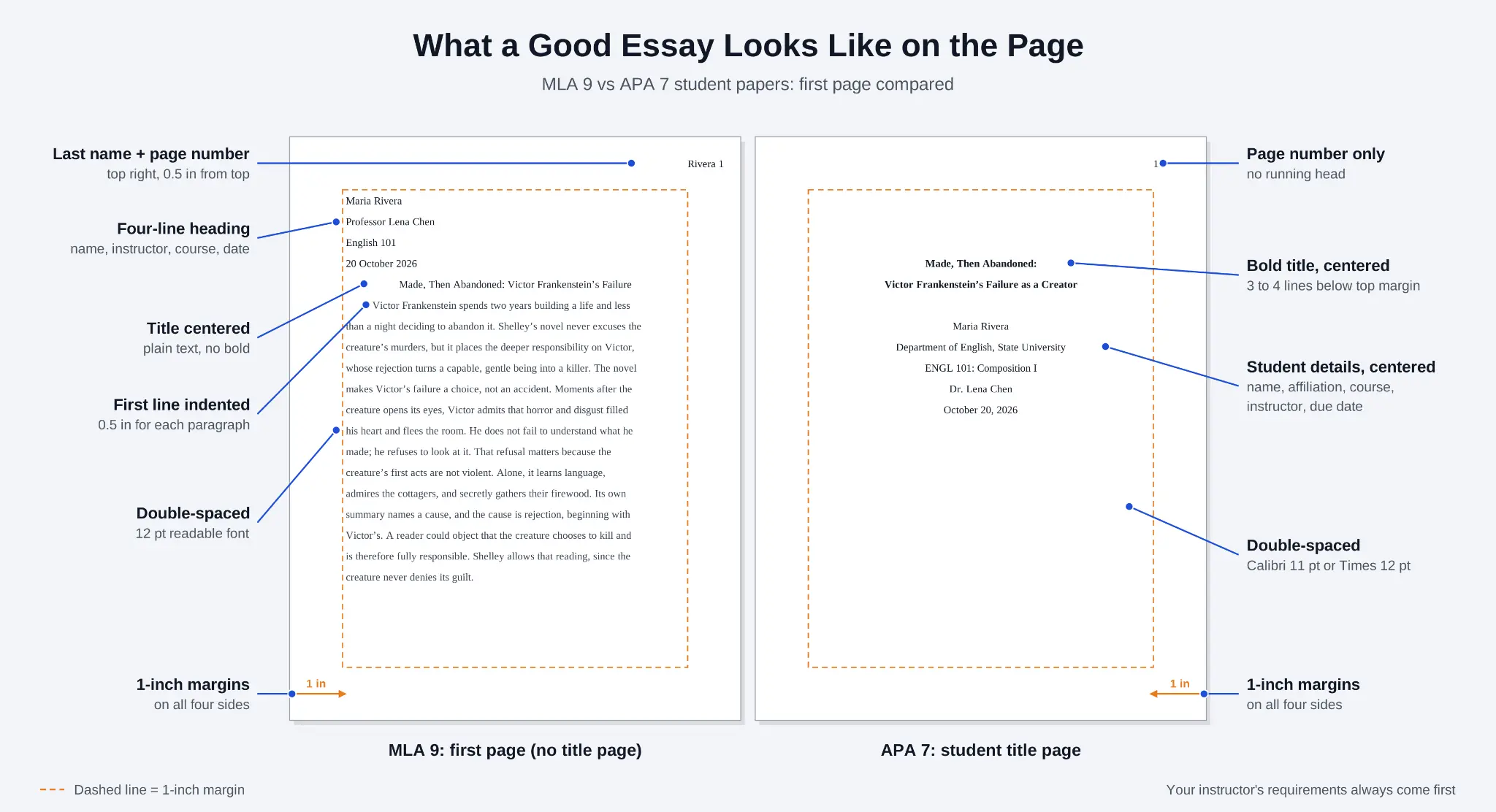
Beyond the style rules, a good essay also looks readable. Paragraphs vary in length but rarely run past a page; the University of York's English department notes that most effective paragraphs are shorter. Quotes stay short enough that your own sentences fill most of the page.
One rule overrides both style guides: your assignment sheet. When an instructor asks for a title page in MLA or a running head in APA, follow the instructor.
Quotations follow the same style rules as the rest of the page, so check how to format and cite quotations in MLA and APA before you submit.
What does a good essay title look like?
A good essay title tells the reader your angle, not just your topic. York's English department advises students to write titles that sound like published articles rather than exam questions.
Weak titles:
-
Frankenstein Essay
-
Is Social Media Bad?
Strong titles:
-
Made, Then Abandoned: Victor Frankenstein's Failure as a Creator
-
Built to Interrupt: How Notification Design Competes With Studying
The strong versions preview the argument. A reader knows the claim before reading a single paragraph.
What Are the 5 Qualities of a Good Essay?
The five qualities of a good essay are focus, development, unity, coherence, and correctness.
Focus
Focus means the essay makes one central claim. That claim is your thesis, and it needs to be arguable. A useful test is to ask whether your thesis is a claim someone could dispute or simply a statement of fact. Facts cannot be argued, so they cannot carry an essay.
-
Fact: Frederick Douglass learned to read while enslaved.
-
Arguable thesis: Douglass presents literacy as the first act of resistance, the moment his mental freedom began years before his physical escape.
Once the thesis is set, every paragraph works for it. You can start with a strong thesis by turning your topic into a claim someone could reasonably disagree with.
Development
Development is how well you prove your claim. Good development pairs evidence with explanation. The University of Melbourne's academic skills team warns against listing evidence like a shopping list; you need to evaluate it and show how it supports your point.
A practical rule: every quote, statistic, or example earns at least one sentence of your own analysis. In the IB Theory of Knowledge course, teachers note that the quality of an essay's examples tends to predict its overall grade. The same logic holds well beyond IB: choosing and explaining evidence is one of the highest-value skills you can build.
Unity
Unity means every paragraph serves the thesis. A paragraph can be interesting, accurate, and well written and still hurt your grade when it wanders away from your claim.
Test each paragraph by finishing this sentence: "This paragraph proves my thesis because..." When you cannot finish it, cut the paragraph or rewrite it.
Coherence
Coherence is the order and connection of your ideas. Strong essays use transitions that show reasoning (because, however, as a result, this suggests) rather than transitions that only count (first, second, also).
Correctness
Correctness covers grammar, spelling, punctuation, citations, and format. It rarely earns an A by itself, but errors pull grades down fast because they make the reader stop trusting your care.
How should a good essay use sources?
Good essays use credible sources and blend them into the writer's own sentences. Credible usually means scholarly books and journal articles, government or university publications, and primary texts the assignment names. Anonymous web pages and content farms weaken your support, even when they say the right thing.
How you bring a source in matters as much as which one you choose:
-
Introduce each quote with a signal phrase that names the source and its role ("Historian Eric Foner argues.)
-
Quote only the words you need, and paraphrase the rest.
-
Cite every borrowed idea, not only direct quotes.
What separates a good essay from an excellent one?
The clearest marker is a counterargument: the strongest objection to your thesis, raised and answered inside your essay. A course guide from the Wabash Center lists anticipating and answering objections as one of the core marks of a good essay. It proves you understand the debate, not only your side of it.
A good counterargument paragraph states the objection fairly, grants what is true in it, and shows why your thesis still holds. Excellent essays also have a clear voice, so the writing sounds like a specific person thinking rather than a template being filled.
Does a Good Essay Answer the Prompt?
Yes, and this is where many capable writers lose points. A polished essay that answers a slightly different question will still score low on the "meets the assignment" line of the rubric.
Start by finding the directive word in your prompt. It tells you what kind of thinking the grader expects.
| Directive word | What it asks for | What the thesis looks like | Common miss |
|---|---|---|---|
| Analyze | Break something into parts and explain how they work | "X achieves Y through A, B, and C" | Summarizing instead of explaining how |
| Argue | Take a position and defend it | "X should happen because..." | Sitting on the fence |
| Compare | Show similarities and differences | "Although X and Y share A, they differ on B, which shows C" | Two separate summaries with no link |
| Discuss | Explore an issue from several angles, then judge | "While X has merit, Y matters more because..." | Listing views without reaching a judgment |
| Evaluate | Judge strengths and weaknesses | "X succeeds at A but fails at B" | Describing without judging |
| Explain | Make a process or idea clear | "X happens because of A and B" | Arguing an opinion that was not asked for |
How Do Teachers Grade an Essay?
Teachers grade essays on five things: the thesis, the evidence and analysis, the organization, awareness of the reader, and language and format. They score each one against a rubric, a set of criteria with descriptions for each grade level.
This table combines the patterns found in several published university rubrics, including George Mason University's.
| Criterion | A range | B range | C range |
|---|---|---|---|
| Thesis | Arguable, specific, and developed as the essay moves | Clear and focused, with some insight | Present but broad or close to a statement of fact |
| Evidence and analysis | Well-chosen evidence, closely explained | Solid evidence, uneven explanation | Evidence summarized more than analyzed |
| Organization | Logical at both essay and paragraph level | Logical overall, with some weak paragraphs | Recognizable structure, loose connections |
| Reader awareness | Anticipates questions and objections | Mostly considers the reader | Little sense of audience |
| Language and format | Clear, concise, and correct | Mostly clear, a few errors | Vague wording and noticeable errors |
The gap between B and A is usually not about effort. A first-year writing rubric from Smith College describes B-range essays as having strong ideas that fall short on analysis, transitions, or clarity, while A-range essays show a writer who has made the assignment their own.
Is a B+ a good essay grade?
Yes. Many rubrics label the B range as good work. A B+ usually means the essay is strong on most criteria but held back on one or two, often analysis depth or paragraph-level organization. Ask your teacher which criterion kept it from an A, then fix that one first.
What Should Each Part of an Essay Look Like?
Each part of an essay has one job. The introduction sets up the argument, body paragraphs prove it, and the conclusion explains why it matters. The full essay structure guide covers every part in depth; here is the short version.
A good introduction moves from a concrete opening to an arguable thesis, like the Douglass thesis in the Focus section. A weak one only announces a topic ("This essay will discuss literacy in Douglass's Narrative"). You can write a stronger essay introduction by cutting any opening sentence that could fit an essay on a different topic.
A good body paragraph has four parts: a topic sentence, evidence, analysis, and a link back to the thesis. Here is one, labeled.
[Topic sentence] Douglass shows that the effort to keep him illiterate is what first reveals the logic of slavery to him. [Evidence] After overhearing his enslaver forbid his reading lessons, Douglass writes, "From that moment, I understood the pathway from slavery to freedom" (Douglass, ch. 6). [Analysis] The enslaver means the warning as control, but Douglass reads it as a confession: slavery depends on keeping the enslaved from knowledge. The ban that was meant to close a door shows him exactly where the door is. [Link] Literacy, in Douglass's telling, becomes resistance before he has learned a single word.
Notice the analysis is longer than the quote. That ratio is what separates explained evidence from a dropped quote, a quotation left sitting in a paragraph with no explanation of why it matters. You can structure each body paragraph this way for any essay type.
A good conclusion answers "so what?" A University of North Carolina course rubric describes outstanding conclusions as ones that leave the reader with insight into why the argument matters rather than restating it. A weak conclusion repeats the thesis; a strong one widens the lens. Learn how to conclude your essay with impact using this test.
Good Essay vs Bad Essay: A Side-by-Side Example
This good essay example sits next to a weaker version written for the same prompt. Read them in order, then compare the notes.
Prompt: In Mary Shelley's Frankenstein (1831 edition), who bears more responsibility for the creature's violence, Victor or the creature?
What does a C-range essay look like?
Frankenstein is a novel by Mary Shelley about a scientist named Victor who creates a monster. The monster kills several people in the book. This essay will discuss who is responsible.
Victor creates the creature in his laboratory. When it comes to life, he is scared and runs away. The creature is left alone. Later, the creature learns to speak by watching a family. He tries to make friends with them, but they attack him. The creature says, "I was benevolent and good; misery made me a fiend" (Shelley, ch. 10). Then he kills William.
In conclusion, both Victor and the creature are responsible for what happens. Victor made the creature, and the creature did the killing. It is a very interesting book that teaches many lessons.
What does an A-range essay look like?
Victor Frankenstein spends two years building a life and less than a night deciding to abandon it. Shelley's novel never excuses the creature's murders, but it places the deeper responsibility on Victor, whose rejection turns a capable, gentle being into a killer.
The novel makes Victor's failure a choice, not an accident. Moments after the creature opens its eyes, Victor admits that "breathless horror and disgust filled my heart" and flees the room (Shelley, ch. 5). He does not fail to understand what he made; he refuses to look at it. That refusal matters because the creature's first acts are not violent. Alone, it learns language, admires the cottagers, and secretly gathers their firewood. Its own summary is precise: "I was benevolent and good; misery made me a fiend" (ch. 10). The sentence names a cause, and the cause is rejection, beginning with Victor's.
A reader could object that the creature chooses to kill and is therefore fully responsible. Shelley allows that reading, since the creature never denies its guilt. Yet the novel repeatedly shows Victor with the knowledge and power to stop the violence and declining to use either. Responsibility in Frankenstein follows power, and Victor holds it from the night of the creation to the last page.
Shelley's warning reaches past laboratories. Creating something, whether a life, a technology, or an institution, carries a duty to stay with it. Victor's real crime is not ambition but abandonment.
Why the A-range version earns the higher grade
-
Version A never takes a position ("both are responsible"), while Version B argues a clear, debatable claim. That is focus.
-
Version A drops the creature's quote and moves on; Version B explains what the quote proves. That is development.
-
Version A spends its middle paragraph retelling the plot, while every sentence in Version B serves the thesis. That is unity.
-
Version B raises the strongest objection and answers it, and Version A never considers the reader at all. That is the counterargument.
-
Version A restates and adds a vague compliment, while Version B explains why the argument matters beyond the novel. That is the conclusion's job.
Version A is not careless. It is accurate, organized, and readable. It reads as C-range work because it reports what happens instead of arguing what it means.
Does a Good Essay Look Different by Type and Level?
The five qualities stay the same, but what "good" looks like shifts with the essay type and your academic level.
By essay type
The characteristics of a good essay change with its purpose.
| Essay type | What good looks like | Most common weakness |
|---|---|---|
| Argumentative | A debatable claim, strong evidence, a fair counterargument | Ignoring the other side |
| Expository | Clear, neutral explanation organized for a reader new to the topic | Slipping into opinion |
| Narrative | A focused story that builds toward a clear insight | Telling events with no point |
| Analytical | Close reading that explains how a text or process works | Summary in place of analysis |
| Reflective | Honest connection between experience and learning | Describing feelings without growth |
| Compare and contrast | A thesis that explains what the comparison reveals | Two separate summaries |
For the most common assignment type, learn how to build an argumentative essay with a counterargument that strengthens your case.
By academic level
High school. A five-paragraph structure is usually acceptable and often expected. Teachers reward a clear thesis, three supporting points, and correct mechanics.
College. Expectations change sharply. The argument should develop as the essay moves rather than repeat itself paragraph by paragraph. A UNC course rubric marks down essays that stay locked in a static five-paragraph pattern. College graders also expect you to engage counterarguments and, in many courses, scholarly sources.
Graduate. A good essay contributes something. Graders expect you to place your argument within existing research and show what it adds.
What does a good timed or exam essay look like?
Under time pressure, graders expect less polish and more clarity. A good timed essay states its thesis in the first paragraph, uses two or three well-explained points instead of many thin ones, and saves a few minutes to reread.
AP English exams show this priority in their scoring. The AP English Language scoring guidelines give 4 of an essay's 6 points to evidence and commentary, with 1 point each for a defensible thesis and for sophistication. Grammar costs points only when errors interfere with communication.
What does a good college application essay look like?
A college application essay follows different rules. It is personal rather than academic, usually has no thesis in the classroom sense, and is judged on what it reveals about you. Specific moments, honest reflection, and your natural voice matter more than formal structure. When you are ready to start, write your college application essay with its own guide.
What Should a Good Essay Avoid?
Strong ideas can still produce a weak essay. These are the patterns that pull grades down most often:
-
Plot or event summary in place of analysis. York's English department warns students not to simply follow the order of the text they are writing about.
-
Padding to reach a word count, such as repeated points or long quotes doing your thinking for you.
-
Sweeping openers like "Since the dawn of time" or "In today's society."
Will generic, AI-sounding writing lower your grade?
Often, yes, even when no detector is involved. Generic writing tends to make broad claims, use stock transitions, and avoid specific evidence. Those same features are what rubrics mark down under thesis, analysis, and voice.
Some instructors now ask for outlines, drafts, or version history alongside the final essay. The safest approach is to let your own reasoning show on the page: specific evidence, your own explanation of it, and a position you can defend in conversation.
How Do You Know If Your Essay Is Good?
You know your essay is good when it passes five checks a grader would apply. Run them in this order before you submit.
-
Make a reverse outline. Copy only your thesis and topic sentences into a new document and read them as a list. They should form a logical argument by themselves.
-
Score yourself against the rubric. Grade your draft with the A, B, and C table above, and be strict about the analysis row.
-
Match the prompt. Underline the directive word and confirm your thesis does that exact job.
-
Read it aloud. Places where you stumble are usually places where a reader will too.
-
Ask "so what?" after every paragraph. Any paragraph without an answer needs revision.
Here is the reverse outline test applied to the Frankenstein example. Version A's key sentences read: "This essay will discuss who is responsible. Victor creates the creature in his laboratory. Both Victor and the creature are responsible." That list has no claim and no reasoning, so the essay will not have them either.
Version B's key sentences read: "The deeper responsibility belongs to Victor. Victor's failure is a choice. A reader could object that the creature chose to kill. Responsibility follows power." That list is an argument on its own, which is the clearest sign the full essay works.
When a check fails, fix the biggest problem first. A weak thesis comes before weak paragraphs, and weak paragraphs come before grammar. Polishing sentences in an essay with no clear claim only produces a cleaner C.
Frequently Asked Questions
What does an essay look like?
An essay is a document of paragraphs organized into an introduction, body, and conclusion. On the page, it follows a citation style such as MLA or APA: usually 1-inch margins, double spacing, a readable 10 to 12 pt font, page numbers, and a source list at the end.
How long should a good essay be?
A good essay is as long as the assignment asks and no longer. Word counts usually give a range, and graders expect you to land inside it. Landing well under the range signals thin development; running well over it signals weak editing.
How many paragraphs should a good essay have?
As many as the argument needs, with one main point per paragraph. Short essays of 500 words or so often land at five paragraphs, while a 2,000-word paper may need ten or more. Let the number of claims you have to prove set the count, not a template.
Can a good essay use "I"?
It depends on the assignment and the field. Personal, reflective, and narrative essays usually welcome first person. Many academic essays work better in third person, though some instructors and disciplines accept "I" for stating your argument. Check the assignment sheet or ask your instructor.
Get Expert Support for Your Next Essay
Reviewing finished work is one of the quickest ways to raise your own standard. Explore our essay samples to see these qualities applied across subjects and academic levels.
For assignments with tight deadlines or demanding requirements, work with professional essay writers at MyPremiumEssay who tailor each paper to your prompt, grading criteria, and citation style.