
To write a draft essay, turn your outline into a complete version of the essay in full paragraphs: draft the body first, then the introduction and conclusion, and save all editing for later. A good first draft is judged by whether the whole argument is on the page, not by how polished the sentences are.
Keeping drafting and editing separate is what makes the process fast. The method below covers seven steps, a word budget for each section, an annotated rough draft example, and advice for specific essay types.
What Is a Draft Essay?
A draft essay is the first complete version of an essay, written in full paragraphs, that contains every main point and piece of evidence but has not yet been revised or edited.
It has an introduction, body paragraphs, and a conclusion, and it follows your outline closely enough that the argument is visible from start to finish. You will also hear it called a rough draft or first draft; most instructors use the three terms interchangeably.
A messy draft that makes every point in your outline is more useful than three polished paragraphs followed by a blank page.
How Is a Draft Different From an Outline or Final Draft?
Each stage of the writing process does a different job. Mixing them up is the main reason drafting feels slow.
| Stage | Format | Your focus | What to ignore |
|---|---|---|---|
| Outline | Bullets, phrases, evidence notes | Order of ideas and which evidence supports which point | Sentences, style, transitions |
| First draft | Full paragraphs | Getting every point written out with its evidence | Word choice, grammar, citation formatting |
| Second draft | Full paragraphs, reorganized | Argument logic, paragraph order, gaps in evidence | Commas and typos |
| Final draft | Polished essay | Clarity, flow, accuracy, formatting | Nothing; this is the version you submit |
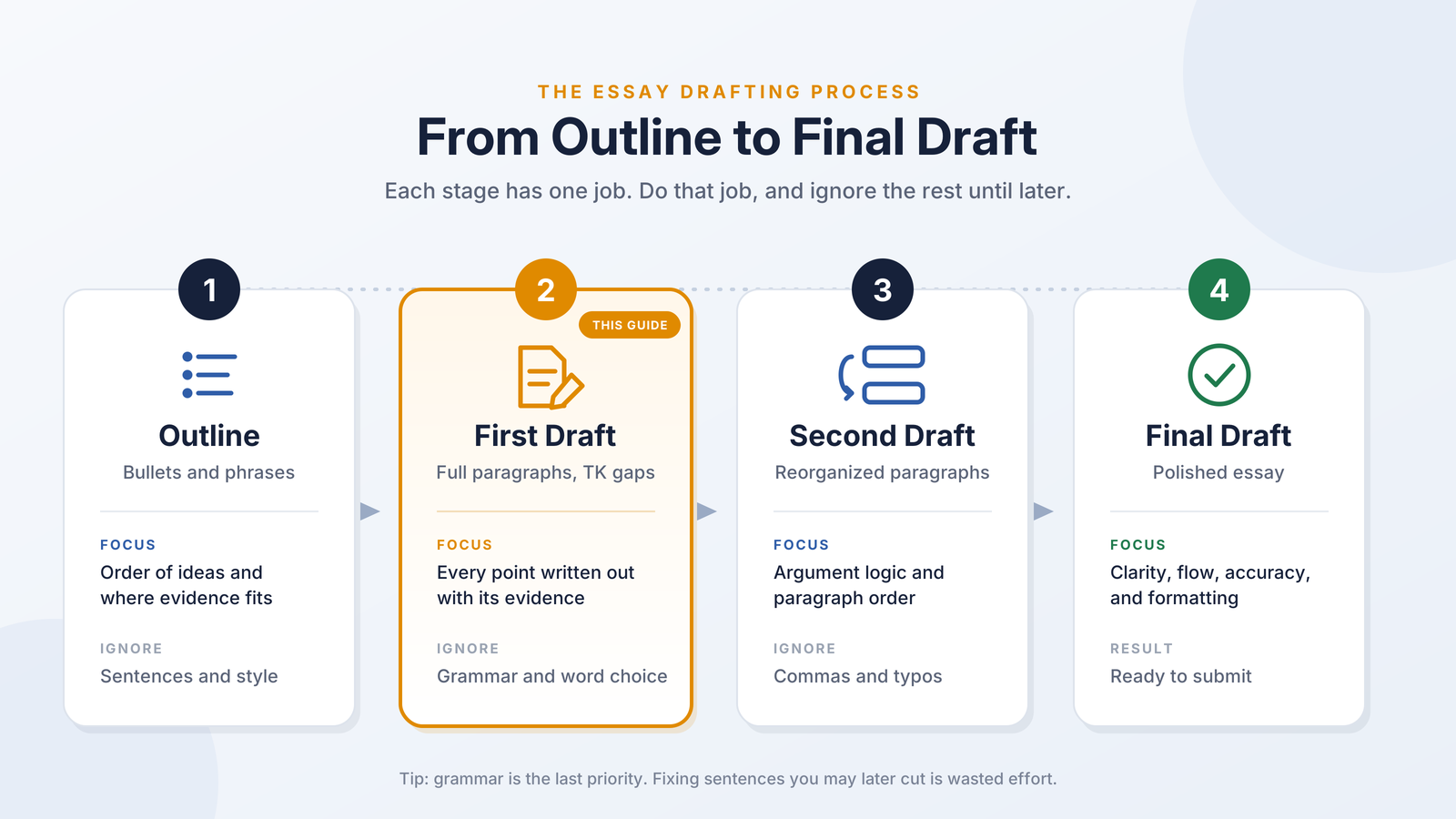
Grammar does not become a priority until the final stage. Fixing sentences you may later delete is wasted effort.
What Is Needed Before Starting a Draft?
Drafting goes fastest when the thinking is already done. Have these four things open before you write a sentence:
-
The assignment prompt, with the task verb (analyze, argue, compare) and word limit underlined
-
A working thesis you can revise later; this guide on writing a strong thesis statement shows how to test one
-
An outline listing the main point of each body paragraph and its evidence; start with these essay outline templates if you do not have one yet
-
Your evidence with exact locations, such as quotes with page numbers
One more item is worth five minutes before you start: a word budget.
How Many Words Should Each Section Get?
A word budget assigns a target length to each part of the essay before you write it. It prevents a 500-word introduction in a 1,500-word essay, or a final body paragraph squeezed into three sentences because you ran out of room.
A practical split for most academic essays is roughly 10% introduction, 80% body, and 10% conclusion:
| Total length | Introduction | Body (total) | Per body paragraph | Conclusion |
|---|---|---|---|---|
| 1,000 words | ~100 | ~800 | ~265 (3 points) | ~100 |
| 1,500 words | ~150 | ~1,200 | ~400 (3 points) | ~150 |
| 2,500 words | ~250 | ~2,000 | ~400 (5 points) | ~250 |
Treat these as targets, not limits. A first draft can run 10 to 20% long, since trimming is easier than padding. For how these parts fit together in different essay formats, see the complete essay structure guide.
How to Write a First Draft of an Essay, Step by Step
-
Turn your outline into headings and note each section's word budget.
-
Draft the body paragraphs first, starting with your strongest point.
-
Build each paragraph around a claim, evidence, and analysis.
-
Mark missing quotes, facts, and citations with TK and keep writing.
-
Draft the introduction once the body exists.
-
Write a working conclusion.
-
Save a version and step away before revising.
Step 1: Turn the Outline Into Headings
Copy your outline into a new document and turn each main point into a temporary heading. Put your working thesis at the top in bold, and write the word budget beside each heading so you can see it while you draft.
These headings act as a map. Delete them before submission unless your format calls for them; most humanities essays do not use internal headings, while APA papers and reports often do.
Save the file under a versioned name, such as "Essay_Draft1." The reason becomes clear in the section on AI and version history.
Step 2: Draft the Body Paragraphs First
Skip the introduction for now. It is the hardest paragraph to write first because it introduces an argument that does not exist on the page yet.
Start with the strongest body paragraph, usually the one with your best evidence. Early momentum matters more than order. You can draft paragraph three, then one, then two, and the essay still assembles correctly because the outline holds the sequence.
Step 3: Build Each Paragraph Around Claim, Evidence, Analysis
Every body paragraph in your draft needs three parts, even when the wording is rough:
-
A topic sentence that makes one claim connected to your thesis
-
Evidence that supports the claim: a quote, statistic, example, or source summary
-
Analysis that explains how the evidence proves the claim
Analysis is where drafts run thin. Students often drop in a quote and move straight to the next point. As a rule for this stage, write at least two sentences of explanation for every piece of evidence. You can cut later, but you cannot revise analysis that was never written. The guide to writing body paragraphs with PEEL breaks this structure down further.
Three drafting habits make this step faster:
-
Quote when the exact wording matters to your analysis, and paraphrase when only the idea matters. In a draft, paste the quote and add the page number in parentheses immediately.
-
Introduce every quote with a rough signal phrase ("Nick describes...") so quotes do not float unattached, a common revision headache.
-
End each paragraph with a rough bridge sentence pointing toward the next idea. It only needs to record how the two points connect while you still remember; you can polish it later with the right essay transition words.
Step 4: Mark Gaps With TK and Keep Writing
Journalists use TK (short for "to come") to flag missing information. It works well in essays because the letter pair rarely appears in English words, so one search finds every gap later.
Use it whenever you would otherwise stop:
-
[TK: quote from chapter 4 about the trial]
-
[TK: find 2023 enrollment figure]
-
[TK: better transition here]
-
[TK: confirm this counts as a primary source]
Write the note, finish the sentence as best you can, and move on. Stopping to research mid-draft breaks your train of thought and turns a two-hour session into a lost evening.
Step 5: Draft the Introduction Once the Body Exists
Now that you know what the essay argues, write the introduction. A standard academic introduction does three things:
-
Opens with context or a focused hook tied to the topic
-
Narrows to the specific issue your essay addresses
-
Ends with your thesis statement
A placeholder opening line is fine in a first draft; choose from these hook types and templates during revision. Then compare your working thesis to the body you just wrote. Drafting often shifts your position slightly, so update the thesis to match the essay you produced rather than the one you planned.
Step 6: Write a Working Conclusion
A draft conclusion only needs to restate the thesis in fresh words, pull together your main points, and explain why the argument matters. Avoid adding new evidence here. A plain, functional working conclusion is fine at this stage, and you can sharpen it later by following the steps to avoid a generic essay ending.
Step 7: Save a Version and Step Away
Once every section exists, save the file and close it. Time away lets you return as a reader rather than the writer. Overnight is ideal; even 30 minutes helps when the deadline is close.
Start a new file for draft two. Keeping each draft separate protects earlier work and gives you a record of your writing process.
What Does a Complete Rough Draft Look Like?
"Complete but rough" is easier to understand when you see it. Below is a skeleton rough draft for a short literary analysis essay on The Great Gatsby, followed by one paragraph before and after revision.
A Rough Draft Skeleton
[Working thesis: The green light shows that Gatsby's dream only works while it stays out of reach.]
Intro (rough): Lots of symbols in Gatsby. The green light is the biggest one. [TK: better hook, maybe the ch. 9 line?] I'm arguing the green light shows Gatsby's dream depends on distance.
Body 1: The green light is a really important symbol in the book. It shows that Gatsby wants Daisy and his dream. In Chapter 1, he reaches out toward it [TK: exact quote, end of ch. 1]. This shows the American Dream and how people want things they can't have. At the end, the green light comes back [TK: ch. 9 quote], which is important.
Body 2: When Gatsby finally meets Daisy, the light loses its meaning [TK: ch. 5 quote about "enchanted objects"]. So getting close actually ruins it. [TK: transition]
Body 3: Nick ties it to everyone at the end, not just Gatsby. [TK: expand, 2 more sentences of analysis]
Conclusion (rough): So the green light is about wanting more than having. Fitzgerald is saying something about America too. [TK: stronger last line]
Every paragraph exists, the thesis is stated, and every gap is marked. That is what a finished first draft looks like.
One Paragraph, Before and After Revision
Rough draft version:
The green light is a really important symbol in the book. It shows that Gatsby wants Daisy and his dream. In Chapter 1, he reaches out toward it [TK: exact quote, end of ch. 1]. This shows the American Dream and how people want things they can't have. At the end, the green light comes back [TK: ch. 9 quote], which is important.
Revised version:
Fitzgerald introduces the green light as an image of longing that Gatsby cannot close the distance on. At the end of chapter 1, Nick watches Gatsby stretch "out his arms toward the dark water" toward "a single green light, minute and far away." The physical gesture matters more than the light itself: Gatsby is reaching, not holding. By chapter 9, Nick widens the image beyond one man, describing the future the light stands for as one that "year by year recedes before us." The symbol shifts from Gatsby's private hope for Daisy to a shared condition, suggesting that the dream depends on staying out of reach.
What changed between drafts:
-
The vague claim ("really important symbol") became a specific, arguable one
-
Both TK markers were replaced with exact quotes
-
One sentence of thin analysis grew into four sentences that explain how the evidence works
-
The paragraph now builds toward a point instead of listing observations
To study more finished work at different academic levels, browse MyPremiumEssay writing samples.
How to Write a Rough Draft Fast
Speed in drafting comes from removing decisions, not from typing faster.
-
Set a timer for 25 to 45 minutes, draft one section, then take a short break; timed sprints make starting easier because the commitment feels small
-
Draft in one or two sittings, since a draft spread across many short sessions loses its line of thought
-
Type when you want speed and version history, or draft by hand when a screen tempts you into constant editing, then type it up the same day
-
Gather evidence before the session and use TK for anything missing
-
Turn off spell check underlines so red lines do not pull you into editing
For the full process from topic selection to submission, see the complete guide on how to write an essay.
How to Draft an Essay Without a Thesis
Sometimes the argument only becomes clear through writing. A discovery draft (sometimes called a zero draft) is a loose draft written to find your position rather than to present it.
-
Write the question the essay answers at the top of the page.
-
Draft freely about your evidence for 20 to 30 minutes, noting what each source suggests.
-
Read what you wrote and look for the claim you keep returning to. That is your working thesis.
-
Build a quick outline around that claim, then write a proper first draft.
A discovery draft is not wasted time. It replaces hours of staring at an outline with something concrete to react to.
How Does Drafting Change by Essay Type?
The core process stays the same, but each essay type has a drafting priority. For compare and contrast essays, for example, choose block or point-by-point structure before drafting, since switching halfway forces a full rewrite.
Argumentative Essays
Draft the counterargument paragraph early, right after your strongest point. Students who leave it for last tend to write a weak, one-sentence rebuttal. The guide on structuring an argumentative essay shows where the counterclaim fits.
Literary, Analytical, and Response Essays
Draft from your quotes outward. Place each key quote in its paragraph first, then write the claim above it and the analysis below. For thesis help, see building a literary analysis thesis. For response essays, draft summary and response in separate paragraphs so you can check the balance; the critical response essay guide explains the split.
Narrative and Personal Essays
Draft the central scene first, even when it falls in the middle of the story. Write it in full detail, then add the lead-up and reflection around it.
Timed and Exam Essays
You get one draft, so planning carries more weight. Spend the first five to ten minutes on a quick outline with your thesis and three points, write straight through, and leave a few minutes to reread and fix obvious errors.
How to Draft a Longer Research Paper
Papers of 10 pages or more are easier to draft as a series of mini essays, one per section, each with its own word budget.
-
Draft the sections you understand best first, often the literature review or main analysis
-
Track your word count section by section; a section running double its budget early on usually means the scope needs narrowing
-
Keep a running "parking lot" document for good ideas that do not fit the current section
-
Draft the introduction and abstract last, once the findings and argument are fixed
The full sequence, from research question to final submission, is covered in this step-by-step research paper guide.
How to Get Past Writer's Block While Drafting
Blocks during drafting usually come from trying to write well instead of writing at all. These techniques lower the bar enough to start:
-
Freewrite for 10 minutes about the paragraph you are stuck on, without stopping
-
Explain the point out loud as if to a friend, record it with a dictation tool, and type up what you said
-
Begin with "The point of this paragraph is..." and delete the phrase later
-
Switch to a different section of the outline and come back
-
Write the paragraph as bullet points, then turn each bullet into a sentence
What Mistakes Do Students Make in a First Draft?
-
Editing while drafting, which costs momentum every time you pause to fix a sentence
-
Starting with the introduction, where most stalls begin
-
Drifting from the outline without updating it, so the argument loses coherence
-
Stopping mid-paragraph to research instead of leaving a TK marker
-
Overwriting one file, which erases your process and any ideas you cut
-
Padding to reach the word count when the real gap is thin analysis
-
Treating the first draft as nearly finished, when it is the midpoint of the writing process
Where to Get Feedback on a Rough Draft
A rough draft is the best stage to ask for feedback because big changes are still cheap.
-
Visit your instructor's office hours with a complete draft and one or two specific questions, such as whether the thesis is arguable
-
Book a session at your campus writing center, where tutors work with drafts at any stage
-
Ask a classmate to summarize your argument in two sentences; a summary that misses your thesis shows where the draft is unclear
-
Read the draft aloud yourself to catch gaps in logic that silent reading skips
Ask for feedback on argument and structure at this stage, not grammar.
Are AI Tools Allowed When Drafting an Essay?
That depends on your course. AI policies vary by institution, department, and individual syllabus. At Stanford, for example, an academic integrity working group encouraged departments to adopt clearly communicated AI policies and found AI detection tools too unreliable to serve as evidence in high-stakes cases. Read your syllabus before using any AI tool, and ask your instructor when the policy is unclear.
Because detectors are unreliable, your drafting history has become one of the clearest ways to show your work is your own. Some instructors ask students to share version history from Google Docs or Microsoft Word, or to submit earlier drafts. A document where full paragraphs appear in a single paste can raise questions even when you wrote them elsewhere.
A few habits protect you:
-
Draft directly in a cloud document with version history on
-
Save each major draft as a separate file
-
Keep your outline, notes, and source list
-
Write the paragraphs yourself, even when a policy allows AI for brainstorming
What Comes After the First Draft?
Revision works best in passes, from big issues to small ones. Start with a reverse outline: read each paragraph and write its main point in the margin in five words or fewer, then read only those notes. Gaps, repeated points, and paragraphs in the wrong order become obvious.
Next, fix structure and fill every TK in a second draft. Then refine sentences and transitions, and proofread last, since earlier passes change the sentences anyway. For the full process from topic selection to submission, see the complete guide on how to write an essay.
How to Tell When a First Draft Is Finished
Your first draft is done when you can say yes to each of these:
-
The working thesis appears at the top and matches what the essay argues
-
Every main point from the outline has its own paragraph
-
Every body paragraph has a claim, evidence, and analysis
-
The introduction and conclusion exist, even in rough form
-
All gaps are marked with TK
-
The draft is within about 20% of the target word count
-
The file is saved as a separate version
Frequently Asked Questions
Is a rough draft the same as a first draft?
Yes. In most academic settings, the terms are interchangeable. Both describe the first complete version of an essay in full paragraphs, before revision and editing.
How many drafts should an essay have?
Most take-home essays benefit from at least three: a first draft for content, a second for structure and argument, and a final draft for style and accuracy. Longer research papers often need more.
Does a rough draft need citations?
Yes, in short form. Add the author and page number as you write, such as (Smith 42) in MLA or (Smith, 2020, p. 42) in APA, and format the full citations later using an APA, MLA, and Chicago citation guide.
How long should a rough draft be?
Aim for within 10 to 20% of your target word count. A slightly long draft is easier to work with, because cutting is simpler than adding substance.
Is it okay to turn in an unfinished rough draft?
Check the assignment instructions. When an instructor collects rough drafts for feedback, a complete draft earns far more useful comments than a partial one. Mark unfinished parts with TK so the reviewer knows what is still coming.
Is it okay to start a draft in the middle?
Yes. Starting with the body paragraph you know best is one of the most reliable ways to beat a blank page. The outline keeps the final order intact.
Need an Expert Read on a Draft?
A complete draft is the right moment to bring in an experienced reader. MyPremiumEssay matches students with academic writers by subject and level; compare pricing by academic level to see what fits your deadline.